

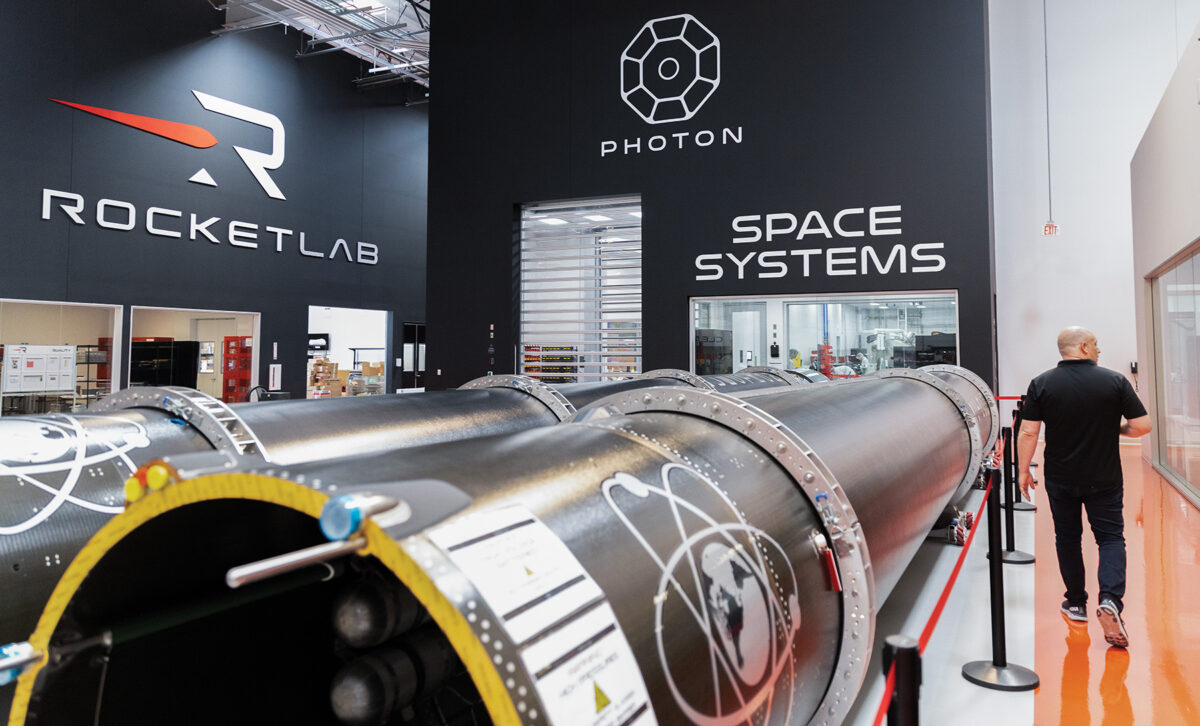
Long Beach-based Rocket Lab announced it struck an $8 billion deal Monday to buy Iridium, a satellite communications company, in an aggressive move to strengthen the upstart rocket-and-satellite company’s challenge to SpaceX in the commercial space industry.
Rocket Lab agrees to pay $54 a share in cash and stock, a 24% premium over Iridium’s last closing price. The transaction is expected to close in mid-2027, pending regulatory approval.
“This will be one of the most transformative deals in the space industry,” said Peter Beck, chief executive of Rocket Lab, in a recorded presentation.
Murielle Baker, director of Rocket Lab’s corporate and launch communications, said it’s too early in the acquisition process to say how and whether this will bring jobs and facilities to Long Beach.
“This deal positions Rocket Lab as a vertically integrated space communications powerhouse able to build our own satellites, launch our own rockets, and operate our own constellation across the only truly global network that guarantees 100% coverage over every ocean, desert, and airway — creating one of the strongest space companies in the world,” Baker said in a statement on Monday.
It comes as a sign that the company is looking to compete with SpaceX and its Starlink network, which offers broadband internet service using a fleet of more than 10,000 satellites.
Rocket Lab, which was founded in New Zealand in 2006 and relocated its headquarters to Long Beach in 2020, has for years said it intends to be a self-sufficient satellite provider, able to design, build, launch and operate its own satellite fleet.
With 2,600 employees — 800 of whom work locally — the company has already built a network of launch vehicles, satellite manufacturing facilities and 245 satellites.
This acquisition gives them Iridium’s own constellation of 66 low-Earth-orbit satellites, as well as its mobile phone service used by more than 2.55 million subscribers across government, defense, aviation and maritime markets.
Rocket Lab is second only to SpaceX in the number of missions flown by U.S.-based launch providers, and its smaller Electron rocket is the second most purchased in the country behind SpaceX’s comparable vehicle.
The company, since last winter, has received a number of contracts, including an $805 million contract from the U.S. Space Force to develop 18 defense satellites meant to detect enemy missiles in low Earth orbit and a $30 million contract with defense firm Anduril for hypersonic test flights in Virginia. Last week, it announced it would launch Electron rockets for several NASA missions from its New Zealand launch site in early 2027.
Though Rocket Lab has been here for years, the acquisition signals a continued expansion of defense and aerospace companies around Long Beach’s airport grounds, known locally as ‘Space Beach.’ Companies including Relativity Space, Vast, JetZero, SpinLaunch and True Anomaly have all built or expanded operations in the city in recent years.
In January, Rocket Lab hosted Defense Secretary Pete Hegseth as part of a national tour of defense contractors, touring the company’s engine development complex — a 144,000-square-foot warehouse once used by the now-defunct Virgin Orbit.