

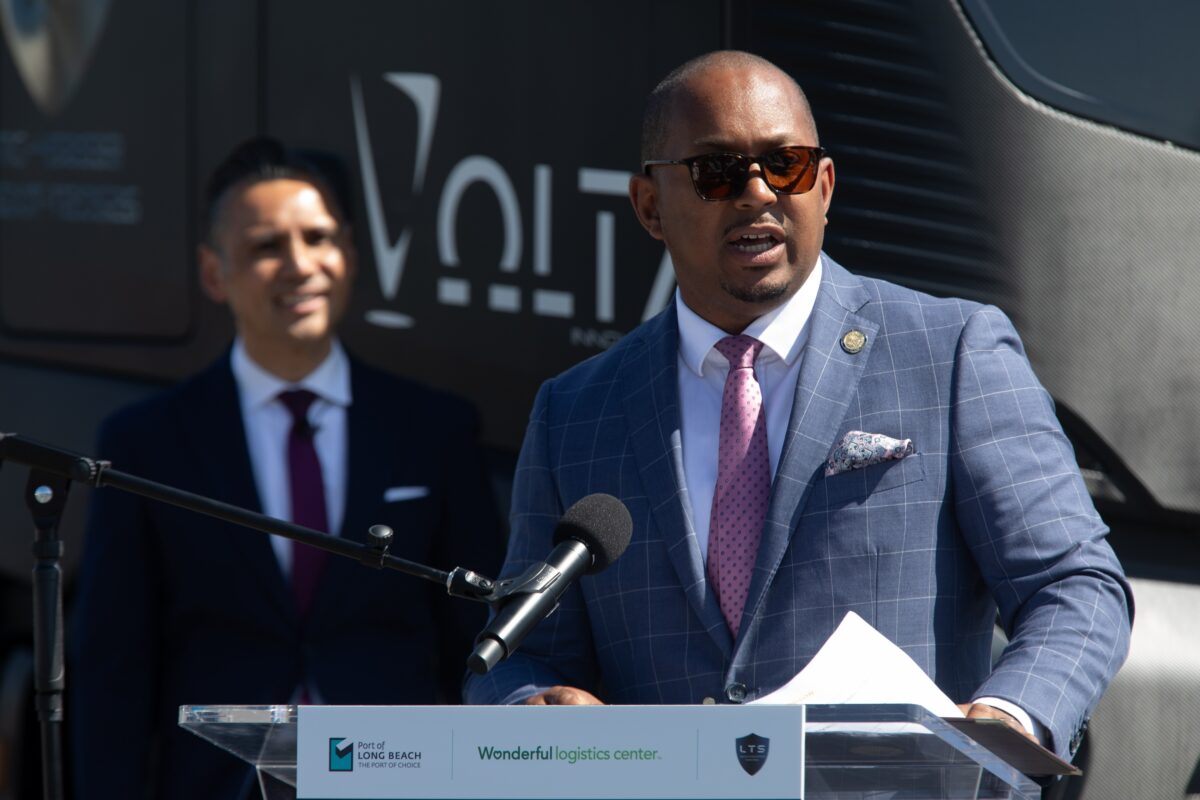
The Port of Long Beach signed an agreement Monday committing to a zero-emission trucking route from the Central Valley to the San Pedro Bay, an ambitious move meant to counter shoreline air pollution from the twin seaports and the highways used to ferry their goods.
The agreement was signed alongside The Wonderful Company’s real estate arm, which agreed to include charging stations in its multi-million dollar logistics center near Bakersfield, and Lincoln Transportation Services, which recently ordered 300 newly built electric Tesla trucks. The first 50 to 70 semis should arrive in June.
Long Beach Port CEO Noel Hacegaba said there is strong momentum around this new model, which is capable of a 325- to 500-mile range and can charge to 60% within 30 minutes. Other companies, like Long Beach-based WattEV, have also put orders forward for the Tesla semis and have trucks expected to hit the road this year. About 200 of these models are already reserved through the seaports truck voucher program, he said.
But despite the massive investment, it still pales in comparison to the industry’s reliance on fossil fuels. More than 18,000 trucks are registered to move cargo through the city seaport, overwhelmingly fueled by diesel. Only 654 trucks — 548 battery electric, 106 hydrogen fuel cell — are zero emission, according to port officials.
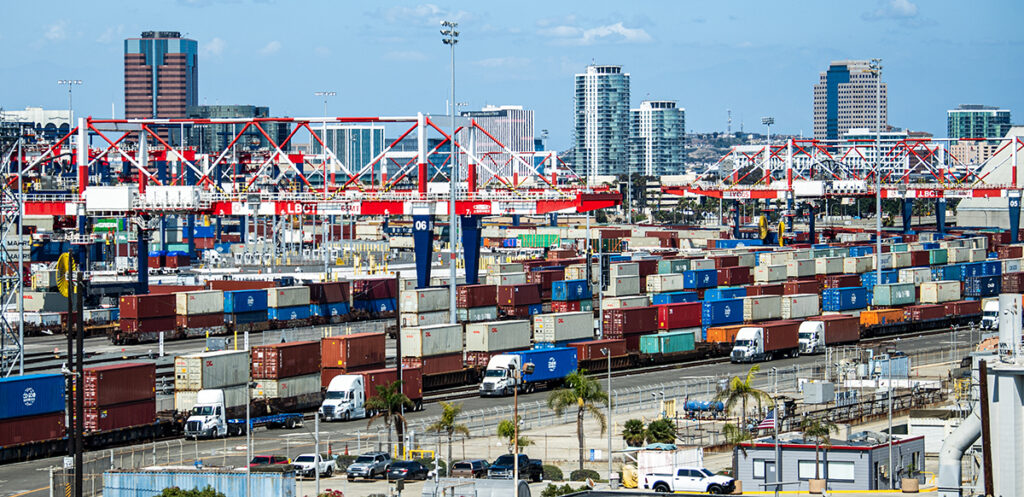
Diesel fumes contribute to well-documented health problems like childhood asthma in neighborhoods near the ports and warehouses. Studies have shown that those affected are disproportionately low-income and people of color.
A lot of hesitation to convert fleets rests on the lack of charging stations along truck routes.
As of last year, California has more than 16,000 electric chargers dotted across its highways — about a tenth of the estimated 157,000 chargers that state energy officials say are needed to support its requirement that new heavy-duty vehicles sold must be all-electric by 2035.
As part of the agreement, the Port and either company will help create a plan to invest in clean energy infrastructure at either end of the major trade route, which needs far more charging stations and warehouses capable of accommodating electrified semis.
Each year, more than 300,000 TEUs, a standard measurement for shipping containers, move between the port complex and the southern Central Valley, a roughly 150-mile route with few charging stations.
Hacegaba said talks have not yet matured to the point of the Port agreeing to pay for or subsidize new stations being built along the route. For now, the seaport is anxious to have 92 more charging stations online on its grounds within the next year. It currently has 102.
“What we’re agreeing to do is pare our investments on either end of one of the nation’s busiest trade routes,” Hacegaba said. “We have the highest number of truck charging stations of any port in the world.”
And the Wonderful Company, known for its citrus and specialty nuts grown in the Central Valley, will look to include charging stations and other new amenities as part of its expansion of its Wonderful Logistics Center in Shafter, a small farmland community 18 miles north of Bakersfield.
Under the plan, the center would nearly double in size — to 3,400 acres — using 1,800 acres of its own almond groves to build warehouse space. The company also has plans for a $120 million inland rail terminal located along the BNSF Railway main line — expected to be completed in early 2027 — and a new highway, called the Central Valley Green Pass, which will divert trucks from central Shafter onto major highways.
Each organization says they will spend time advocating to the industry and public on the benefits of the plan, with the hope of eventually encouraging other truck and warehouse companies to agree to make similar, greener arrangements.
This comes years after the city seaport joined a green-shipping corridor alongside Los Angeles, Shanghai and Singapore.
“But we know once that cargo, once that container, gets off that ship, it still has a little ways to go,” said Long Beach Mayor Rex Richardson.