

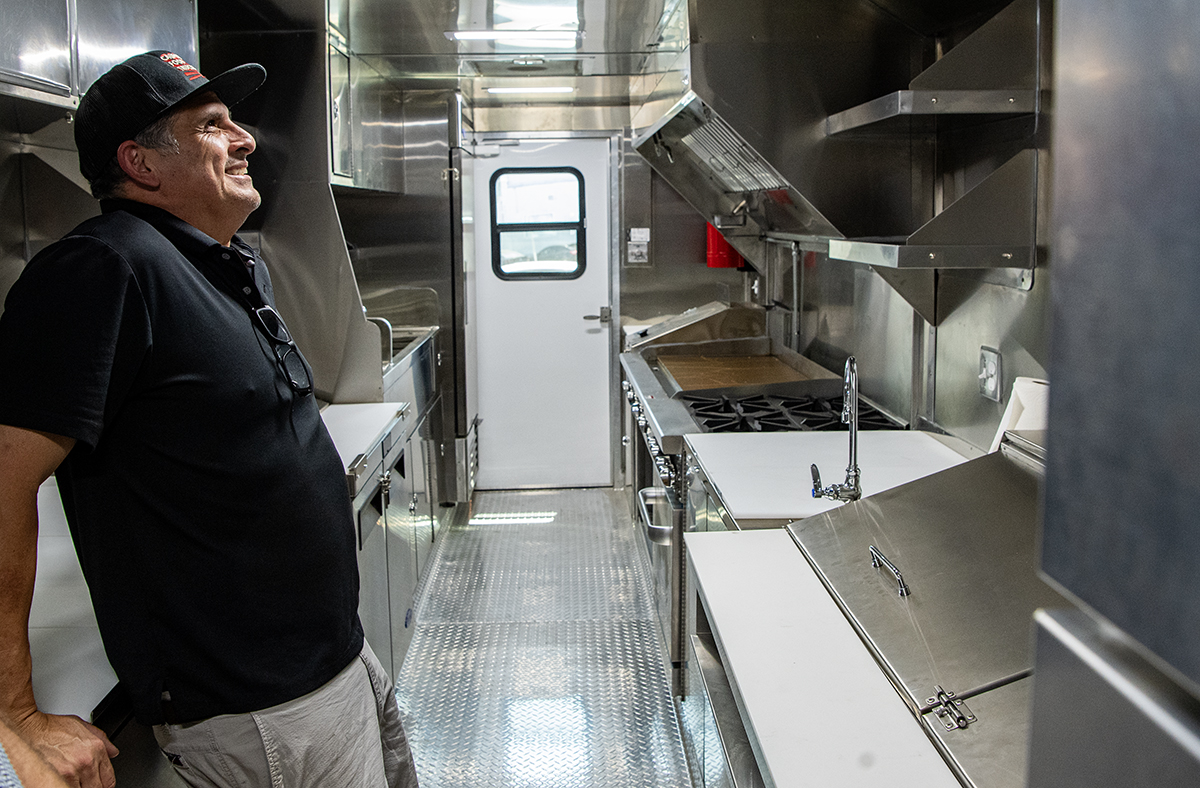
What do Ukrainian food, soft serve and Thai fusion tacos have in common? They’re all served out of trucks built from scratch in an industrial building on Anaheim Street next to the Los Angeles River.
“This is where food trucks are born,” said Martin Ramirez, owner of California Food Trucks.
Over the past 15 years, he’s quietly had a hand in the success of some beloved local businesses and major corporations. He’s built custom projects for the Long Beach dessert shop SnoCorner and Peruvian food truck Mikhuna, along with major 30- and 40-foot catering trucks for high-profile clients like Google and Monster Energy.
Ramirez, his shop manager Cody Madole, and four other employees are a one-stop shop for everything a food truck needs, including plumbing, welding and electrical work to transform vans and commercial trucks into functioning mobile kitchens.
It’s a niche manufacturing business that caters to enterprising chefs and restaurateurs who are testing a concept or hitting the road for music festivals, farmers markets or a meal break at offices.
The food truck industry has grown as the costs to start a brick-and-mortar restaurant have steadily increased. In a business that’s notorious for having razor-thin profit margins, a truck is a safer bet — and one you can also resell if things don’t work out, Ramirez said.
Ramirez, who grew up in Bellflower, found his way to food truck manufacturing through his stepmother. In the late 2000s, she discovered how lucrative the business could be when she bought a truck to start selling tacos in Miami. Before she sold her first taco, she decided to list the truck on Craigslist to test the resale market. Within a few days, a buyer offered her double what she had paid for it, Ramirez said.
After some coaxing from family, Ramirez realized he was perfectly equipped to create mobile kitchens from scratch.
He had spent more than a decade remodeling homes as a general contractor and also had experience in metal fabrication from a job building race cars. Food truck manufacturing was like a blend of the two, Ramirez said.
For years after he started building trucks, Ramirez and his cousin also ran a taco truck called LA Tacos and Co.
He’s no longer involved in that business but runs a pizza truck with Avalou’s Italian Pizza founder and Long Beach resident Louis Lombardi.
The two met through a mutual friend, Lombardi said. Ramirez loved the pizza and offered to build a truck to make the pop-up concept mobile.
“We hit it off, and we’ve been great buddies since,” Lombardi said.
Starting next week, the pair plan to sell pizzas for delivery through UberEats from the truck parked outside Ramirez’s California Food Trucks business.
Working in food truck businesses has given Ramirez first-hand knowledge of how to efficiently lay out a mobile kitchen and set up new food vendors for success before they even pick up a knife.
Ashley Monconduit, owner of SnoCorner near Long Beach Poly High School, ordered a custom food cart from Ramirez in 2024. Her brick-and-mortar business specializes in New Orleans-style shaved ice, called Snoballs, but Monconduit was looking for a cart to serve beignets and soft serve at corporate events and birthday parties.
Ramirez made the cart “based entirely on what was in my head” and even made the soft serve machine removable, Monconduit said. That’s been a big help for events where she only serves beignets because the soft serve machine accounts for a significant portion of the cart’s weight.
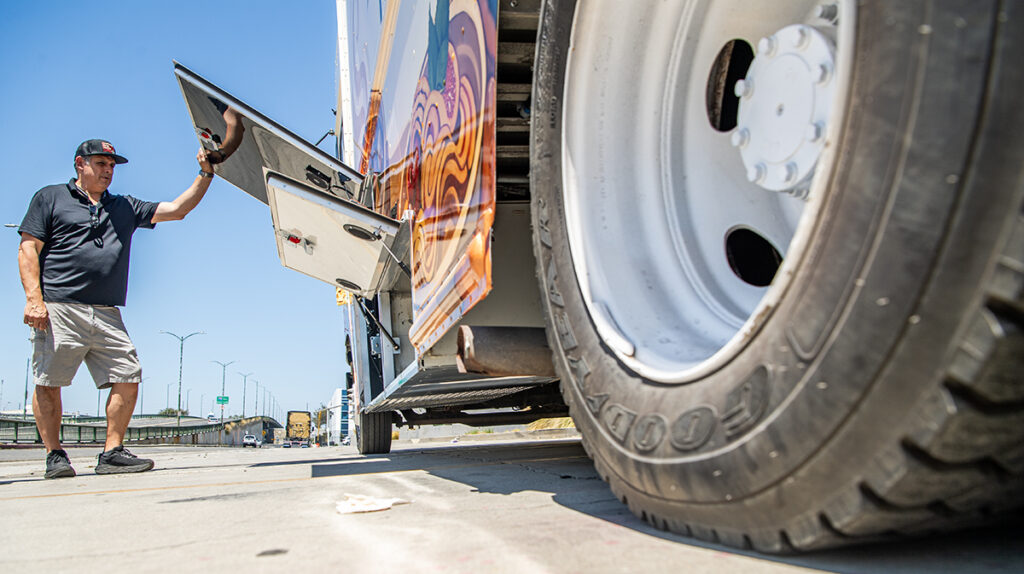
Ramirez also tries to stay ahead of the curve on innovations in the food truck industry. He now steers clients away from using generators in favor of solar-powered batteries. Ramirez knows from experience that if you use a generator, “it will break down at the worst time.”
With most of the batteries he installs, he can troubleshoot problems from his desk no matter where a truck is.
But he still makes his fair share of on-site repairs for drivers who accidentally sheared off a side mirror or rooftop exhaust fan in their scramble to make it to an event.
Not all the repairs are a drag: He’s built out several trucks for clients in Hawaii. Ramirez, an avid surfer, makes a point to visit those trucks whenever his schedule allows.