


Frustrated by delays and no firm idea of when work will be finished, the Long Beach City Council on Tuesday asked that city staff return in 30 days with a clear end date to the longstanding Colorado Lagoon project.
The project, meant to build a tidal channel connecting the lagoon to Alamitos Bay, was expected to finish in March 2024 but has gone at least $4 million over its original $32 million budget and been delayed at least three times. Officials have tied hangups to heavy rainfalls in 2024 and the continued discovery of 25 unmapped utility lines and hazardous asbestos materials during their excavation of the ground.
Councilmember Kristina Duggan, who represents the neighborhoods around the lagoon, said the delays around the project’s two intersecting roads — Colorado and Eliot streets — have only strained public confidence in the city’s ability to deliver projects in a timely manner.
City officials have said street closures should end by the summer. In the interim, commutes for those living in East Long Beach neighborhoods detoured onto nearby Seventh Street, Anaheim Street and Bellflower Boulevard. A temporary pedestrian path is currently the only through‑route.
The streets’ reopening, though, won’t necessarily mark the end of construction. At a recent community meeting, city staff resisted giving any estimated end date.
“When the decision was made in 2022 to close both Colorado Street and Eliot Street at the same time, it was based on the expectation that the project was going to be 18 months,” Duggan said. “Today we are at 39 months with no firm date.”
“That gap between expectation and reality is why residents are so frustrated, why I am so frustrated with this; we need an end date,” Duggan continued.
As of this month, construction crews have completed a troublesome sewer siphon system they said was exacerbating the delays, and have begun filling the excavation areas with sediment as they proceed to “final roadway elevations.”
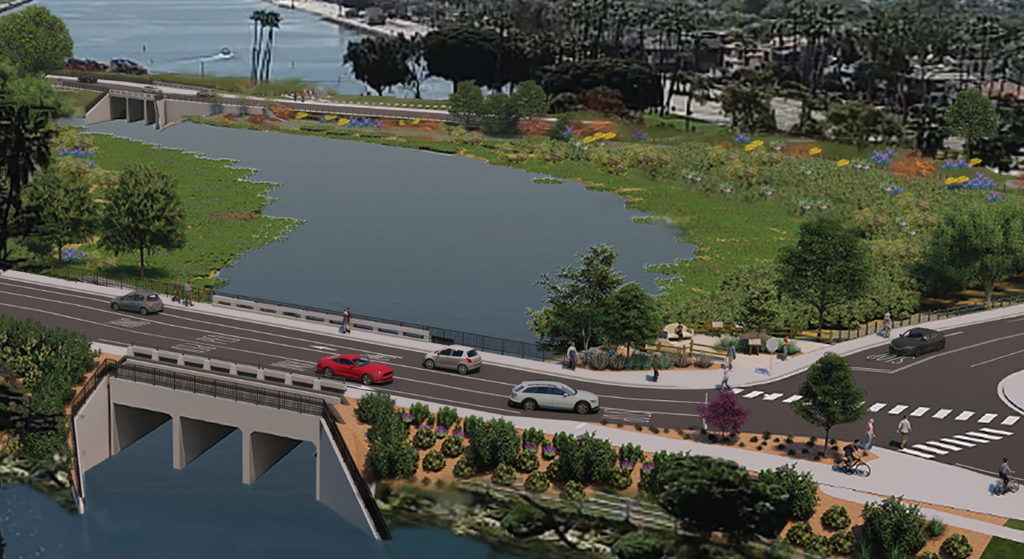
“Construction of the required sewer airline system also began and will continue into March,” the city wrote in its update. “Once installation is complete, the new sewer system will undergo pressure testing and camera inspections.”
Once finished, the project will establish a tidal flow between the saltwater bodies, improving the estuary’s health by replacing a 900-foot box culvert that offered poor circulation and accumulated bacteria, metals and other pollutants.
Elizabeth Lambe with the Friends of the Colorado Lagoon, an environmental advocacy group, said to stay optimistic, comparing the waterway known today to when it was looked at with scorn, known then as the “polio pit.”
“People will start to forget about their longer commute or their inconveniences when they see this wonderful amenity when it’s finally done,” Lambe said. “I really don’t want the takeaway to be ‘let’s not dream big for our city or our natural resources.’”