

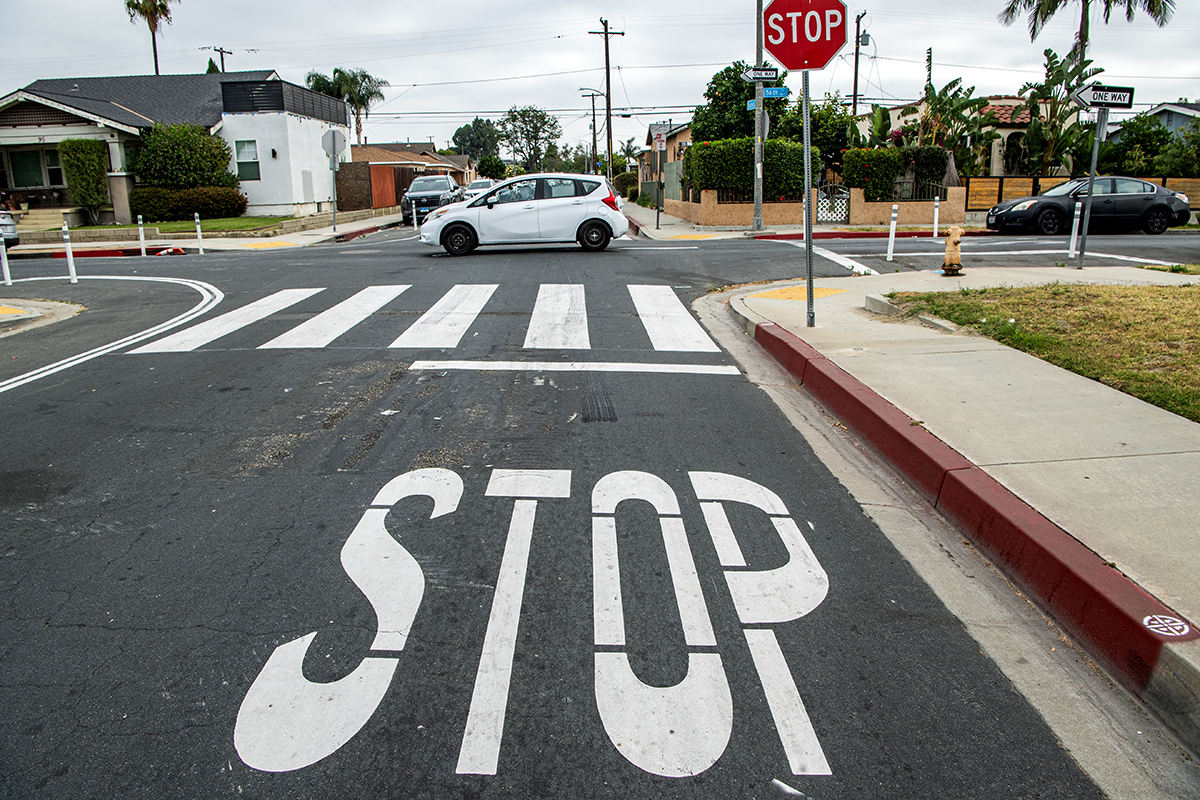
There’s been a huge surge in the number of people asking the city of Long Beach to do something about speeding cars and dangerous drivers slicing through their neighborhoods.
In the first three months of 2026, the city’s Public Works Department. which manages local roadways, got 129 requests for traffic studies, in which workers evaluate whether a street is unsafe and what can be done about it.
That was “more than 12 times the average of the previous three quarters,” Public Works Director Joshua Hickman wrote in a recent memo.
A good chunk of that increase is likely because Long Beach made it easier to request traffic studies, setting up a simplified online form. But traffic safety has also been a hot topic because of rising fatalities.
Long Beach recorded its deadliest year on the roads in more than a decade last year, and the 21 fatal collisions this year are already outpacing that. In March, more than a dozen people showed up to a City Council meeting to demand action, and council members expressed their frustration that fixes weren’t arriving faster.
In response, the Public Works Department is trying to kick into high gear, according to Traffic Engineer Paul Van Dyk.
“To have [deaths] happening so frequently now is just, it’s a devastating thing,” he said.
The urgency adds to an already large task. Even before the flood of 129 traffic study requests to start 2026, there was a backlog of 207 requests to end 2025. Van Dyk said he saw clearing that backlog as the first step toward tackling the problem, so staff prioritized it.
They’ve now cleared the backlog, he said, and found 21 locations to install “quick-build” traffic-calming measures like new crosswalks, yellow reflectors designed to slow drivers down as they’re making turns and synchronizing lights to reward drivers who travel at the speed limit.
A handful are already in place, like a new high-visibility crosswalk on Dairy Avenue and yellow reflective delineators on Nieto Avenue. Those flexible posts are also coming to a stretch of Third Street between Orange and Alamitos avenues where a traffic survey found that more than 58% of drivers were speeding, Van Dyk said.
In other problem spots that don’t qualify for a quick fix, the department will track them to see if the streets can be redesigned or fixed during any major capital improvement projects planned in the area.
The newfound urgency hasn’t so far turned the tides on Long Beach deadly streets, but Van Dyk said getting through last year’s backlog was a major accomplishment for his short-staffed department.
Right now, there are only two people on Long Beach’s “Vision Zero” team responsible for delivering on the city’s pledge to eliminate traffic deaths, according to Van Dyk. It should be four, he said, but two positions are vacant.
“We’ve been trying real hard to fill those positions,” Van Dyk said, “but senior traffic engineers are a hot commodity. We’ve been really competing intensely with neighboring jurisdictions to get folks in.”
The current two-person team is also responsible for rolling out Long Beach’s speed-camera program, which activists have criticised for moving too slowly. They’re also tasked with responding to the scenes of every fatal crash, to see if there’s a quick-build measure that can prevent future wrecks, Van Dyk said.
Because of their work after recent fatal crashes, the Alamitos Beach neighborhood is getting two new crosswalks: one at Fourth Street near Bonito Avenue and another at Ocean Boulevard near Falcon Avenue.
Van Dyk said his team has now turned to the flood of 129 traffic study requests that rolled in to start this year. He wants to close each one out within six months and report the results back to the person who requested it. The Public Works Department plans to ask for more funding in next year’s budget in the hopes of meeting that goal.