


Environmentalists are calling for stricter enforcement of oil producers and a doubled pace to plug the thousands of uncapped and idle wells that once produced oil or gas and now continue to leak pollutants and carcinogens into neighborhoods.
In a study released Wednesday, researchers with the Center for Biological Diversity’s Climate Law Institute found nearly 3,800 schools, hospitals, playgrounds and parks throughout California remain within a kilometer of abandoned, uncapped wells.
Across Long Beach and Signal Hill, there are more than 750 active wells, as well as 378 idle wells. More than 2,900 wells citywide have been plugged, according to CALGEM data.
Hundreds of idle derricks form a streak that cuts diagonally across Long Beach, through Signal Hill and just short of the Traffic Circle. More wells dot the land southeast of Recreation Park through the Los Cerritos Wetlands.
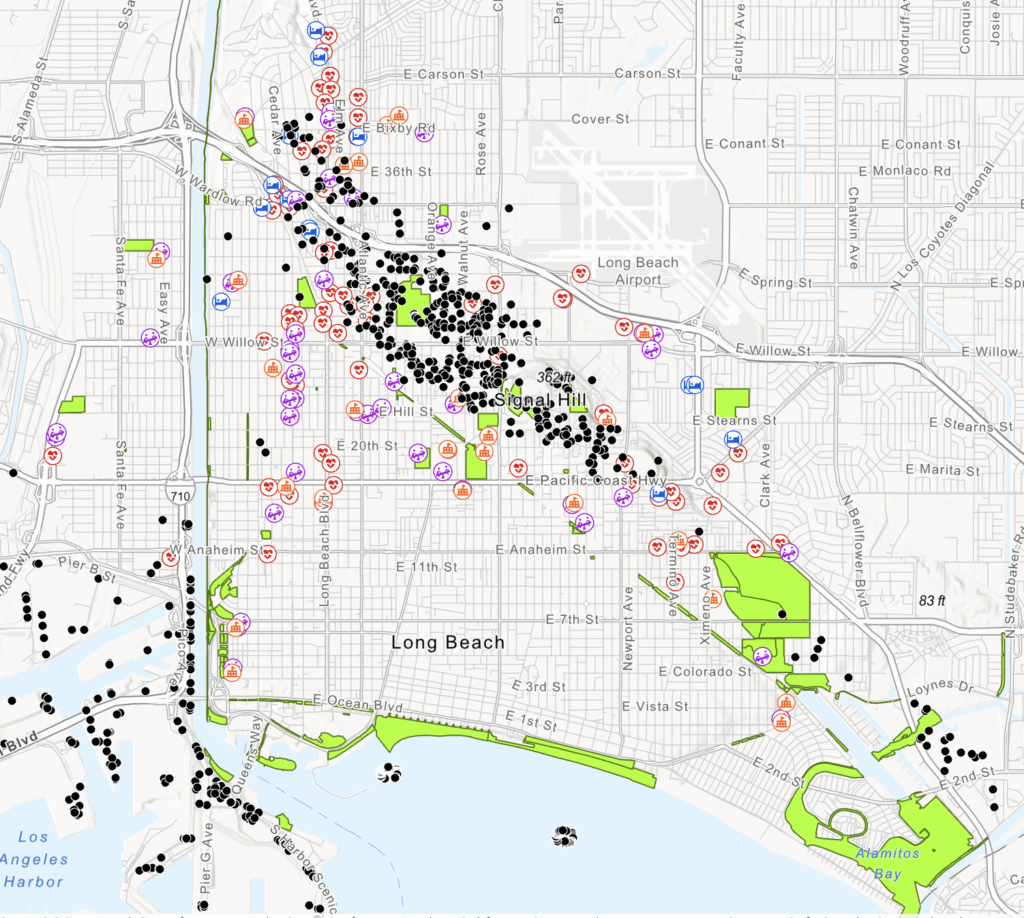
Hundreds of those wells sit within eyesight of “sensitive sites” that include schools, hospitals, child care facilities and medical offices, said Emily Diaz-Loar, a staff scientist at the Center.
The center was unable to specify the exact number of at-risk sites they found in Long Beach, but they provided an interactive map that lets you search your address or neighborhood.
Diaz-Loar said this trend extends to L.A. County, where housing density has led to 86% of the idle wells being located within a kilometer of a sensitive site, putting an estimated 230,000 schoolchildren at risk. Nearly a third of the county’s idle wells have been unplugged for more than a century, the study found.
Whether they’re active or idle, unplugged oil wells are known to emit likely carcinogens, including benzene and formaldehyde. These wells also release a potent greenhouse gas, methane, that helps drive climate change and increase one’s risk for asthma, cancer and heart disease. Both active and idle wells can also threaten water supplies.
“People should feel safe in their community spaces, not worried about explosions caused by methane leaks or their air and water being contaminated by unplugged wells,” Diaz-Loar said.
Researchers at the center are urging lawmakers and state agencies to speed up the pace of idle well plugging, especially near sensitive sites and residences, and to make polluters pay for the work. Methane monitoring of idle wells should also be ramped up, they said.
The average per-well cost for capping wells and dismantling associated surface infrastructure in California is between $40,000 and $152,000, totaling about $21.5 billion statewide ($2.7 billion in L.A. County). Despite the potential hazards presented by idle wells, oil and gas companies have provided financial assurance for less than 1% of the money needed to clean up their old wells, the report found.
According to records from the California Geologic Energy Management Division, or CalGEM, only about 40 of the more than 1,200 operators statewide submitted management plans for their nearly 3,500 idle wells (or paid a fee) ahead of the state-required July 2025 deadline.
This report comes as the Trump Administration sued the state last month over a law that prevents new oil and gas drilling within a kilometer of homes, hospitals and schools.
The complaint, filed Jan. 14 by the Department of Justice, argues the bill — S.B. 1137 — violates longstanding federal law allowing the government to lease public lands for extracting oil, gas, coal and other minerals.
Another lawsuit is being pushed by two California siblings based in Signal Hill and Long Beach who own mineral rights that entitle them to oil royalties. They claim the state law has deprived them of that value without fair compensation.
With court dates scheduled later this year, it will likely take months before any ruling is made.