

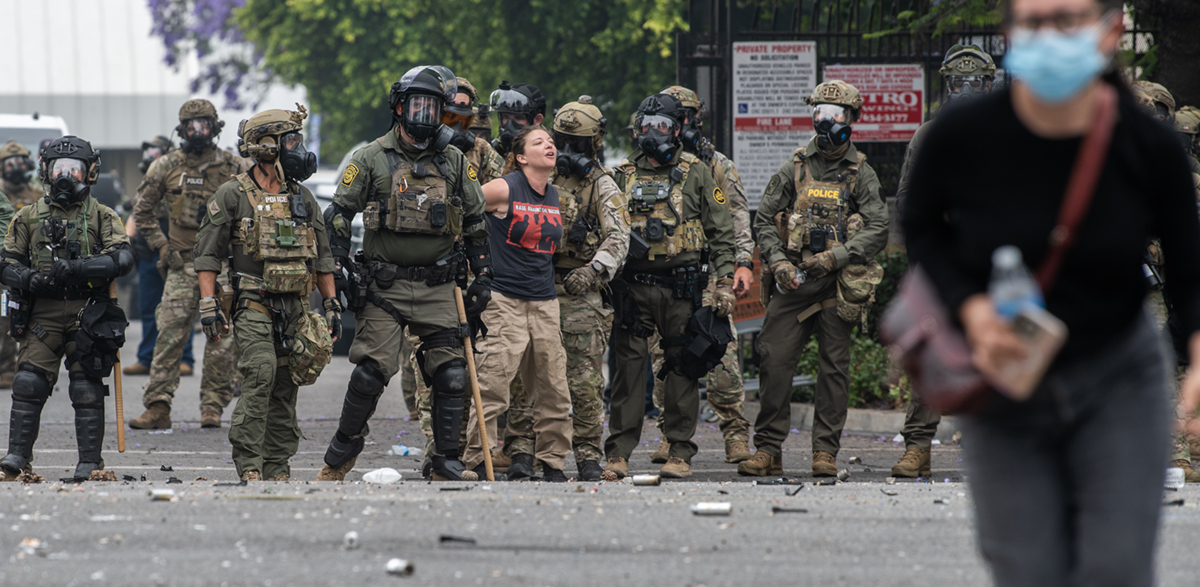
A much-publicized state law banning law enforcement officers from wearing facial coverings was supposed to take effect Jan. 1, but local and state officials say they are not currently enforcing the ban and don’t yet know when they may start.
The Trump administration sued in mid-November to block the law from taking effect, arguing California has no authority to interfere with federal immigration operations.
Last month, the state of California, Gov. Gavin Newsom and state Attorney General Rob Bonta agreed to delay enforcement until a judge presiding over the lawsuit can rule on a preliminary injunction the Trump administration requested to temporarily block the law while court proceedings play out.
Agreeing to pause enforcement is likely a tactical decision by the state, speeding the court proceedings toward a conclusion while avoiding a temporary restraining order that likely would have prevented the law from taking effect in the meantime, according to a person familiar with the litigation.
The initial preliminary injunction hearing is set for Wednesday.
There, court records show, state officials plan to argue the ban is needed to maintain trust in law enforcement — “the foundation of confidence in our criminal justice system.”
A ruling would come sometime after that and could be subject to further appeal.
In the meantime, Long Beach City Attorney Dawn McIntosh said Thursday that cities are at a standstill on enforcing that law.
The law, introduced last February and approved last September, came after a summer when masked federal immigration officers roved through cities across the state. Lawmakers said there was urgent need for the mask ban, as agents refused to identify themselves while they detained people who were sometimes targeted based on their skin color, place of work or the fact that they ran in fear. The chaos, they argued, paved the way for people impersonating officers to sow chaos.
If the law, SB 627, isn’t blocked by the judge, it would allow local authorities to cite or arrest other law enforcement officials seen wearing a facial covering while performing their duties.
It would also cause officers to lose the ability to assert “qualified immunity” legal protections if they cover their faces, meaning they could be sued individually for assault, battery, false imprisonment, false arrest or malicious prosecution. The minimum penalty for those offenses while wearing a mask would be $10,000.
It remains unclear exactly how enforcement of the law would play out. In Long Beach, officers are barred from assisting in civil immigration enforcement, but they are also mandated not to interfere.
This has led to some stark scenes, including in November when federal agents who burst into a restaurant startled two Long Beach police officers who had been eating breakfast. According to a witness, one LBPD officer drew his gun in surprise, but put it away and allowed federal agents to apprehend the gardener they were chasing.
Long Beach City Prosecutor Doug Haubert, whose office handles misdemeanors, said even if LBPD officers did make an arrest under SB 627, he could not prosecute until there’s a ruling on the preliminary injunction.
SB 627 also requires all law enforcement agencies statewide to develop and implement a policy limiting the use of facial coverings by their own officers.
The LBPD already has a policy. Officers must not use masks unless on a SWAT team, undercover or in a situation where one is needed for physical safety.
The policy specifies that “generalized and undifferentiated fear and apprehension about officer safety shall not be sufficient to justify the use of facial coverings.”
Federal officials have argued that immigration agents need to wear masks to avoid blowback, including being doxed and harassed.