

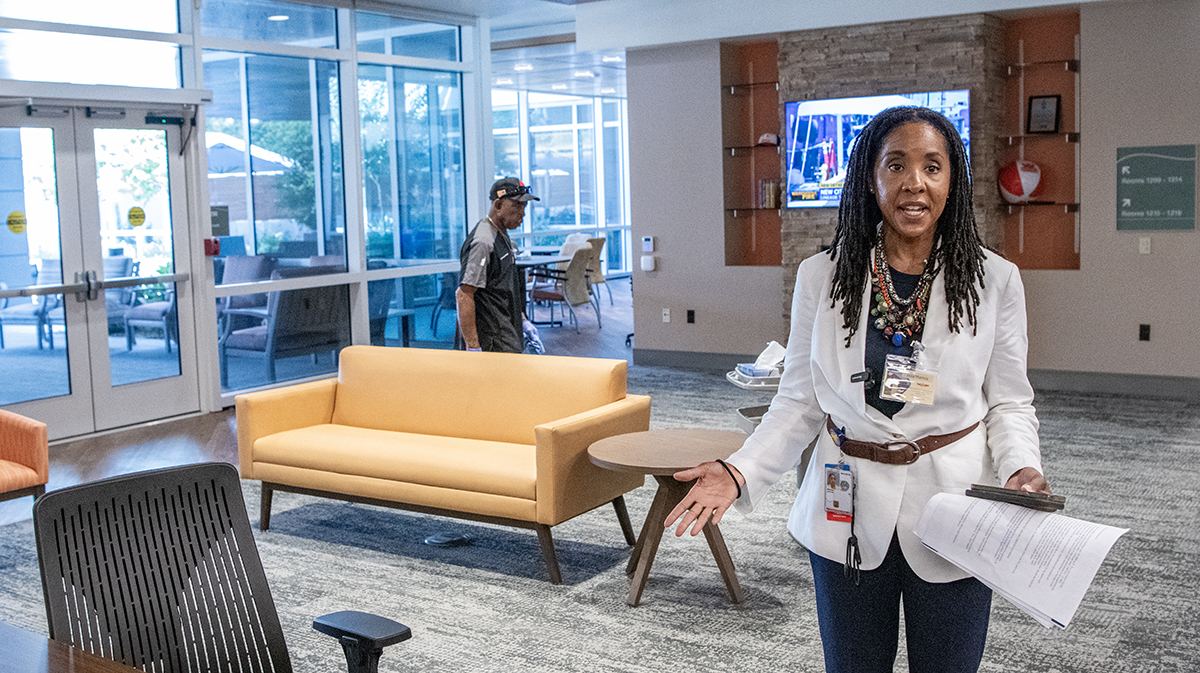
As dozens of veterans and their families looked on Friday afternoon, officials at the Tibor Rubin VA Medical Center unveiled the new Community Living Center, a sprawling residential-style facility that administrators are calling a model for the future of long-term veteran care.
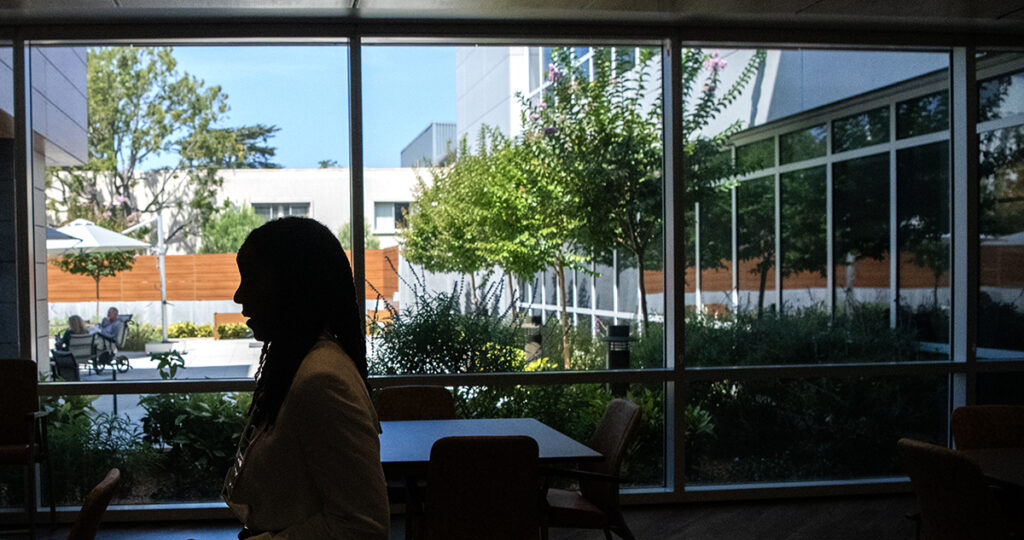
The 181,350-square-foot center, roughly triple the size of the facility it replaces, houses 120 private beds spread across 10 separate residential “neighborhoods,” each with its own dining area, kitchen, lounge and quiet room. The design departs sharply from the institutional hallways of a typical nursing home.
Dr. Jaza Marina, the chief of geriatric and extended care at the medical center, said during a tour on Friday that the intent of the facility is to feel like a second home. Each “neighborhood” carries the names of local landmarks, like Naples, Marina and Belmont, that surround the Long Beach VA’s 100-acre campus.
The $189 million project replaces a 1960s era nursing home that had declined with age and is planned for demolition. Initial plans for the new building were drawn up as early as 2008, though construction didn’t break ground until August 2019. Residents and staff began moving in on June 29.
Marina said that administrators hope to have the facility running at full capacity by 2028; they are currently operating at 40% capacity and will incrementally phase in sections of the center.
It’s part of a broader $387 million plan to modernize the hospital campus with a new mental health facility, parking structures and athletic fields.
Once fully operational, the center will act as a skilled nursing facility, with 24-hour supervised care, rehabilitation and hospice. Veterans are typically admitted after a hospitalization for an acute illness, or for needs such as intravenous antibiotics, complex wound care, or physical, occupational and speech therapy. The building also includes a respite program for veterans who require 24-hour supervision, but whose family caregivers need a break, as well an acute inpatient rehabilitation unit for those expected to recover within two weeks.
Most residents stay less than 100 days, though some remain longer if they cannot be safely discharged, according to staff. How long they stay, Marina said, depends on the person.
A dedicated unit serves veterans with dementia, and the building includes a beauty salon, a gym, indoor and outdoor dining areas and activity rooms.
The Long Beach VA, one of the largest veteran hospitals in the country, treats more than 65,000 veterans annually — mostly those living across Southern California.
Addressing the crowd Friday, Antony Palocaren, the LA deputy commander of the Army Corps of Engineers, spoke on how the building means an incredible deal more to its patients than simply a new building.
“For the veteran who comes here this is not a project, it’s a place to rest, it is a place to recover, it is a place to feel like home,” Palocaren said. “May this place stand as a daily expression of our gratitude towards our veterans.”
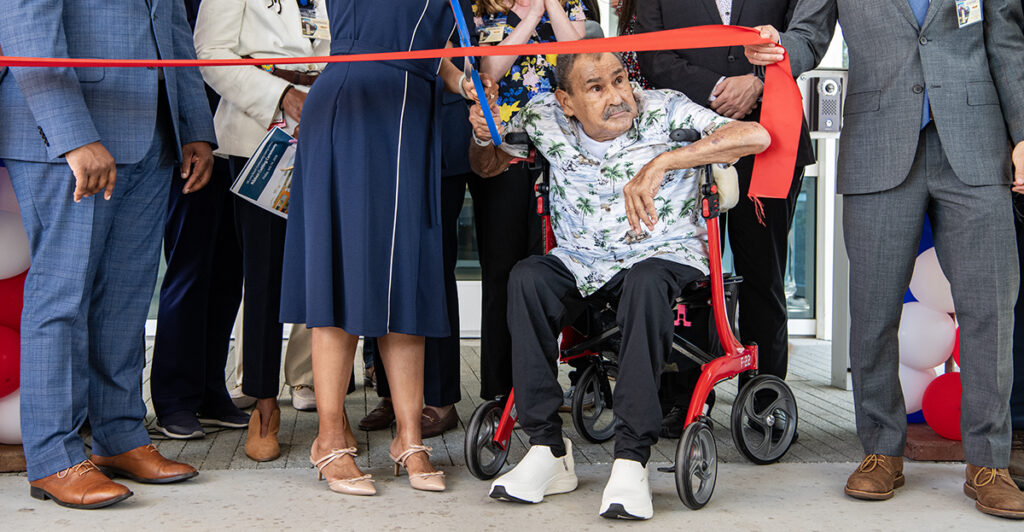
Ahead of a tour, a ceremonial ribbon was cut by Bill Jimenez, a veteran currently living at the center and president of its resident council, who said the nurses there had given him and other veterans “the will to walk again,” and “the will to heal.”
Some veterans already living in the center’s units watched the celebration from inside their rooms, with a few venturing downstairs. Judi Ann Rivera, an Army veteran who moved into the old facility in September 2022,said she watched the new building rise from her window as she spent 18 months there.
She had arrived in poor shape, unable to dress herself as she navigated using a wheelchair. She left in 2024, less than a month after the death of her husband, also a veteran. “They were there for me, and I’m so grateful for it,” she said. “For someone who couldn’t even dress herself, I’ve come a long way.”
She keeps busy since her months of treatment and still does athletic training at the Long Beach VA center. She flies out to Tampa and Orlando for paralympic tournaments in downhill skiing, sled hockey, curling and shuffleboard.
Among those touring the new building was Cece Yim, a volunteer with Blue Star Moms and the local chapter of the American Legion in Torrance. For her, visiting the center Friday was for closure.
Yim explained that four generations of her family have served in the military, starting with her great-grandfather’s enlistment into the Spanish-American War, her father in World War II and later in Korea, one brother in Vietnam and another in Desert Storm; her son served in Afghanistan and is still on active duty. Her daughter-in-law, also a veteran, works at Tibor Rubin as an X-ray technician.
“Since I was born, there hasn’t been a war that I haven’t been in with my family,” she said.
Her son was treated at the old facility in 2007 after surgeries on his arm and shoulder. Her brother died there in hospice care in 2019.
Yim remembers how staff draped his body in an American flag and carried him out as veterans and employees lined the doorways in salute. A Vietnam veteran, her brother never received “a hero’s welcome,” she said, adding that he at least received a “dignified end.”
Walking through the new building Friday, Yim said she thought of him.
“It’s a thousand times better here now,” she said, adding that she was certain her brother would have loved it.