

For roughly a century, procrastinators in Long Beach have relied on the roar of a trash truck coming down their street as a last-ditch reminder to take out their garbage.
But that may soon change, for the quieter.
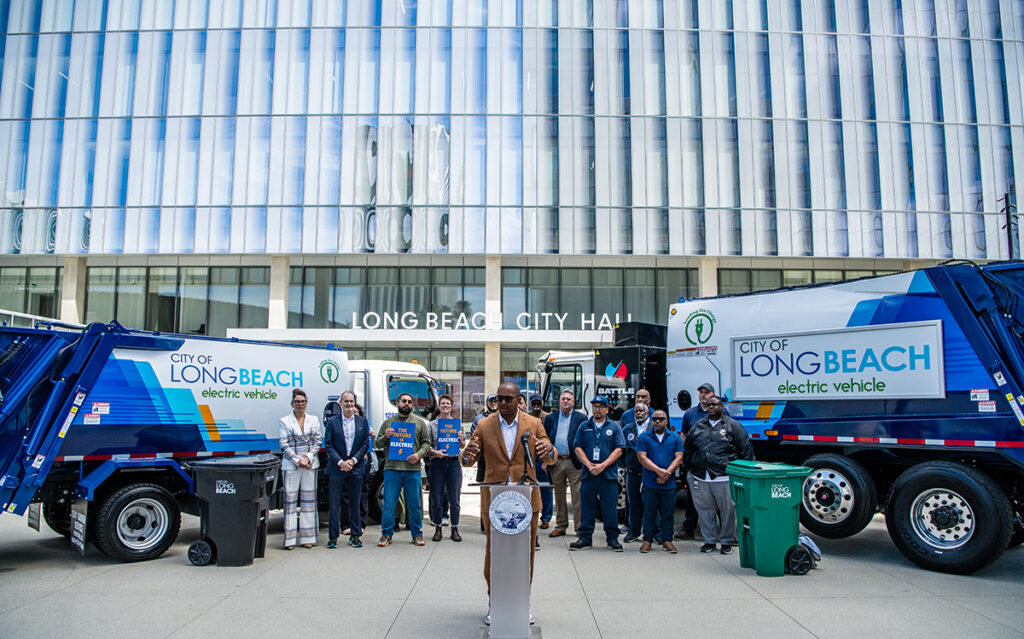
The city unveiled its first two all-electric garbage trucks on Wednesday, among the first in the county.
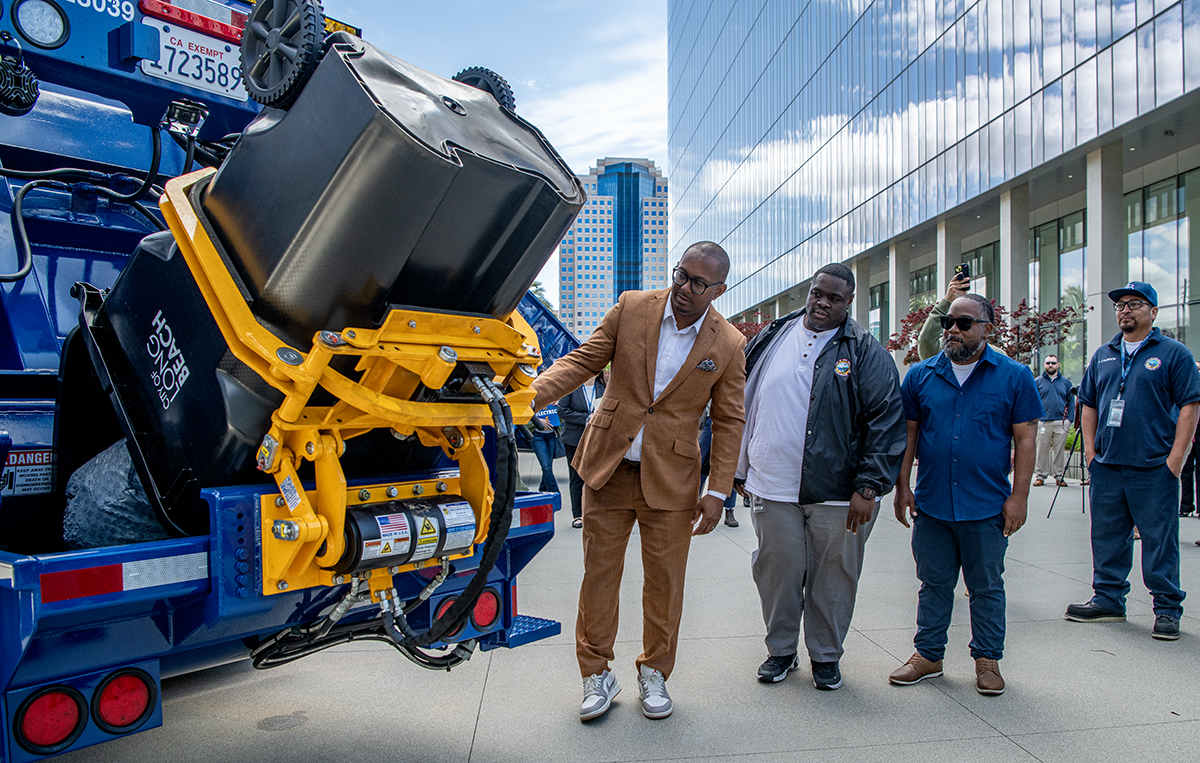
Parked outside City Hall, officials and activists gathered for the unveiling watched as Mayor Rex Richardson wheeled a trash can to the rear of the vehicle and watched as the claw grabbed and lifted it up toward its bed.
“We are going electric,” Richardson said. “The future is electric, and we are proud to be charting that future here in the city of Long Beach.”
The 400 Kilowatt truck, letting out a low hum, is far quieter than one powered by diesel or natural gas. Workers say its controls are about as different as switching to a Tesla from a typical sedan.
It’s part of the city’s goal to transition its entire fleet of 89 garbage trucks that together service nearly 120,000 homes each week. Each is currently powered through compressed natural gas, thought to be a safer and cleaner alternative to diesel, but still emits its fair share of smog into the air.
It’s the second city behind San Pablo to establish such a goal, though similar efforts have been seen in communities like Antelope Valley to replace its buses and trucks as a way to cut local pollution.
Reducing pollutants is a high priority for Long Beach because the city — particularly along neighborhoods that border its port, highways and busier roads — has especially high rates of asthma and deaths from respiratory diseases.
The Los Angeles-Long Beach region has consistently led the nation in the worst rates of smog, according to the annual reports published by the American Lung Association.
The state has also ordered that municipalities starting in 2027 must commit half of their new vehicles purchased for electric models. The city already has about 200 electric vehicles in its fleet.
But regardless of city and state aspirations, sanitation officials say they must be able to afford the switch; a typical electric garbage truck goes for $900,000, as opposed to $460,000 for one powered by fossil fuels. Switching all of them at once would cost millions of dollars during a period of fiscal austerity, with the city expecting a $61.5 million deficit next year.
There’s also the cost to build chargers. Officials say construction will soon start on a 10-port station at the city’s Energy and Environmental Services Department. One worker said the power needed to charge 90 of these garbage trucks could power the Empire State Building seven times.
With fewer federal grants and incentives available, officials say they may have to eat the upfront cost on a rolling basis, a handful of trucks each year, and see if they can save money over the course of the vehicle’s lifespan — about 7 to 9 years.
Electric garbage trucks are thought to be cheaper to maintain than traditional models because their chassis is structurally different and doesn’t bear oil-lubricated parts like pistons and valves. Some studies have also shown that electric versions are cheaper to fuel.
These two trucks, officials say, will serve more as a pilot; they will be studied across different routes in Long Beach to see how they fare, and whether the cost to keep them is worth the effort.
“It’s a wonderful first step, if it continues to do what its intentions are,” said Bob Dowell, the city’s director of Energy and Environmental Services. “But we just have to be assured on our end and we’ll be able to put it in the service and have it perform what we need.
“If it can’t perform, we’re going to have to probably fall back and make some other thoughts …” he continued. “Residents don’t care if we have all this but can’t pick up their refuse on the scheduled days and dispose of it in the right manner.”
Eventually, officials hope to stop ordering compressed natural gas trucks altogether. In a city memo from last June, officials said they’ve already ordered 42 new natural gas trucks but plan to order 47 electric trucks starting in 2027. The first order of 13 trucks is expected to go into service in 2029.
Editor’s note: This story has been updated with the Energy and Environmental Services Department’s new name. It is no longer the Energy Resources Department.