

Editor’s note: This story was updated to show that firefighters whose jobs are eliminated are expected to be offered vacant positions elsewhere.
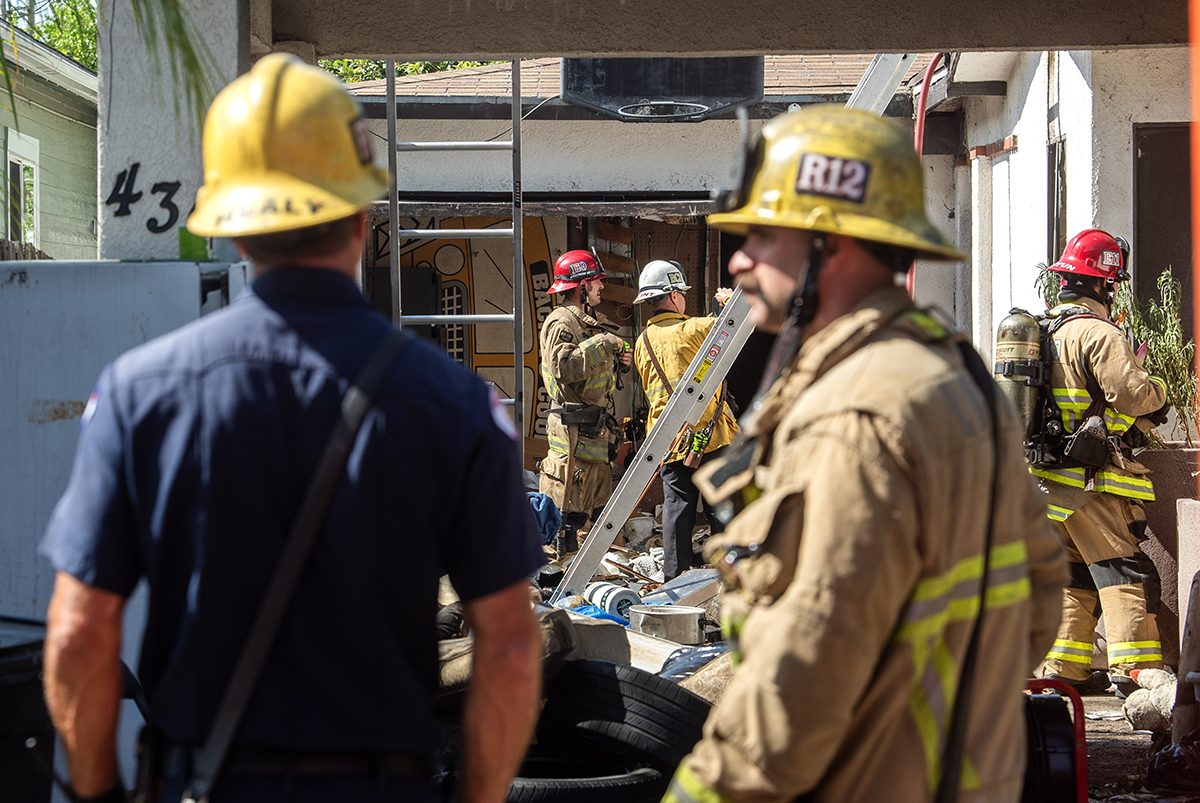
Residents and City Council members are raising concerns about Long Beach’s plan to shut down a fire engine, cut dozens of firefighters and reduce fire station staffing on a rotating basis.
They said city management should consider other options to balance the budget before making cuts that would drive up response time and limit how effectively first responders can handle emergencies.
Objections came during a City Council meeting Tuesday night when officials discussed potential cuts at the Long Beach Fire Department, which are part of sweeping cost-saving measures City Manager Tom Modica proposed to close a $58 million deficit in the coming fiscal year.
Modica’s plan called for trimming $11 million from the LBFD’s $201 million budget. It would mean shutting down Fire Engine 14 in East Long Beach, eliminating 34 positions overall — including 28 currently filled jobs — and taking one engine out of service on a rotating basis among the city’s 23 stations. Employees whose jobs are cut are expected to be offered jobs that are vacant elsewhere in the department.
Four fire captain positions would be cut, including roles tied to the Los Angeles Joint Regional Intelligence Center, community services and public information, and training and recruitment, along with a vacant battalion chief position in the Operations Bureau. The Fire Department’s headquarters front desk would also lose its in-person staffing and shift to a remote receptionist system.
In arguing to shut down Engine 14, which operates out of the fire station near Colorado Lagoon, officials said it responds to about 2,200 — mostly medical — emergencies each year but only about 200 fire calls, which is fewer than other engines. Fire Station 14’s ambulance crew will continue without interruption, they added. Eliminating the engine, along with eliminating the positions assigned to it, is expected to save the city $3.88 million.
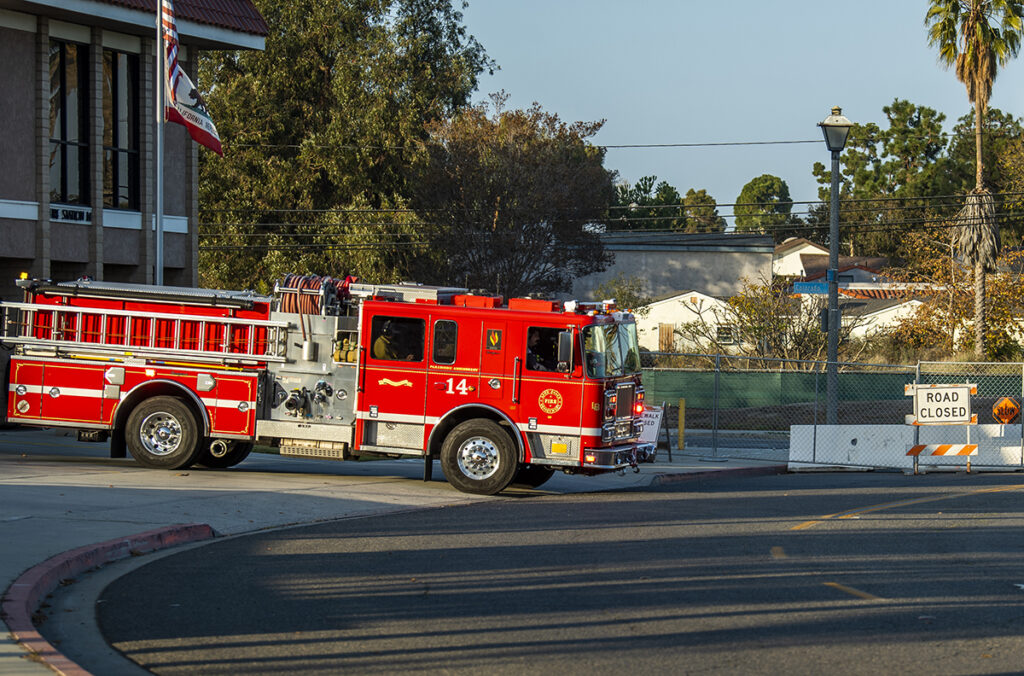
Taking an additional engine out of service on a rotating basis would save an additional $3.82 million.
But after pushback from the public and City Council members, Modica said his office would bring back other options to consider within the next week.
The City Council must ultimately vote on any cuts before they take effect.
What would the cuts mean?
Cuts of the magnitude proposed would invariably affect operations, Fire Chief Dennis Buchanan told City Council members. “When I say operations, I mean I have to impact the community,” he said.
The cuts would lead to an increased strain on firefighters and paramedics, leading to longer response times and instances where there is no engine available to respond to an emergency.
“Even a mild adjustment can affect the way we respond to calls,” he said.
Lamont Nguyen, president of the city firefighters union, said that the loss of Engine 14 would reverberate through the city. He said the engine, unlike some others, is also a paramedic-assessment unit, meaning it’s equipped to respond to medical calls and administer IVs and life-saving medication, or use heart monitors that could save someone in the time leading up to the arrival of an ambulance.
Firefighters and paramedics responded to more than 67,200 calls for service in the past fiscal year, department data show, with 85% for medical emergencies and 11% for fires.
The pushback
Councilmember Kristina Duggan, whose district includes Station 14’s coverage area, said the calls for service won’t stop just because the engine does.
She noted her district has more than 1,200 new housing units coming online in the next two years, along with an expanded battery storage facility next to a natural gas power plant.
“It still does respond to 2,200-plus calls per year,” Duggan said of Engine 14. “If Engine 14 is eliminated, that doesn’t mean the calls disappear.”
Calls currently handled by Engine 14 would be redirected to Engine 4 in Belmont Heights, Engine 8 in Belmont Shore and Engine 22, which serves the area near Cal State Long Beach.
Councilmember Daryl Supernaw said that redistribution could overextend Engine 22, whose coverage area already stretches north to Cal State Long Beach, sometimes along the 405 Freeway and south to the border of Seal Beach.
“To say it’s going to be impactful is an understatement,” Supernaw said.
Supernaw also noted that Engine 22 sits near the 405 Freeway and sometimes must respond to time-consuming freeway incidents and must go into the coverage area of Fire Station 18, which does not have its own engine.
During the City Council meeting Tuesday, resident Patrick Pianezza urged the council to reconsider the cuts, arguing that removing Engine 14 would leave a gap that ambulances alone can’t fill, since they typically don’t carry fire-suppression equipment.
“When you remove resources for public safety and public health, nothing good happens,” Pianezza said.
What’s next?
Mayor Rex Richardson has already proposed revising a portion of the cuts, specifically the rotating engine closure.
However, he said Long Beach has survived prior budget crises that also required public safety cuts.
“We know that budgets are cyclical. Sometimes there’s good years, sometimes there’s bad years,” Richardson said. “The last three mayors had to deal with it, the last three councils had to deal with it.”
He and others pointed out that Long Beach has closed and later restored fire engines before.
Engine 12 was shut down and took roughly a decade to be structurally re-funded, according to city officials, while Engine 17 was restored in 2019 after seven years without full funding.
Both engines, along with Engine 8, have since been brought back into service. Some council members and residents argued that history shows how difficult it can be to bring back a unit once it’s gone, even as the surrounding neighborhoods continue to grow.
Richardson expressed optimism that the current shortfall is temporary and that the city is on track to reach a structural surplus within two years.
“But the good news is, once it is structurally addressed through this plan, you know, forecast long-term fiscal stability that we haven’t had since the pre-pandemic era,” Richardson said. “That’s what we’re doing in this budget.”
You can give your opinion on the budget by submitting a comment card here until Friday. The City Council and its Budget Oversight Committee will also continue discussing the budget at upcoming meetings, which you can find here. City Council members must adopt a balanced budget by October.