

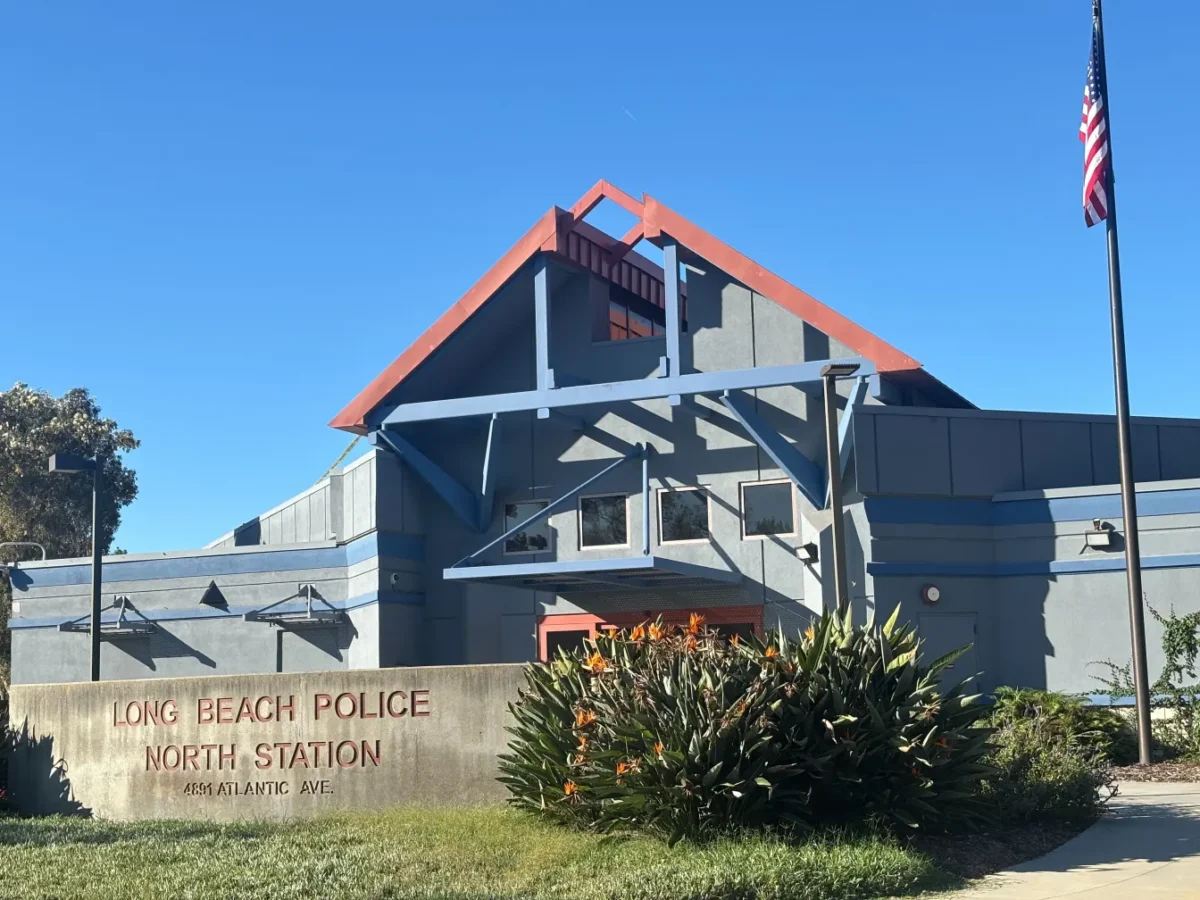
Can Long Beach police be trusted to uphold the constitutional right to a fair trial? That’s the question raised in a new court filing by a prominent defense attorney, who alleges the department failed his client, Lonnie Jacobs, when it comes to ensuring basic due process rights.
At issue is a now-former Long Beach Police Department officer’s long-undisclosed conviction for an out-of-state assault.
In his filing Thursday, Scott Sanders, a defense attorney, outlines how the department hid an arrest and conviction involving one of its officers from defendants and the Los Angeles County District Attorney’s Office for seven years. Sanders’ filing makes the case that the LBPD’s failure to disclose that information for so long suggests the problem goes well beyond this case.
It’s unclear how many potential cases could be affected.
“The defense submits that the repeated and varied efforts by the LBPD at concealment and deception … reveal a department that simply cannot be trusted to meet its disclosure obligations,” Sanders wrote in a motion to dismiss a case against Jacobs.
It’s a potentially major allegation. The 1963 U.S. Supreme Court case Brady v. Maryland established that law enforcement — both prosecutors and investigating law enforcement working on behalf of the government — must turn over any information that could help the defense win its case. Failure to do so represents a violation of a defendant’s right to due process and can result in mistrials or overturned convictions.
The Long Beach Police Department has not yet responded to a request for comment about this latest filing, but previously told LAist it complies with requirements under Brady.
The Los Angeles County District Attorney’s Office also has said it works with Long Beach to ensure Brady information is produced and has not responded to a request for comment on this story.
How we got here
Sanders, who exposed the consequential Orange County jailhouse informant scandal, was appointed to represent Jacobs by the court when felony charges were filed in May 2025.
Jacobs is facing up to four years in prison on charges that he brought a controlled substance into a jail.
Jacobs landed in jail after Erik Suarez, then a Long Beach police officer, arrested him in March 2025 on suspicion that he threatened a repo man with a gun. No charges were ever filed on that allegation, but Jacobs was taken to the sixth-floor jail at the Long Beach Police Department, where a jail staffer allegedly found a small bag of cocaine in his sock.
Sanders has argued the arrest that landed Jacobs in jail was based on misrepresentations and omissions of evidence from Suarez and another Long Beach police officer.
It wasn’t until Sanders attempted to subpoena Suarez, who left the Long Beach force in June 2026 and has since been hired by the Burbank Police Department, that the defense discovered he had been arrested in Cobb County, Georgia, in 2019 and convicted on battery charges in 2022.
What’s next
Sanders is now asking the court to dismiss the case against Jacobs because not disclosing this information amounts to “outrageous governmental conduct” on the part of the Long Beach Police Department.
“One of the most important responsibilities placed upon law enforcement is that of disclosing evidence favorable and material to the defense,” Sanders wrote in the most recent motion, “and the willingness to do so even when said evidence is damaging to the credibility of one of its officers, hurts the chances of a successful prosecution, or damages a department’s reputation.”
The information is relevant under Brady, the filing said, because Suarez’s conduct in Georgia demonstrates “moral turpitude” — one of the standards that requires sharing information with defendants — that could be used to impeach him as a witness.
LAist has previously tried to reach Suarez twice by calling a phone number linked to him in public records. Each time, a man answered and said he was not Suarez, but that he was in contact with Suarez and had no interest in connecting him with a reporter.
The Long Beach Police Department told LAist it was aware of the 2019 arrest, but that the internal investigation was part of Suarez’s personnel file and not releasable under California law. It’s not clear when the department first learned of the case against Suarez, who initially faced felony battery charges. In 2023, Suarez was disciplined for excessive use of force. A report on that case, which has been released, references a two-day suspension for the Georgia altercation.
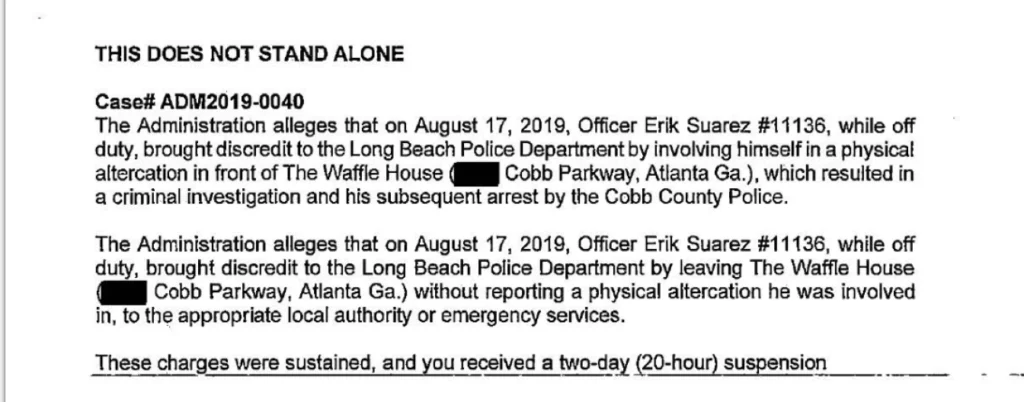
The Los Angeles County District Attorney’s Office previously told LAist it was unaware of Suarez’s arrest and conviction.
Why it matters
Sanders argues that would mean the Long Beach Police Department had ignored years of legal precedent, policy and agreements with local prosecutors.
The motion to dismiss Jacobs’ case outlines what Sanders calls a “shameful seven-year history” of hiding that arrest and subsequent conviction. Not disclosing that information, the filing argues, demonstrates the police department has an office-wide policy of intentionally withholding information that would reflect badly on its officers.
Two years before Suarez was arrested for assaulting a man in Georgia, then-District Attorney Jackie Lacey issued a special directive stating that “all law enforcement agencies in Los Angeles County have agreed” to disclose the arrest and conviction of any officer who might show up in court as a witness.
And in 2019, in response to a Los Angeles County Civil Grand Jury report about the availability of Brady information, the district attorney’s office told the report’s authors that it conducted training at law enforcement agencies regarding Brady disclosures.