

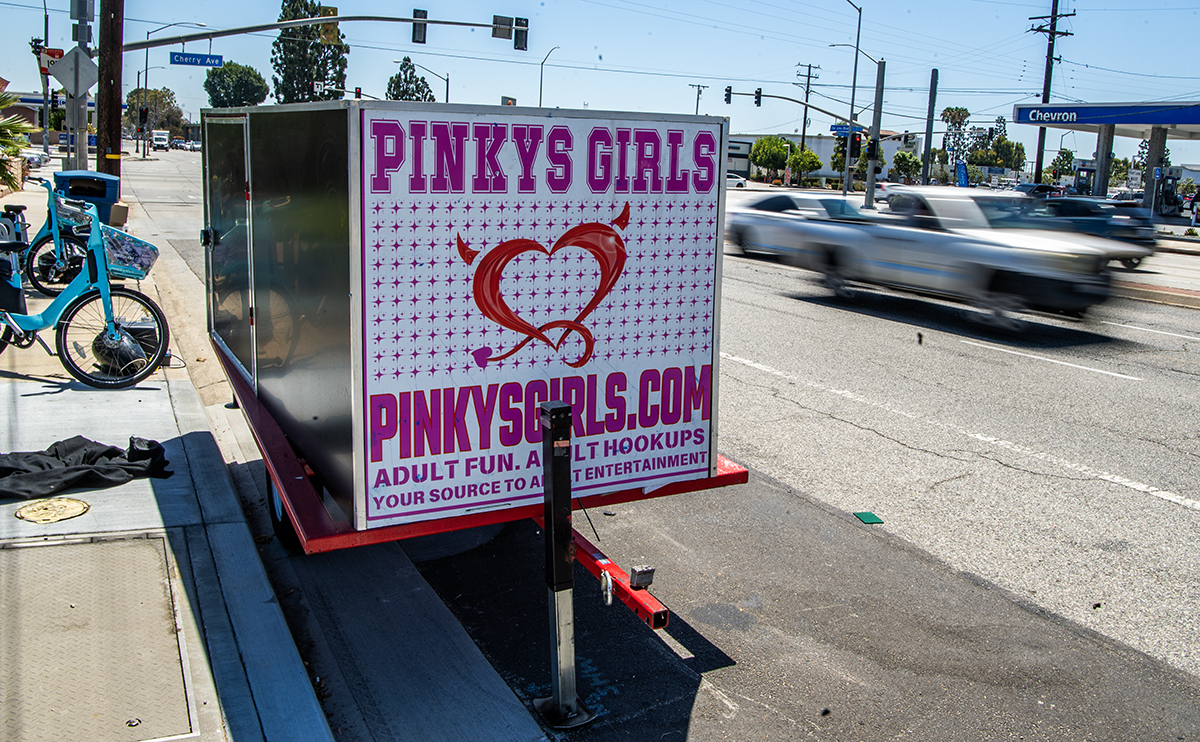
After dozens of complaints from North Long Beach residents about a detached trailer advertising “adult fun” and “hookups,” city leaders say they’re looking for ways to get it out of the neighborhood for good.
The two-wheel trailer covered in pink-and-white ads has been parked around North Long Beach for months. Most recently, it’s at the intersection of Cherry Avenue and Del Amo Boulevard since at least Thursday, Long Beach residents say. It’s promoting a website, Pinkys Girls, that advertises sex on demand in more than 400 cities across the country, including Long Beach.
Residents have been asking the city to intervene. Many expressed concerns about sex work in an area of Long Beach where human trafficking and prostitution have disrupted daily life.
One resident worried about kids being exposed to these kinds of ads. Lately, the trailer has been parked directly adjacent to the Spires, and the restaurant’s owner, Adelfo Brito, said it’s bad for business.
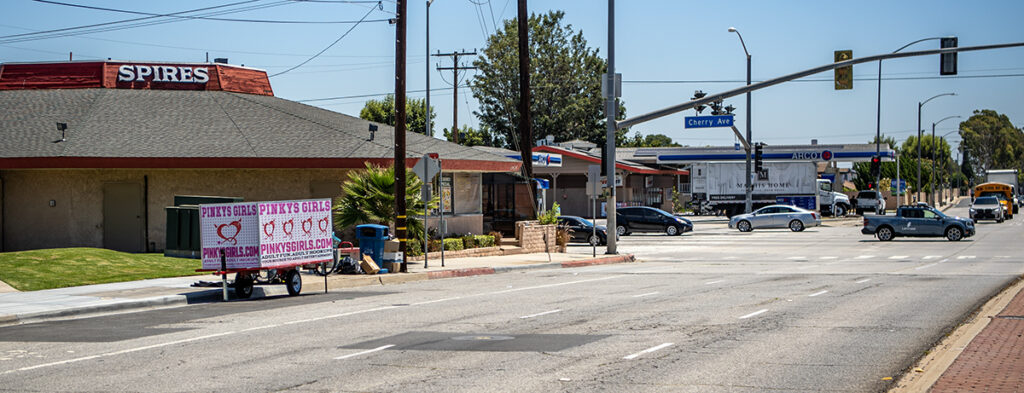
On Sunday, Councilmember Tunua Thrash-Ntuk, whose 8th District encompasses the intersection, responded publicly on Facebook and said her team and the police department are “highly aware” of the situation and the “bad actor” who has been “bouncing this trailer around our neighborhoods.”
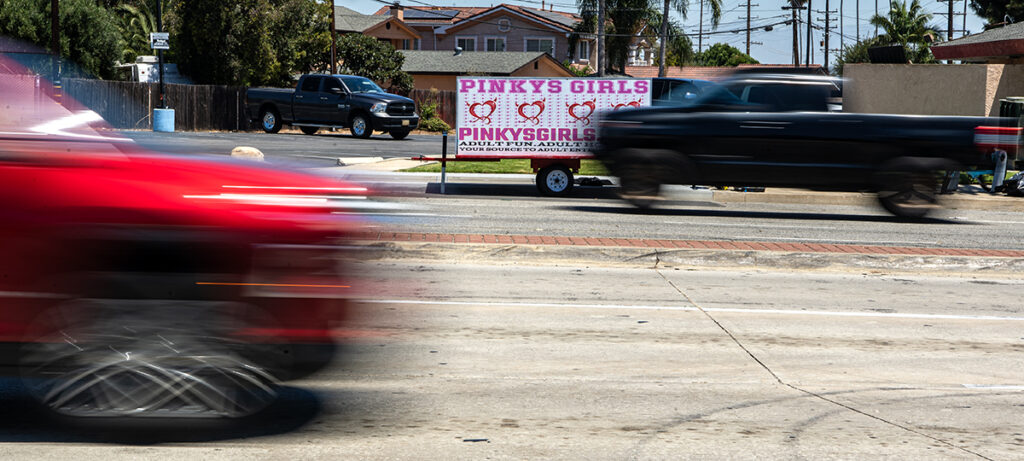
Even before the trailer showed up in District 8, it was a problem in nearby District 9, which includes northernmost Long Beach, and the trailer had previously been parked on Long Beach Boulevard, a known corridor for trafficking, she said in an interview. Already, Thrash-Ntuk’s office has received approximately 50 complaints about the trailer and the topic has dominated neighborhood association meetings, she said.
In response, the councilmember said she coordinated with parking enforcement to tow the trailer on multiple occasions, yet “playing a game of whack-a-mole every 72 hours is not a permanent solution,” she said in her Facebook post, referring to a city ordinance that allows vehicles to remain parked in the same space for up to three days.
Now, she said she’s working with police and the city attorney’s office to find more permanent solutions.
The trailer’s operator might be required to obtain a business license to continue using public streets to advertise, Thrash-Ntuk said. She also suggested establishing buffer zones to prevent the trailer’s operators (and others) from advertising adult content — like cigarettes, alcohol and sex — near elementary schools and daycares.
Long Beach police said in a statement that they “have and will continue to take enforcement action when appropriate” but did not explain what kind of enforcement.
Yet even though the trailer has been towed in the past, the city must proceed cautiously, as a judge previously found the city had acted inappropriately in a similar case. In 2018, the city attorney’s office ordered a company to remove its trailers, which advertised its services while legally parked on public streets. (The company, Hit & Miss Enterprises, operated a cleaning service and used the trailers to store and transport cleaning supplies, according to a court document.)
The city began impounding the trailers, and the company sued the city for violating its constitutional rights. The court ruled the city had restricted advertising based on content and that those restrictions did not hold up to “strict scrutiny,” a legal test. Therefore, the city was found in violation of the company’s First Amendment rights and was required to pay nearly $300,000 in damages.
In the meantime, Thrash-Ntuk encouraged residents to continue reporting Pinkys Girls trailer to police and via the GO Long Beach app to create a record of the nuisance. Some neighbors, though, have grown impatient and floated the idea on social media of taking matters into their own hands by spray-painting it.