


Long Beach says it finally has the money to start a long-awaited project to move a busy roadway out of a downtown park.
By 2030, residents will be able to walk from one end of César Chávez Park to the other without crossing northbound Shoreline Drive, where drivers are accelerating to get onto the 710 Freeway. When finished, the northbound side will run alongside Shoreline’s southbound lanes next to the Los Angeles River.
Ryan Wolfe, president of the Wilmore City Community Association, said it’s been a long time coming. Neighbors have been calling for the city to make the park more accessible “for decades.”
He called Shoreline a “surface-level freeway,” where drivers routinely travel around 60 mph.
To get to most of Chávez Park, “You literally have to run across the street, a very fast street, to get there,” he said.
Moving Shoreline will be part of a larger three-part project to add greenspace and bike lanes to the area.
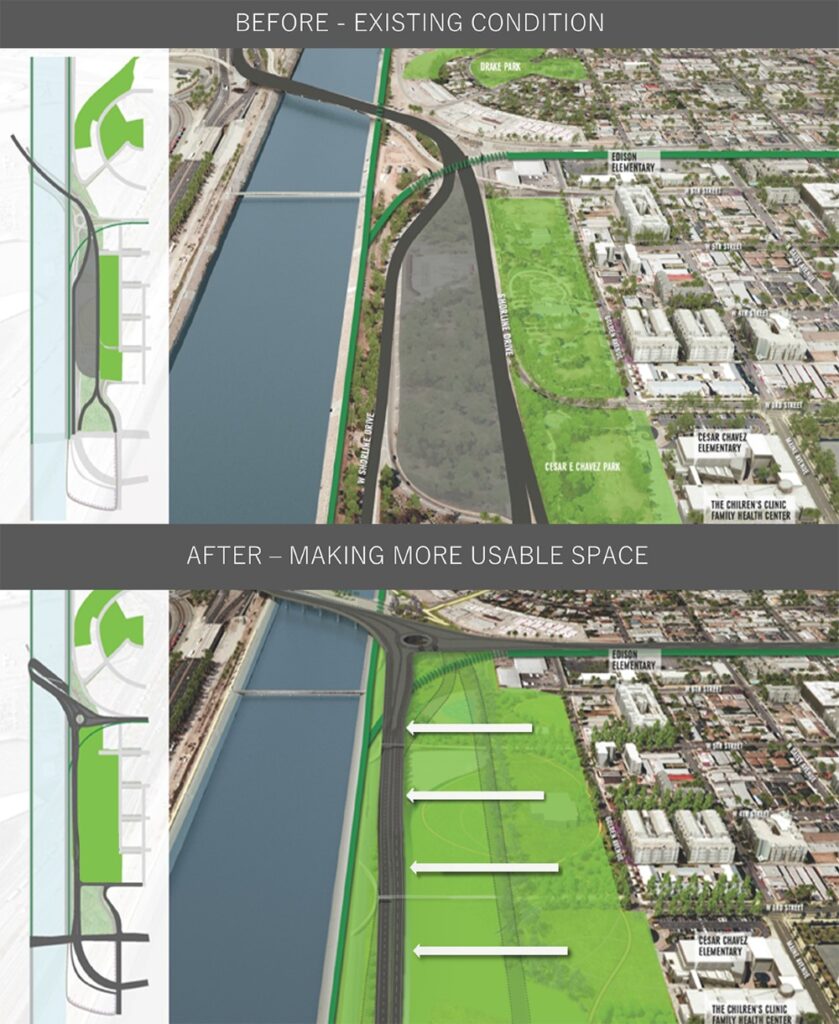
The plan, approved by the City Council this month, will create a new 4.5-acre park connecting Drake Park and Chávez Park. It also includes a pedestrian and bike path that will connect all three parks and run all the way down to the start of the city’s waterfront on Shoreline Drive just south of Ocean Boulevard.
Work on the stretch of Shoreline south of Ocean is expected to start early next year and finish before the 2028 Olympics.
Moving Shoreline out of Chávez Park won’t happen until after the Games. Following that, the city will also start work on the new park just north of Seventh Street with pickleball and basketball courts, children’s play areas and skateable landscape pieces. It’s replacing an old MTA lot that the city currently uses for storage.
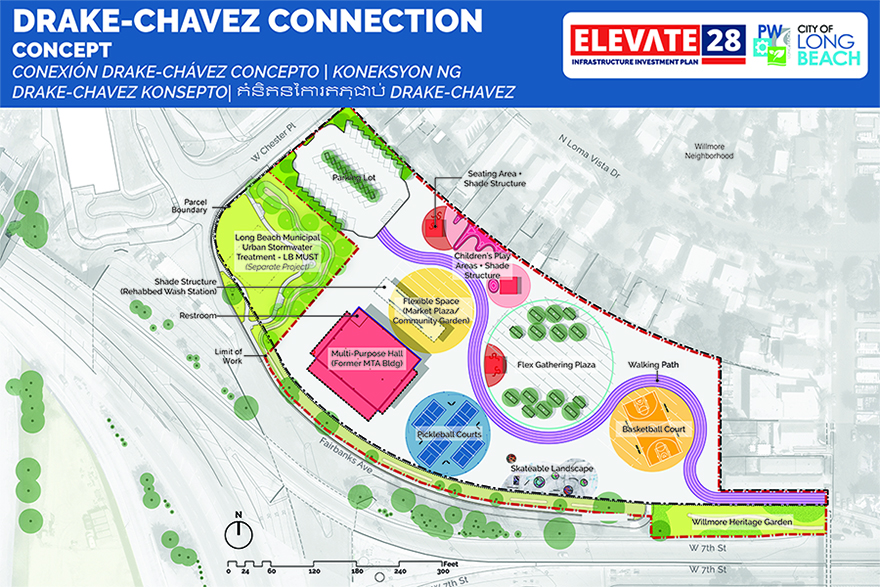
City officials say the new park, which it aims to complete by 2030, will create 22 acres of continuous green space running from Drake Park south to Chávez Park.
Funding for the plan finally came together through a $30 million Reconnecting Communities grant awarded by the Biden administration and $35 million from the Los Angeles County Metropolitan Transit Authority, according to a staff report.
Long Beach will repay a third of that $35 million ($11.5 million) over 10 years starting in fiscal year 2033.
Funding from Metro Measure R, local Measure A sales tax and gas tax funds make up the remaining $8 million on the $73 million project.
Previous plans included demolition of the Shoemaker Bridge, which carries cars over the LA River from the southbound 710 Freeway, but the current project does not. Previous cost estimates for that project hit nearly $900 million. The city is still searching for funding to replace the bridge.
At the Oct. 6 City Council meeting where the current plan was approved, Mayor Rex Richardson called it a “landmark project” that will “completely transform how people enter our downtown.”
Wolfe and his neighbors are also hoping it’s a sign of more to come.
“We’ve kind of had this long-term issue of building kind of halfway around walkable communities and then building the rest of it around moving our cars fast,” Wolfe said. “We haven’t really picked a lane, so to speak, and now it kind of seems like we’re picking that lane.”