


City and state officials on Monday shared details of a homeless encampment clearing last week along the Los Angeles River near Artesia Boulevard, saying it forced about 25 people to move from the area.
Officials said the encampment underneath the crossing of the 91 and 710 freeways has been a recurring health and safety concern. Those living in the encampment were warned twice of the cleanup, with a final notice posted one day before Thanksgiving.
The cleanup, which spanned three days, Dec. 1 to 3, collected 150 tons of rubbish. Caltrans crews were seen in aerial footage corralling trash and uprooting tents, lean-to shacks and makeshift homes before setting up rocks and other barriers as a deterrent to future camps.
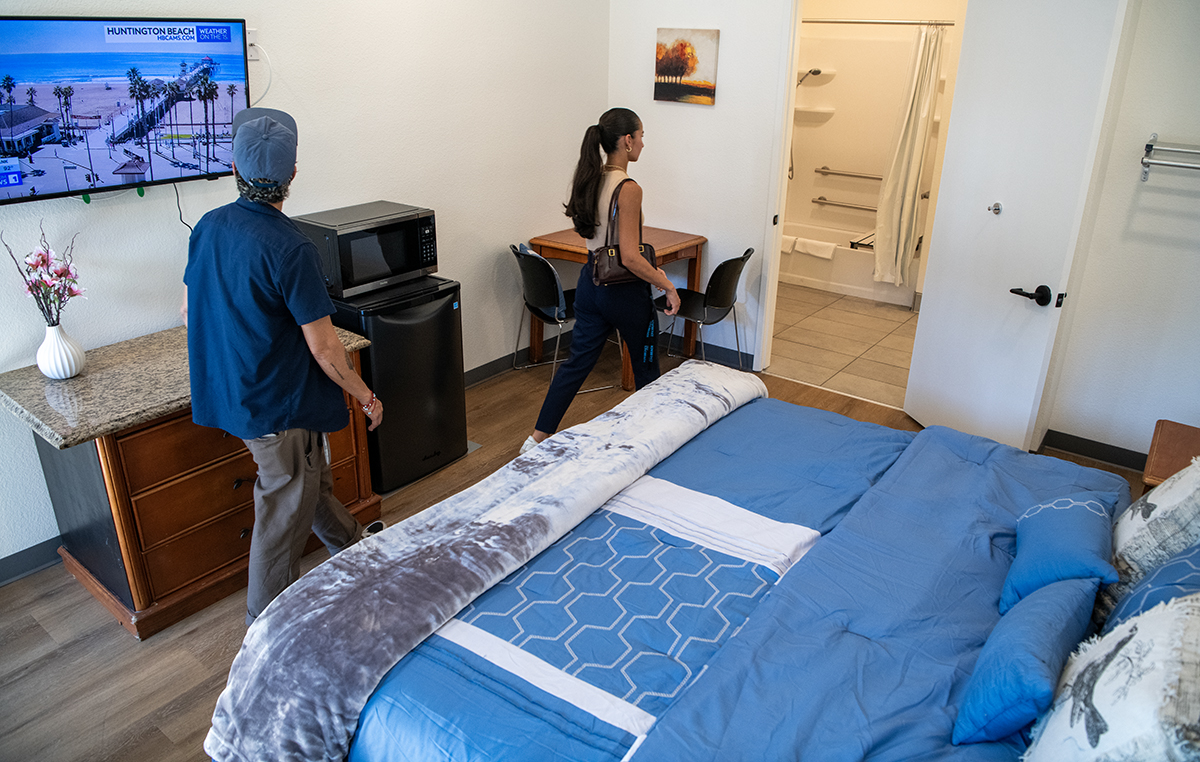
In total, 25 people — and eight pets — were moved from the site, each accepting a room at the city’s new state-funded Project Homekey site, the former Luxury Inn in North Long Beach. Officials said the timing of the clearing was based around the site’s opening.
“Over the next month or so, we’ll be moving additional people in,” said Paul Duncan with the city’s homelessness bureau.
The 78-room renovated motel opened in late October.
As people arrive, social workers there say they next plan to schedule visits by mobile medical units to administer physicals, as well as bring in representatives from the DMV to help people get a driver’s license.
Officials were proud to say that every homeless person at the freeway camp gladly took a room at the interim housing site.
One of those new tenants, a man named Steven, said he accepted a room as soon as it was offered.
After becoming homeless in Arizona, he and his wife drifted town to town — to San Diego, then Compton — before coming to Long Beach about two years ago.
It was a tough life there, he said, invisible to the 300,000 travelers who passed a few feet west of them day after day.
“There’s a lot of things you (have) to watch out for,” he said. “It really takes an incredible person to live and survive on the riverbed, because down there you don’t have a lot of help.”
Suffering from chronic back pain and seizures, Steven says he relies on medication that is often stolen. Following a mauling six years ago, he’s been left with a crippling fear of large dogs.
“If I hear violent dogs, I go nuts,” he said. “It recreates the whole thing in my mind.”
He hopes the last year and a half he spent along the riverbed is his last time being homeless. Once stable, he hopes to reunite with his wife — staying in a shelter in South L.A. — and daughter, who is in the care of child welfare services.
So far, he’s optimistic. Monday was his sixth day at the new site. It’s far quieter than the riverbed, with plenty of food and a staff he said is patient with him.
This comes as Gov. Gavin Newsom, since last July, has told California cities to dismantle street camps that have come to be the most visible depiction of the state’s homelessness crisis.

Encampments judged to pose “imminent threat to life, health, safety or infrastructure” must be addressed immediately, though the directive does not provide a specific deadline.
Caltrans has cleared 19,000 homeless encampments since 2021, with crews commencing similar cleanups recently in Los Angeles, Van Nuys and San Diego.
“I know it feels like we are not moving fast enough, but we disrupt the cycle of homelessness for people every single day,” said Business, Consumer Services and Housing Secretary Tomiquia Moss. “And this site is a reflection of that incredible work.”
An estimated 3,600 people were homeless last year in Long Beach, most of them unsheltered. In total, that was a 6.5% increase from the year prior.