

This article was originally published by LAist on Nov. 24, 2026.
California’s clean air rules for cars and trucks have come under fire from the Trump administration. But a lesser-known rule targeting pollution from ships docked at the nation’s busiest ports is also at risk.
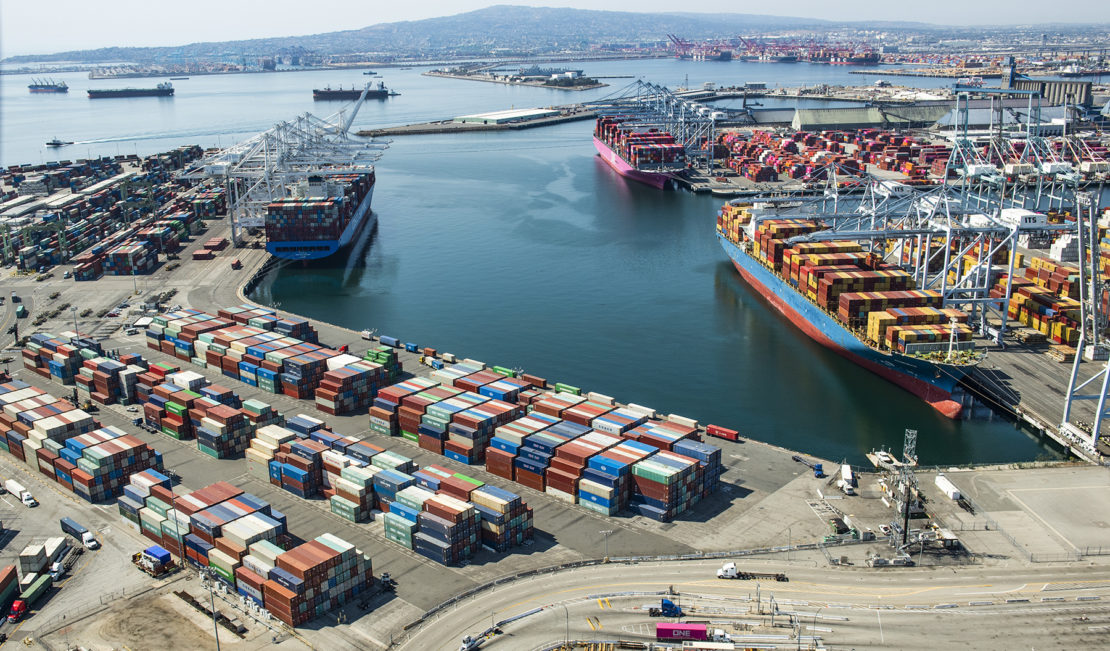
The ports of L.A. and Long Beach are the single largest fixed source of smog in Southern California. The biggest cause of that pollution is ships from all over the world traversing the ports and idling at their docks.
And some of the densest neighborhoods in the region are right nearby.
“Long Beach, Wilmington, San Pedro,” said Earthjustice attorney and longtime clean air advocate Adrian Martinez. “In those communities, you have people literally living right next to where these ships were belching out really toxic pollution.”
Those fumes, largely from burning diesel fuel, have been linked to higher rates of cancer.
“We cannot solve our air pollution crisis in a place like Los Angeles unless we meaningfully and significantly drive down pollution from ships,” Martinez said.
The effort to revoke California’s clean ship rule
That’s why, back in 2007, the state approved the first version of what’s called the ocean-going vessels at-berth regulation. In general, the law requires certain ships to either turn off diesel engines and plug in to electrical power at the port when they’re unloading or capture the pollution that comes out of their smokestacks.
Container ships, passenger ships and refrigerated-cargo ships have been phased into compliance since 2014, reducing smog-forming emissions from those sources by 80%, according to the California Air Resources Board. Since 2023, the rule has expanded to include more stringent emissions standards and more types of vessels.
“It’s really one of the most important public health measures,” Martinez said.
Still, work remains to cut pollution. Southern California regularly exceeds federal air quality standards for fine particulate matter and ground-level ozone.
But one of the key tools to cut such pollution, the at-berth rule, has gotten caught in the crosshairs of the Trump administration’s attacks on California’s clean air regulations. In September, the Republican-controlled House voted to revoke California’s at-berth clean ship waiver.
Now the issue rests with the Senate. It’s unclear whether the Republican-dominated Senate will take up the issue in the lame duck session — or whether it will fall to the incoming Democratic majority when the 120th Congress convenes Jan. 3.
Those fighting the at-berth regulation argue that it increases costs, which get passed on to consumers, and that the technology just isn’t ready.
Capturing at-berth pollution
The ability for ships to connect to power at dock, called shore power, is slowly growing. But most ships still don’t have the ability to connect to that power, and there’s still not enough renewable energy to support it.
Plugging into clean electric shore power is the ideal solution, Martinez said, but ”the public health crisis from shipping is so great that we need all sorts of solutions.”
That’s why a handful of companies, including Stax Engineering, have invested in pollution capture.
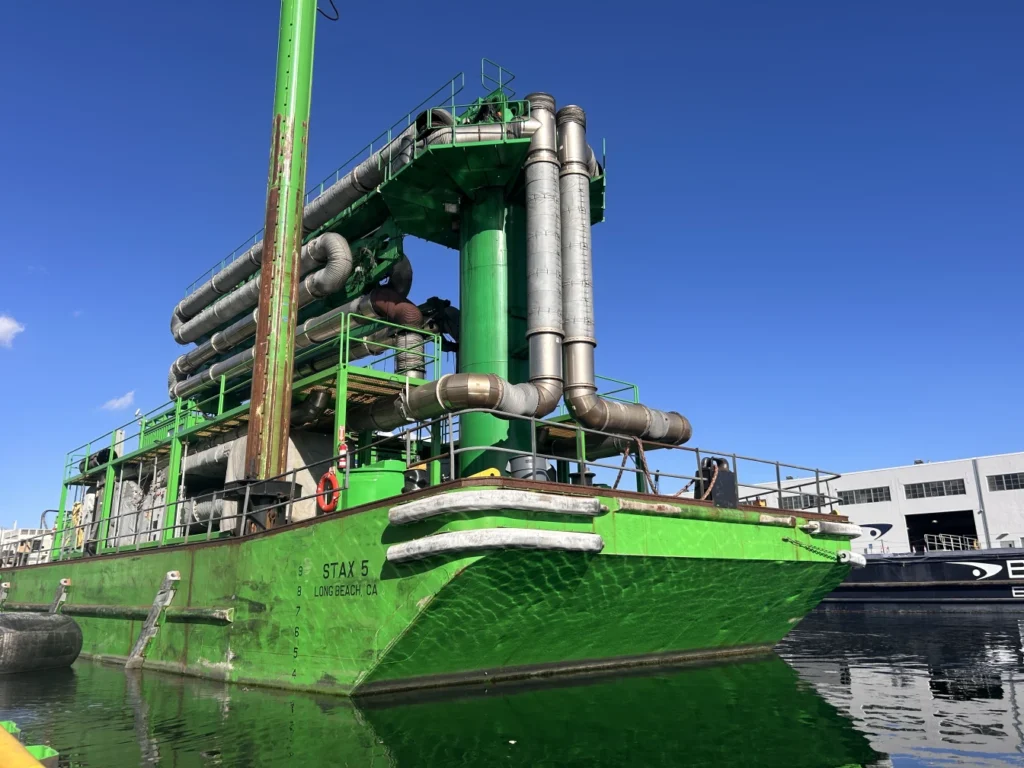
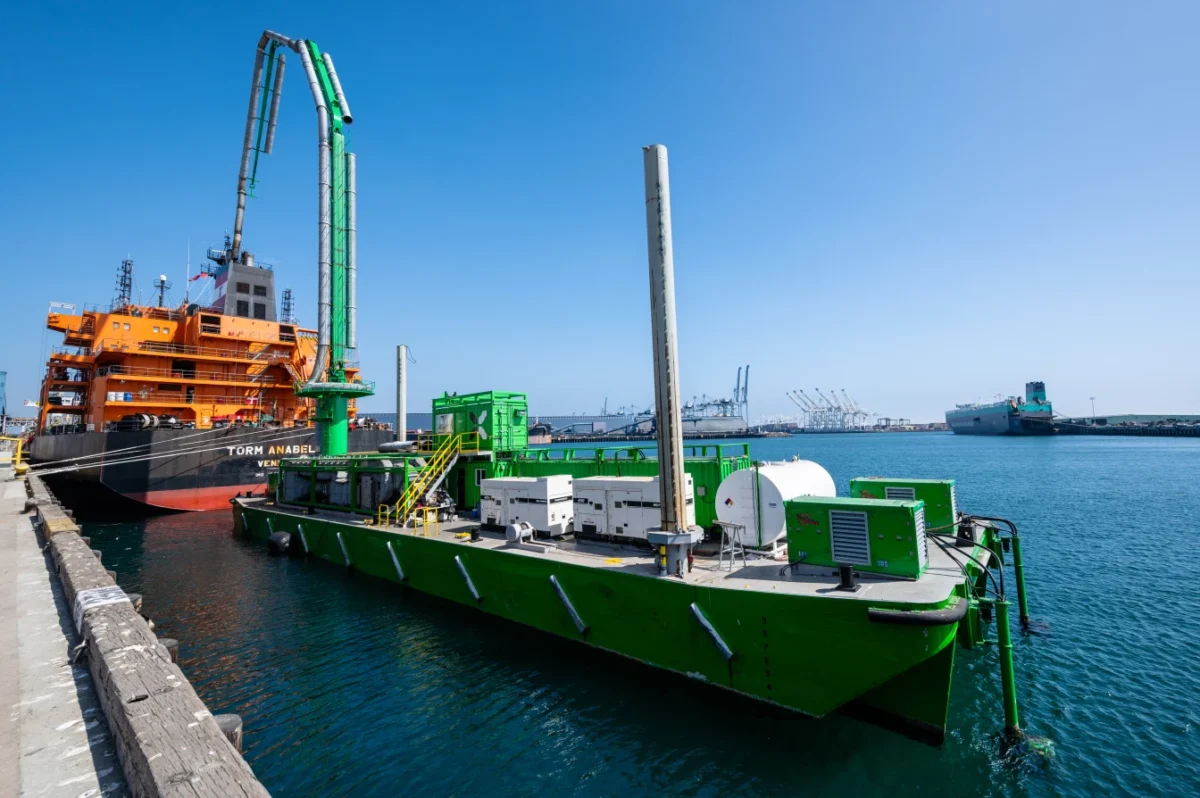
At the company’s berth at the Port of Long Beach one recent morning, two huge neon green barges were docked. Each had a massive, folded mechanical arm that can extend more than 250 feet to connect to the smokestacks of ships.
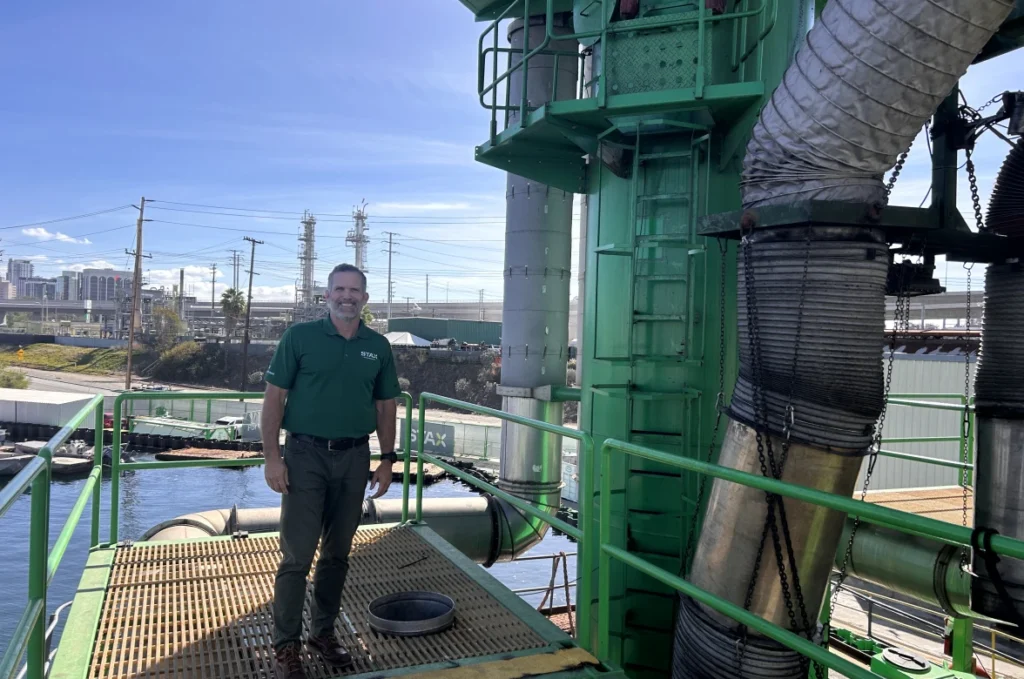
“It’s like a big elephant nose at the end, and it connects to the stack,” said Mike Wallace, Stax’s chief executive.
The arm directs soot and smog-forming nitrogen oxides, or NOx, into a processing unit inside three 20-foot containers. There, fine particulate matter is filtered, and a catalyst breaks apart the nitrogen oxides, releasing them back into the atmosphere as nitrogen and oxygen, the components of the air we breathe.
The process captures about 95% of smog-forming NOx and 99% of particulate matter, Wallace said.
It has yet to help with planet-heating emissions like carbon dioxide, and small amounts of carbon dioxide are released as part of the process. In terms of pollution from the barges themselves, Wallace said, the company works to limit their emissions through the use of low-carbon fuels like biodiesel.
The company is also expanding into carbon capture. That’s more of a challenge to implement because captured carbon needs to be used or disposed of somewhere, Wallace said.
“Longer term, what people are trying to do is reduce carbon across the entire shipping process,” Wallace said.
Stax has partnered with the London-based company Seabound to demonstrate how to capture carbon and other pollutants while ships are at sea.
A growing industry that doesn’t drive up costs
Meanwhile, Stax Engineering continues to grow its efforts to capture NOx and particulate matter. The company has eight pollution-capturing barges, with three more coming online soon. The goal is to have 18 operating in the coming years.
Stax employs about 200 people, mostly union jobs. They’re expecting to nearly double that number as new requirements of the at-berth regulation are set to take effect in Northern California. With strong backers, including actor Edward Norton, the company’s chief strategy officer, Wallace said the company is well-positioned to meet the state’s evolving at-berth regulations.
“The reality is we’re not going to have [cleaner] alternative fuels for 30 years at scale,” Wallace said. “So are we just going to pretend those emissions for the next 30 years don’t need to be captured? When those alternative fuels come, we’re going to have to find another line of business, which we’re good with.”
Across the water from the company’s berth, far on the other side of the port, Wallace pointed to another Stax barge attached to a massive auto-carrying cargo ship. Instead of dark diesel exhaust spewing from the smokestack, there’s just the green arm of the Stax barge.
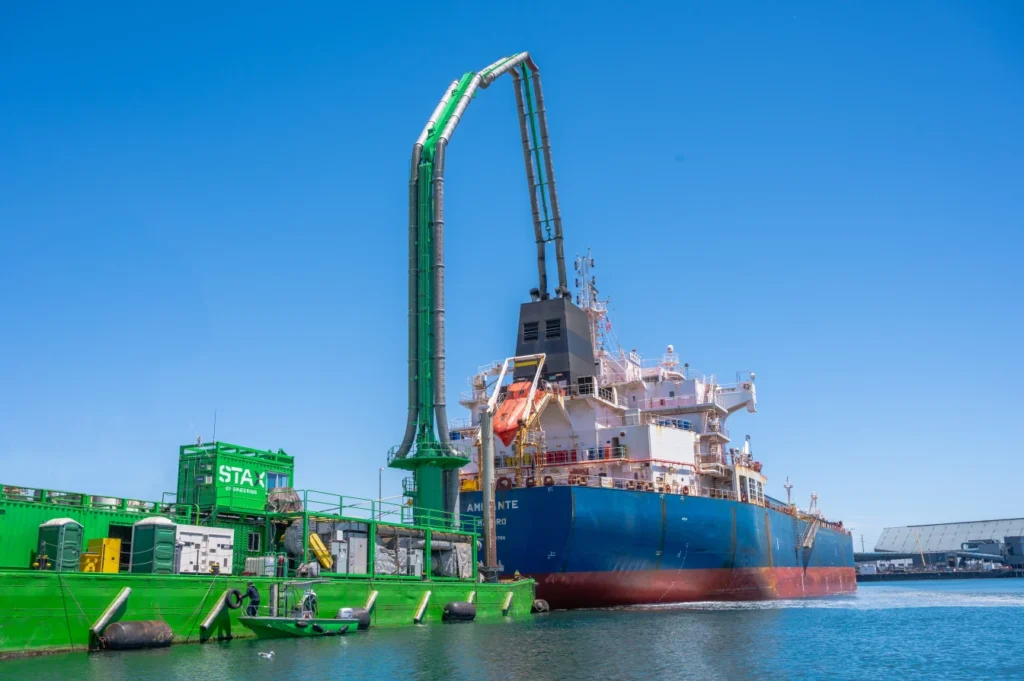
“You’d be seeing black exhaust, diesel exhaust,” Wallace said. “The numbers are somewhere between 20 [thousand] to 60,000 cars’ worth of emissions a day coming out of those vessels.”
The federal government estimates this could add $7.66 to the price of the cars on that ship. For consumer goods, it adds fractions of pennies on the dollar.
That’s why Walker says the argument that the at-berth rule is a significant factor in high prices is “ludicrous.”
“It’s kind of what the marching orders are to go against this regulation,” Wallace said, “but the math just doesn’t add up.”
After the blue wave in the midterm elections, and with other priorities on the minds of Congressional Republicans, Wallace hopes the clock on revoking the at-berth regulation waiver just runs out.