


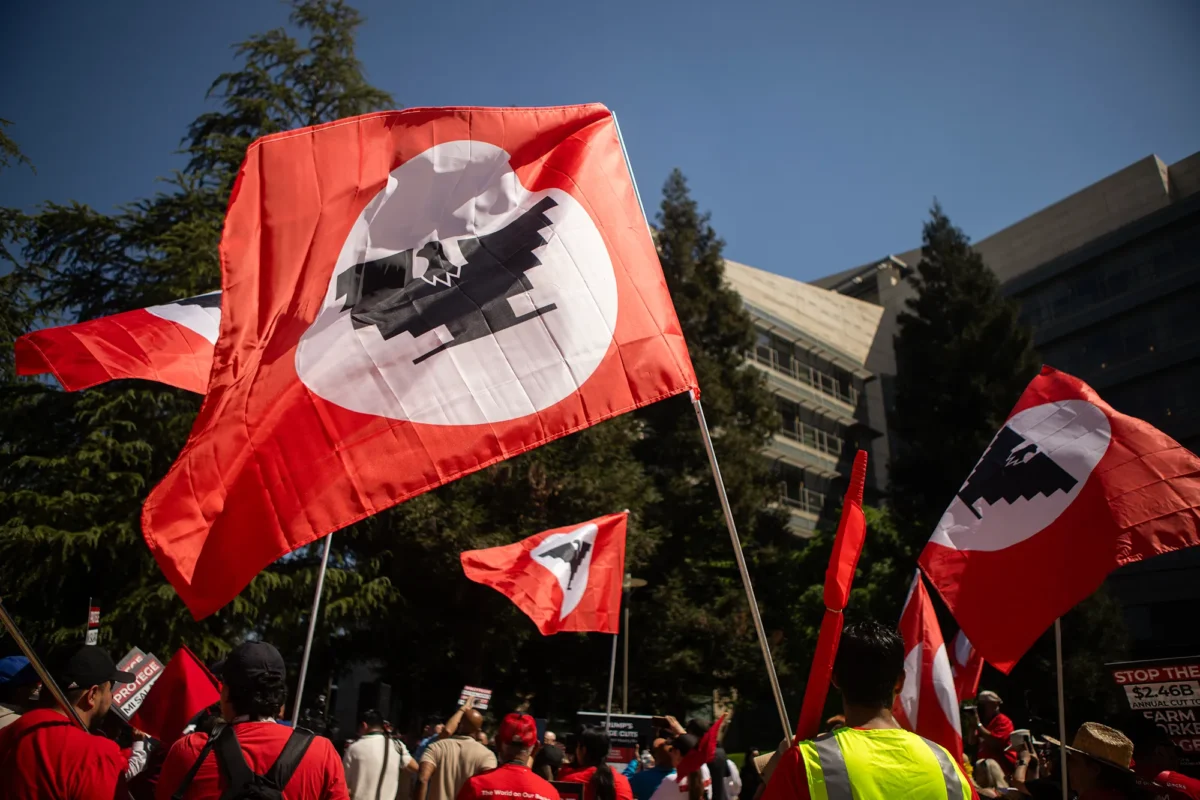
This story was originally published by CalMatters. Sign up for their newsletters.
A Trump administration attorney conceded “there aren’t enough Americans to take these jobs” at a federal court hearing in Fresno this week as she defended a policy that would cut pay to immigrant laborers.
The lawsuit, filed by the United Farm Workers in the U.S. District Court for Eastern California, challenges a federal wage rule tied to the H-2A agriculture visa program, which allows U.S. employers to hire temporary workers from abroad, mostly from Mexico, for agricultural jobs not filled by domestic workers.
At issue is whether that new rule lowers wages in a way that could ripple through the broader workforce and affect U.S. workers by driving down their pay. Federal law requires H-2A wages not undercut domestic pay.
The case highlights the ag industry’s dependence on immigrant labor at a time when the Trump administration is using military-style tactics to crack down on immigration, while at the same time trying to make it cheaper for growers and farmers to hire temporary foreign workers.
Growers argue that labor costs have been rising for decades, warning that without changes, some farms may shut down.
The union representing farmworkers argued in court filings that employers, especially those in agribusinesses, will expand the pay cut to every farmworker, including American workers.
U.S. District Judge Kirk Sherriff said he planned to issue a written ruling soon that would either uphold or suspend the Trump administration policy.
The new interim rule splits H-2A workers into two tiers, resulting in 92% of farmworkers being categorized as “unskilled” and setting their pay to the 17th percentile of average wages, meaning 92% of farmworkers would earn what the bottom 17% of Americans make.
The nonprofit think tank Economic Policy Institute has estimated the minimum wage for many farmworkers would fall to $13.70 an hour. Their average minimum wage last year was $17.43. California’s minimum wage is $16.90.
Alexandra McTague Schulte, an attorney representing the U.S. Department of Labor, argued that the government is obligated to protect American workers from the adverse effects of wages from H-2A laborers.
The labor department refused to concede that bringing in foreign labor at reduced wages would affect American workers’ wages. Schulte said the proposed lower minimum wage for H-2A visa holders would not affect citizens because farmers already can’t find enough workers, meaning the demand for labor is greater than the supply.
In an exchange, Sherriff seemed to disagree. He said setting wages for the vast majority of H-2A farmworkers at a “level way lower than similar workers, including Americans”, would undercut the market.
“Isn’t that just math?” Sherriff asked.
Schulte did not answer directly, saying, “I’m not good at math, your honor.”
Outside court, UFW President Teresa Romero said immigrant laborers are in a weak position to bargain for better pay.
“We know that many of the workers don’t speak English. We know that many of the workers are told ‘if you don’t like it, go somewhere else,’” she said, noting that many are undocumented and don’t feel they can speak up.
Balancing the need for labor with immigration policy is an issue the U.S. has wrestled with for decades, dating to the 1950s and an Eisenhower-era program named with a slur for Hispanics. The H-2A program is a direct descendant of the Bracero program, an agreement between the United States and Mexico to bring 4.5 million temporary workers to fill agricultural and railroad labor shortages during World War II.
Today in California, temporary workers do everything from herding cattle to pushing carts and selling fruit bars and ice cream, according to federal records. The number of certified H-2A workers exploded in the Golden State until 2022, but dropped by 7% in 2023. That year, about 88,000 of them entered the U.S. with a California work destination.
Mixed signals from Trump on farmworkers
The Trump administration vowed that the “largest deportation operation in American history” would give U.S. workers better jobs and pay. But it has also quietly tried to collaborate with farmers to address their shrinking workforce. And top Trump officials have acknowledged that raids and crackdowns have led to further shortages.
In October, the Labor Department wrote in a regulatory filing that finding workers is more difficult following the immigration raids.
“The near total cessation of the inflow of illegal aliens combined with the lack of an available legal work force,” the document said, “results in significant disruptions to production costs and threatening the stability of domestic food production and prices for U.S. consumers.” The document also said American workers are not interested in and do not have the skills to perform agricultural jobs.
That also contradicts U.S. Agriculture Secretary Brooke Rollins, who has said the farm workforce would one day be 100% American.
Trump’s tornado of policy changes on immigration, starting in his first hours in office, have created chaos in courts and fear and confusion at the border for legal temporary workers.
In 2025, a group of about a dozen H-2A workers who had crossed legally into the U.S. through the San Ysidro Port of Entry to harvest fruit in Fallbrook were ordered the next day to appear in immigration court and then mistakenly placed in removal proceedings. Some said they feared they would end up in an El Salvadoran prison for coming to work legally.
Trump said in June that his administration was working on “some kind of temporary pass” for immigrants who are not legally authorized to work but have jobs on farms and in hotels.