


Editor’s note: The story originally mischaracterized a land transfer deal authorized by the Los Cerritos Wetlands Authority, which is a joint powers authority made up of state agencies, Long Beach and Seal Beach. Long Beach did not make or approve a deal with Synergy.
Last year, Long Beach celebrated a deal Synergy Oil & Gas negotiated with a regional wetlands authority in Southern California. A former oil field, 154 acres of land in the city of Long Beach would become public wetlands; the company would gain a more valuable property and environmental credits. But a state law meant to keep wells away from homes and schools thwarted the company’s plan for more drilling – and now the wetlands deal has become fodder for the Trump administration’s war against California Democratic energy policies.
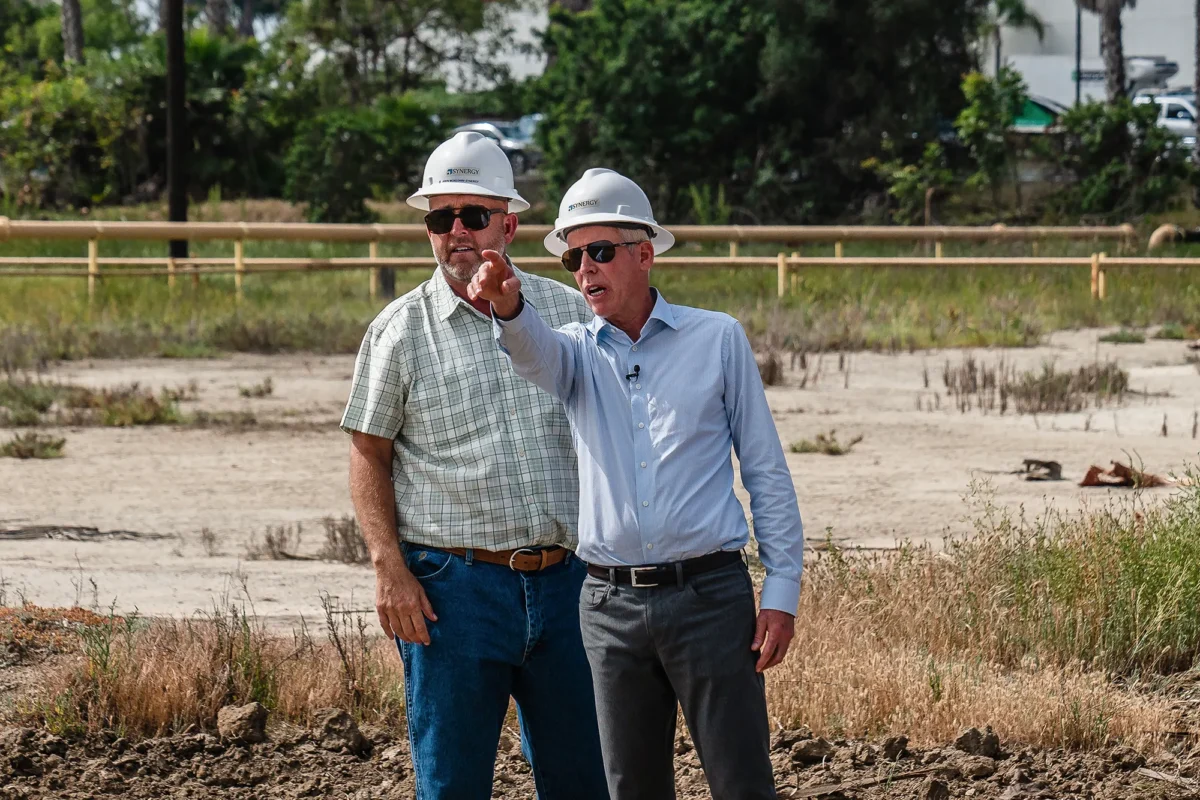
U.S. Energy Secretary Chris Wright traveled to the property, owned by Synergy Oil & Gas, on Wednesday with a message to Gov. Gavin Newsom: state policies are increasing costs for Californians, and the Trump administration will be challenging them.
Wright’s visit to the Synergy site comes just a week after a U.S. district court denied the U.S. Department of Interior’s request to stop enforcement of California’s setback law while a broader legal challenge is pending. Pointing to the deal, Wright said policies that limit oil and gas starve the state of jobs and “enfeeble” California.
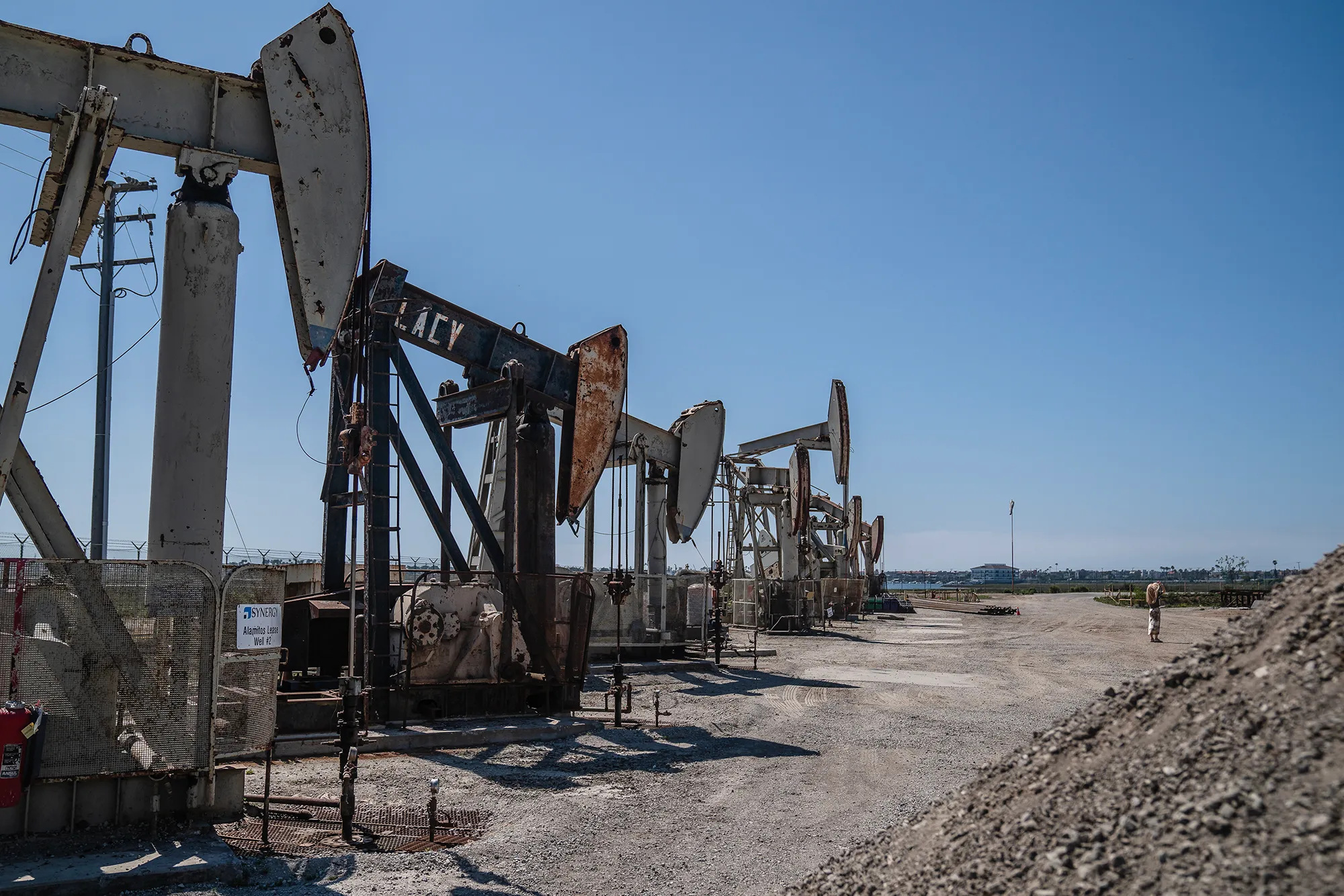
“When you make energy expensive by importing it and putting ridiculous regulations on it, you not only make it more expensive to pay your bills, but you make it so businesses that consume energy aren’t going to locate (in) your state,” Wright said, standing between lines of Synergy-owned oil jack pumps near coastal wetlands.
Wright’s visit points up the active fight on multiple fronts between California and the White House over energy prices, especially gasoline. The state’s gas prices are the highest in the nation, a gap that has widened in the wake of global oil market disruptions following U.S. military strikes on Iran.
“California’s gas prices were stable – and below $5 a gallon – for about two years before Trump launched his reckless war on Iran that closed the Strait of Hormuz and sent crude oil prices through the roof in red and blue states,” said Anthony Martinez, a spokesperson for the governor. “Today, (Wright is) in California pointing the finger to distract from the fact that Americans have paid $10 billion more on gasoline since the start of this war.”
California’s setback law
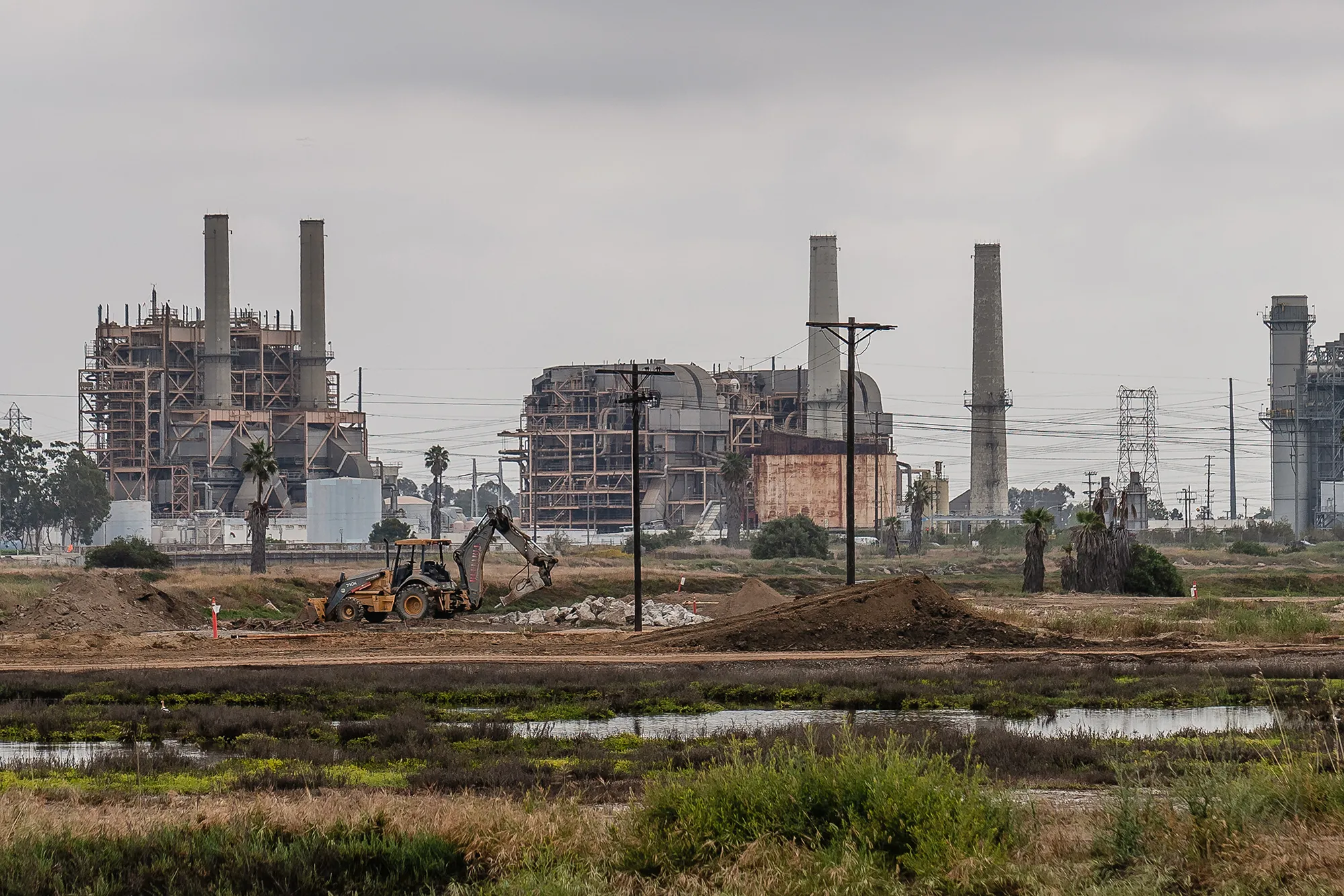
Los Cerritos Wetlands Authority, a state-local public partnership, began negotiating for Synergy to swap land with Long Beach when state law still permitted new oil wells. Synergy would be free to seek permits to drill on its new parcel of land, while Long Beach would acquire new public space.
But in 2024, after the deal was finalized, the state started enforcing SB 1137, a setback law banning new oil wells within six-tenths of a mile of homes, schools and other populated areas. That has made it nearly impossible to get permits, said Synergy owner John McKeown. The site where Wright spoke should be capable of extracting 6,000 oil barrels daily, McKeown said; it is only producing 100 barrels because of state limits.
“What I’m trying to do is save 35 employees, and I’m trying to produce (the oil) we own,” he said on Wednesday.
The chair of the Los Cerritos Wetlands Authority, Kristina Duggan, is also a Long Beach councilperson. She said the setback law harms city finances; Long Beach gets 8.5% of local revenue from some oil production, funds designated for coastal infrastructure.
“We have wells off of the coast of Long Beach on our oil island where we can’t drill new wells, and it is so far from sensitive areas,” Duggan said. “It really makes a difference. We rely on oil production for revenue in Long Beach.”
Earlier this year, the Trump administration sued California over the setback law, arguing it illegally blocks business that the federal government oversees. The administration cited two land management laws, the Mineral Leasing Act and the Federal Land and Policy Management Act, that authorize public lands for oil, gas and coal development.
While the lawsuit is pending, the U.S. Department of Interior requested a preliminary injunction that would bar the state from enforcing the setback law. A U.S. district court judge denied that request, and called California’s setback law “reasonable environmental regulation” that doesn’t bar alternative methods of accessing oil in the state.
The U.S. district court judge said the U.S. Department of Interior has so far not demonstrated it’s likely to succeed in proving the law conflicts with federal law.
The judge is also weighing whether to let community groups, represented by Earthjustice, and the Center for Biological Diversity to intervene in the case.
The setback law’s reach extends beyond private landowners like Synergy. According to the U.S. Department of Justice, it would make invalid about a third of federally authorized oil and gas leases in California.
The setback in California “has absolutely nothing to do with public health,” Wright said on Wednesday. “These setbacks get set at the number that will kill the industry.”
Newsom caught in the middle
The setback law is just one front in a wider political battle that has put Newsom in an increasingly difficult position.
Newsom has sought to blame the White House for gas price increases, arguing that Trump’s actions are responsible. At the same time, he has pushed back against growing criticism that California’s own environmental regulations are contributing to the cost of fuel. But his administration’s actions tell a more complicated story.
Oil companies have shut refineries in recent months, causing the state to lose nearly 20% of its refining capacity. In response, California has increasingly relied on importing more crude oil and gasoline. The governor last year orchestrated a deal to boost production in California’s oil-drilling hub of Kern County. The California Energy Commission also quietly set aside a law that gave state regulators the power to cap refinery profits and penalize oil companies for price gouging.
Newsom in 2024 pushed to delay parts of the oil well setback law, arguing regulators needed more time to implement it. Lawmakers approved a compromise extending the deadline to monitor wells near homes and schools for leaks by three and a half years, to July 2030, while keeping the core buffer-zone restrictions in place. Newsom signed the measure, delaying leak detection at oil wells.
Rising federal pressure
The Trump administration has shown no interest in giving Newsom room to maneuver. It’s pushing to expand oil production in California, including plans to revive offshore drilling along the coast at the site of the 2015 Refugio oil spill, where a pipeline, now owned by Houston-based Sable Offshore Corp., ruptured.

Wright invoked the Defense Production Act to order the restart of operations — overriding local courts — arguing the oil was ‘vital to our national security and defense. Attorney General Rob Bonta has sued Wright arguing he overstepped his authority.
Wright said he hopes to meet Gov. Newsom in the next few weeks to make his plea for more oil production in the state.
A blueprint for wider battles
The stakes of that legal confrontation extend well beyond a single pipeline.
Even if the Sable project itself wouldn’t meaningfully change California’s oil supply, legal experts say the bigger story is what precedents the fights establish. The case could open a window on how far federal officials can go in using national security or emergency powers to override state authority — not just for pipelines, but for new oil development more broadly.
“I have no doubt they’re going to now extend it to try to apply the same theory about a national emergency, about national security, to leasing everywhere,” said Deborah Sivas, a Stanford environmental law expert. “They’re going to use that same rationale.”
But Ethan Elkind, a climate law expert at UC Berkeley, said that strategy faces long odds in California, where the politics of oil and gas have shifted sharply against new development.
“California has really been going in the opposite direction,” said Elkind. “The idea of trying to really expand oil and gas production in the state, is really at odds with where the politics are and the economic realities are in the state at this moment.”
In Long Beach, work to remove old wells on Synergy Oil & Gas property continues. For Kristina Duggan, the city councilmember, the larger battles are secondary. She’s still watching the city’s bottom line.