

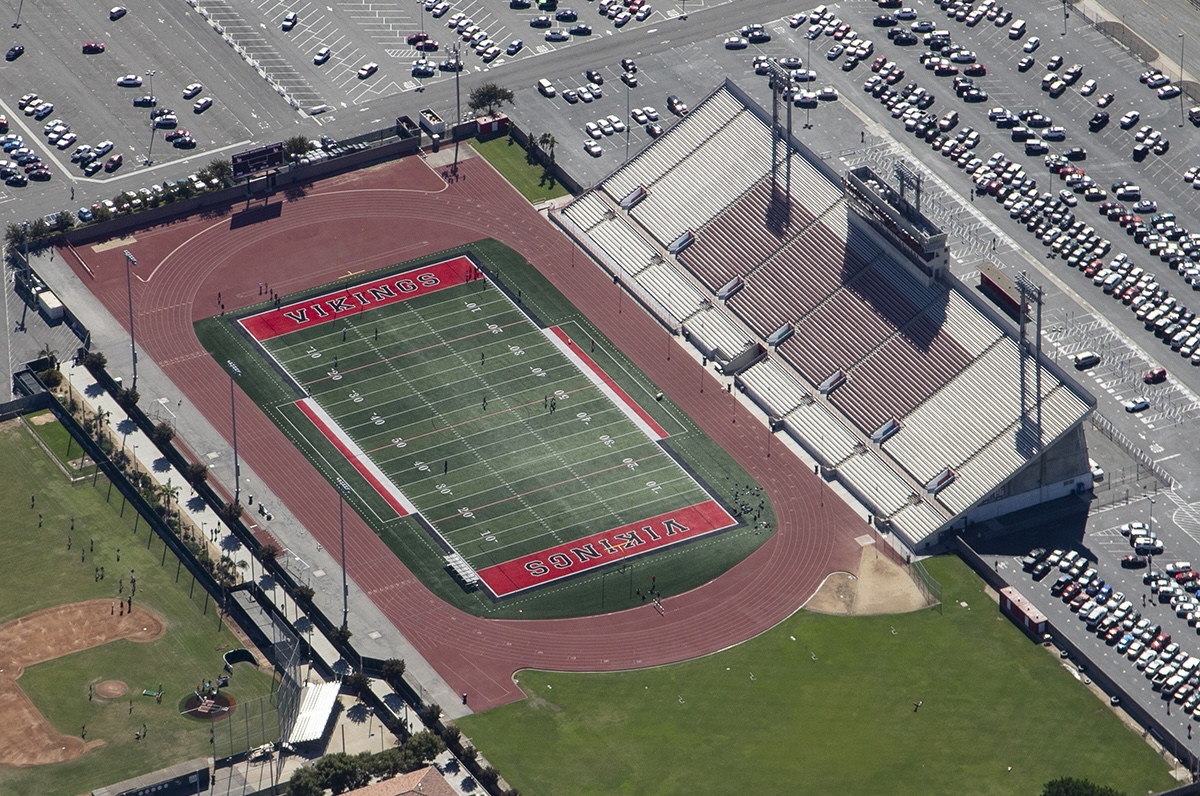
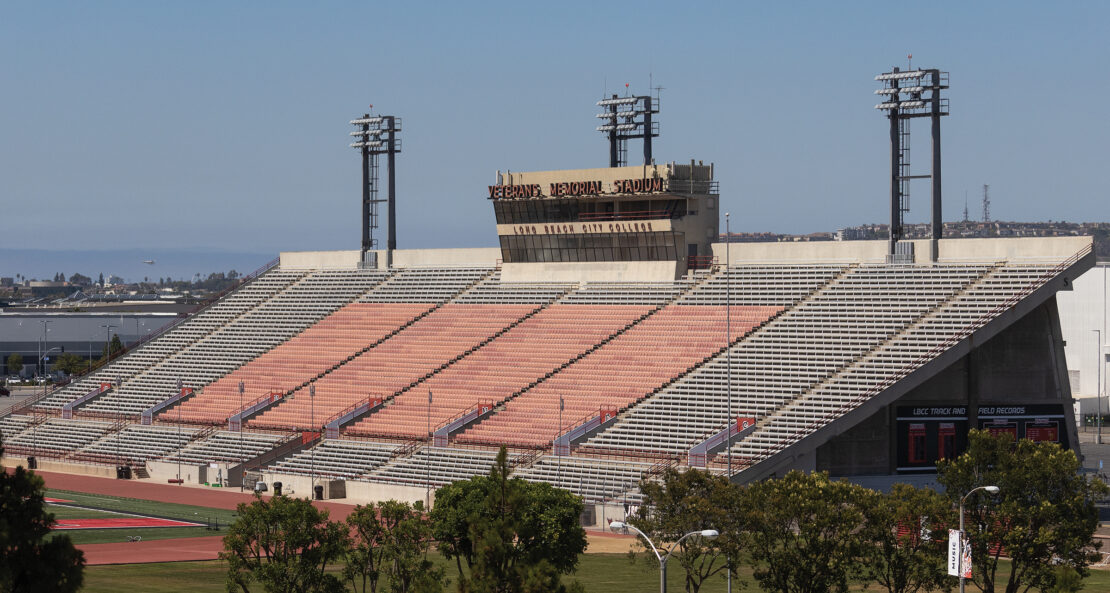
After 70 years as the epicenter of Long Beach football, the iconic Veterans Memorial Stadium will be demolished later this month to make way for a modern replacement, slated for completion in 2029.
The $250 million transformation will have an 18-acre footprint and include a new stadium that pays homage to the original as well as a massive sports complex featuring a 2,500-seat arena, fields for football, soccer and track, basketball and volleyball courts, athletic training and rehab facilities, offices, kinesiology classrooms and a hall of champions. The project is funded by Measure LB, an $850 million bond measure that finances LBCC construction.
The leveling of Vets Stadium closes a celebrated chapter of Long Beach history. The stadium hosted high-profile local and national sporting events, served as a movie set for Evel Knievel and became woven into the fabric of the city. It has accommodated countless graduations, and Long Beach City College and numerous area high schools will have to relocate their commencement ceremonies during construction.

From its inception, Vets Stadium was intended to be a monument for the people of Long Beach, living and dead. During World War II, seventeen homesick soldiers stationed in the South Pacific wrote a letter home to Long Beach, which appeared on the front page of a 1945 edition of the Press-Telegram. As alums of Poly and Wilson high schools, the soldiers implored the city to build a stadium and dedicate it to those who “went beyond the final yard marker” — including their own classmates who had died.
They enclosed $75 as their contribution to the proposed stadium, and the city took it from there, passing a $550,000 bond measure to fund construction. By 1950, the city had erected a colossal arena (significantly over budget, forcing the city to dip into its special projects fund) with 12,500 east-facing seats, the Press-Telegram reported. It boasted a double-decker press box, equipped with a snack bar and its own toilets — a state-of-the-art facility meant to attract visitors to Long Beach, according to a 1951 publication in the public library’s archives.
“The sheer capacity of it was such a big deal,” and it became a significant regional stage, said Mike Guardabascio, sports reporter and editor at The 562 and author of the book “Football in Long Beach.”
The stadium’s size meant it could accommodate state track and field championships, college and pro football, motorcycle racing, roller derby and rugby. It became the site of holiday food drives, large-scale swap meets, Covid-19 vaccinations and the distribution of emergency sandbags.
Yet its defining identity has been the heartbeat of high school football. Even after Long Beach City College acquired the venue from the city for $1 in 1987, Vets was the home stadium for Poly High School’s powerhouse program.
Few events in Long Beach draw tens of thousands of fans, Guardabascio said. But high school football games had a magnetic pull, and spectators consistently sold out the stadium, he said.
In 2001, the country’s top-ranked high school football teams matched up in Long Beach: Poly vs. De La Salle in what was billed as the Game of the Century. Over 17,000 people poured into Veterans Stadium for standing room only, and many more tuned into the first nationally televised high school game.
The noise coming from the stands was deafening — “like nothing else that you would ever hear,” Guardabascio said. He was a senior in high school at the time and remembered how much attention was dialed into the game. “You just had that feeling of Long Beach being the center of the world,” he said.
In the years since, as other large sports arenas became options, Vets Stadium became less of a go-to choice in the region, Guardabascio said. And the structure is now crumbling — pieces of concrete are falling off the back; a hole in the floor of the press box bathroom offers a window to the ground several stories below, he said.
The rebuild could reassert the city as a central player in the wider sports scene, Guardabascio said. He pointed to the exceptional sports facility upgrades Long Beach City College has already executed, including its pool and beach volleyball courts.
Still, the demolition of a symbol for the city weighs heavily on some. “Our whole football history runs through that place,” Guardabascio said. “Everyone who grew up caring about sports and football in Long Beach has memories of being there.”
Football fans can watch the Poly football team’s final game at Vets Stadium on Friday, Aug. 28, and the LBCC Vikings’ last stadium game on Saturday, Aug. 29. LBCC also invites community members to attend a celebration and groundbreaking ceremony on Wednesday, Sept. 9.