

Get this weekly briefing in your inbox each Monday by signing up at LBPost.com/newsletters.
It could soon take crews more than a minute longer to respond to structure fires in neighborhoods around the Colorado Lagoon. That’s the topline conclusion in a city memo outlining the consequences of removing the fire engine from Station 14, which sits right next to the lagoon on Colorado Street.
The area’s City Council member and the firefighters union are already using that conclusion as ammunition to campaign against the cut, which the mayor and city manager argue is necessary to help close a $58 million deficit.
They’re hoping to ease the blow by moving a paramedic ambulance into the station to replace Engine 14 — which mostly responds to medical calls anyway. But because that ambulance is already stretched thin with 12-13 calls per shift, it’s still going to take it almost a minute longer on average to arrive at medical calls than Engine 14 would, according to the Fire Department’s projection.
The new memo also underscores that the burden of a single engine closure rarely stays contained to one neighborhood.

When engines from nearby stations 4, 8 and 22 are pulled to cover calls in Engine 14’s former district, those stations in turn draw coverage from engines as far away as stations 17, 10, 2 and 5. With the department’s remaining engines already responding to more than 15 calls per 24-hour shift, officials said they are also considering removing lower-priority calls from dispatch protocols altogether — a step the memo characterizes bluntly as a systemwide service reduction, separate from the effects of losing Engine 14.
Along with proposed cuts to libraries, shaving from the Fire Department’s budget may be the most politically fraught move the city is pursuing to close its budget gap.
Councilmember Kristina Duggan has asked for possible alternative funding sources for the fire station, warning that losing Engine 14 would have citywide consequences.
Fire Chief Dennis Buchanan has said he does not want to make the cuts but understands the city’s financial constraints, and Mayor Rex Richardson has floated using port funding to restore other Fire Department positions and eliminate a rotating engine closure elsewhere in the budget, even as he has defended the broader package of reductions as necessary.
“We know that budgets are cyclical,” Richardson said, adding that recent mayors and councils have each had to make similar calls in lean years.


Quick sips of the latest news
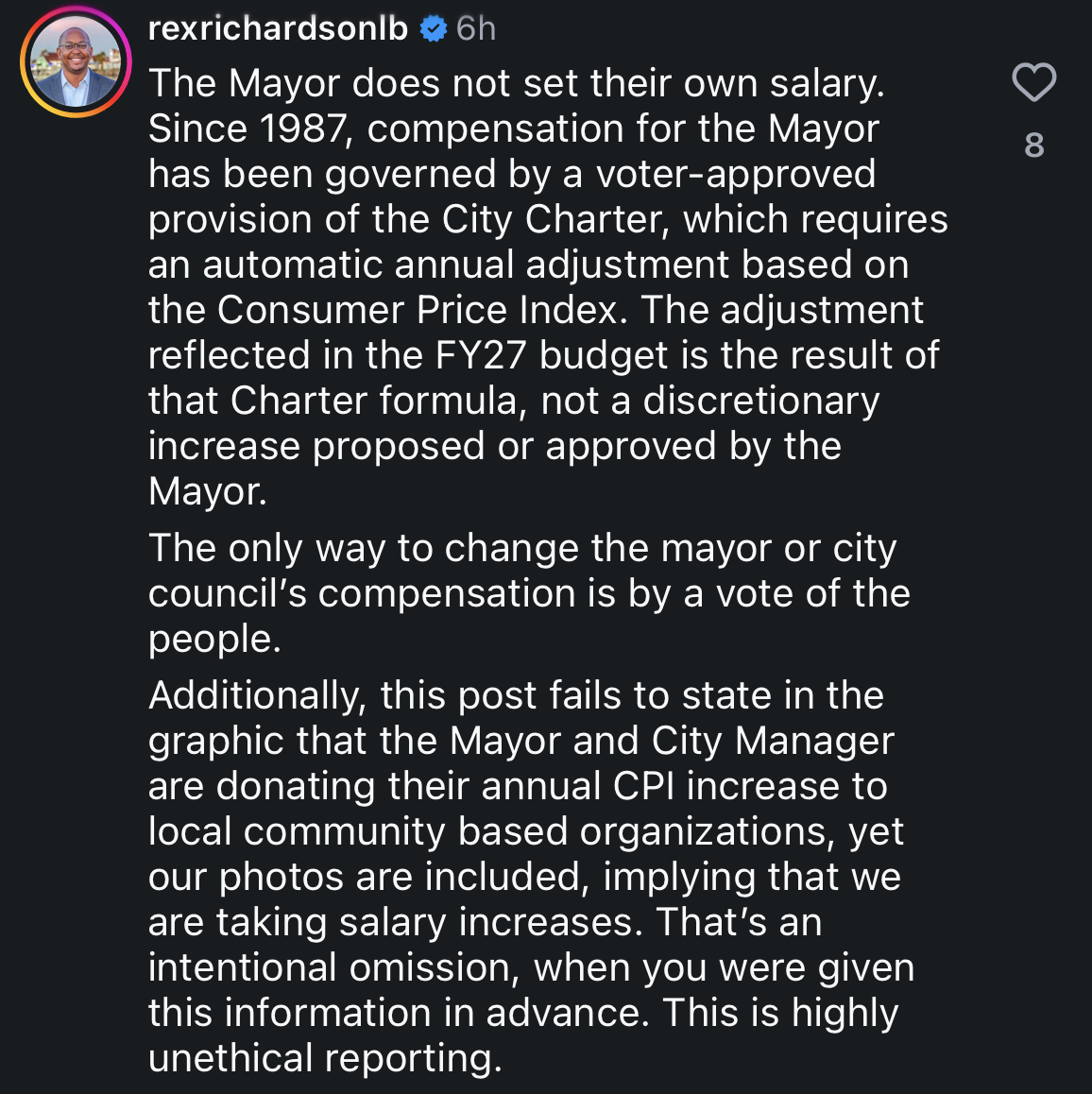
- Bad vibes: The looming budget cuts have put a harsher light on some of the city’s past spending decisions. There’s been backlash over the cost of its Vibe City marketing campaign, and NBCLA has fired off a few articles targeting City Hall, including one that takes aim at regular pay raises for the mayor, city manager and city council. The mayor hit back at the TV station, calling it “highly unethical” for omitting key context from an Instagram post about the raises.
- The cost of Public Works: As part of budget season, the City Council on Tuesday will hear a presentation by the Public Works Department. And the three-member Budget Oversight Committee will hear a presentation on the budget for the city’s Economic Development Department. You can review the city’s entire proposed budget here.
- Getting into the battery business? Long Beach’s Climate Resilient and Sustainable City Commission is asking the City Council to authorize a study on whether to build an electric vehicle battery reuse and recycling hub, arguing the project could turn a byproduct of the port’s electrification push into new revenue and jobs for the city.
The commission says the Long Beach Container Terminal, which has invested about $2.5 billion in port electrification — including more than 100 autonomous battery-powered vehicles and 69 electric cranes — currently ships dead batteries 400 miles to Nevada for disposal. Instead, commissioners argue, the city could act as a broker, collecting end-of-life batteries, screening them for potential reuse and aggregating volume to negotiate better rates with recyclers, while charging collection fees. They think the plan could generate $860,000 to $3.2 million annually and create 10 to 15 jobs in West Long Beach.
- Farewell 2-hour free parking: Starting Oct. 1, the payment structure at City Place public parking garages in downtown Long Beach is set to change. Only the first hour will be free — previously the first two were — and after that it will be $2 per hour, as opposed to $2 per 30 minutes. The daily max of $12 stays the same, as will monthly permits and event rates. Officials say the difference will bring in $120,000 more a year, meant to cover maintenance costs at nearby amenities like the public restrooms at Harvey Milk Park.
- Higher health-inspection fees: Long Beach’s Health and Human Services Department is asking the City Council to raise more than 300 food safety and health inspection fees to close a growing funding gap, reversing course on a 2025 directive that had called for exploring fee reductions. In an Aug. 25 memo, Health Department Director Alison King wrote that the city’s Environmental Health Bureau, which oversees roughly 2,907 permitted food facilities and more than 1,500 temporary food operations with a staff of about 21, is recovering only 57% of its actual costs under the current fee structure. That shortfall, worsened by a 2022 council-imposed cap that limited cost recovery to 60% during the pandemic, has left the city’s Health Fund absorbing an increasingly unsustainable deficit.
Helpful/interesting links
- Here’s Tuesday’s City Council agenda — and a Zoom link to attend virtually. It starts at 5 p.m.
- The city’s Día de los Muertos celebration is back this year after the spectre of immigration enforcement prompted its cancelation in 2025.
- A loophole in Long Beach’s new power plant tax may have blown a $12 million hole in its budget
- How does “LBS Financial Pyramid” roll off your tongue? Long Beach State just unveiled the new signage for its signature sports arena.
- West Nile Virus is surging in Long Beach