

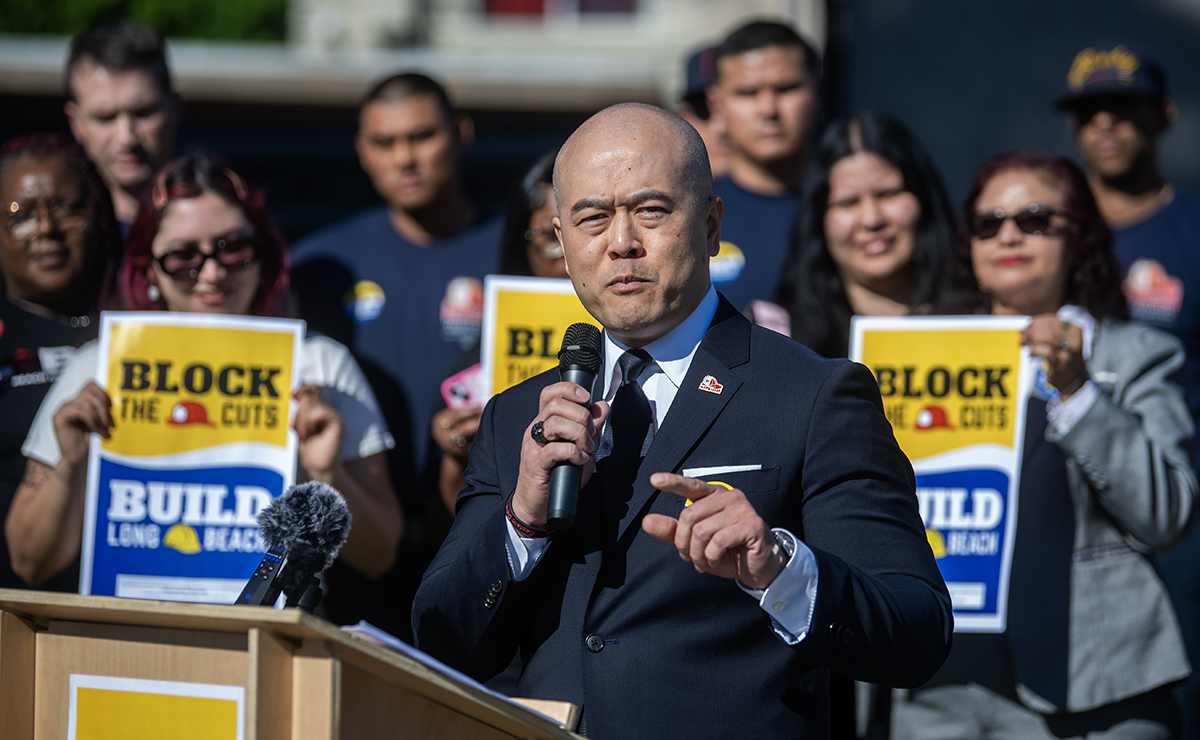
The union representing Long Beach firefighters, in conjunction with pro-housing activists, launched a campaign on Thursday to place a special parcel tax on the November ballot that, if passed, would raise $70 million for public safety, affordable housing and street repairs.
In the coming months, volunteers will be going door-to-door and attending public gatherings to obtain the 28,000 signatures necessary to put it to a vote.
Supporters say the revenue from the tax, charged at 15 cents per square foot of qualifying homes and 45 cents for industrial parcels, would help shore up the city’s fraying network of fire stations, ambulance crews, streets and alleyways, and sluggish production of affordable homes.
Proceeds of the tax would be deposited into a special fund and used on specific programs and capital projects: At least 35% would go to paving new roads, sidewalks and pedestrian safety measures; at least 10% for new fire stations, engines, ambulance and medical equipment; at least 30% for affordable housing production, homeownership and homelessness prevention programs.
Another 25% will be set aside to avoid any potential cuts to core city services, including the city Health Department, which is wrestling with federal funding reductions.
It comes as the city is facing up to an $80 million deficit in 2027 after climbing debts in 2024 and 2025 that, coupled with declining revenues, forced departments to exhaust reserves meant to cover future shortfalls. City officials have since said that this may result in cuts to service.
City management itself considered asking voters to pass a new tax measure but abandoned the idea after a poll showed the public had little appetite for it. Obtained by the Post through a public records request, the poll found that 80% of respondents rejected the idea of an eight-cent parcel tax, even if the money is needed to cover services — street repairs, police and fire — that might otherwise be lost.
But this tax is slightly different, proponents say, as the majority of Long Beach residents would be exempt from having to pay it.
It would instead apply to the 26% of Long Beach home and condo owners whose households make more than $250,000 a year. It would not apply to renters, and proponents say protections are in place to prevent landlords from passing on the costs.
The 45-cent tax, meanwhile, would apply to factories, large movie or production studios, food processing plants, open storage and warehouses inside city limits. Certain government-owned and nonprofit properties would be exempt.
Backers began making their case to the public Thursday:
Since 2021, the city has seen a quarter of the homes — including 13% of affordable units — the state recommends it needs to build by 2029 to meet public demand, according to Long Beach Residents Empowered, or LiBRE.
Even if homes are built, the facilities serving them are aging far past their intended use.
Speaking outside Fire Station 7, union president Lamont Nguyen said firefighters there answer at least 20 calls in a typical 24-hour shift. Each time, they return to a station built in 1940, ushered under the Works Progress Administration by President Franklin Roosevelt with only minor renovations since.
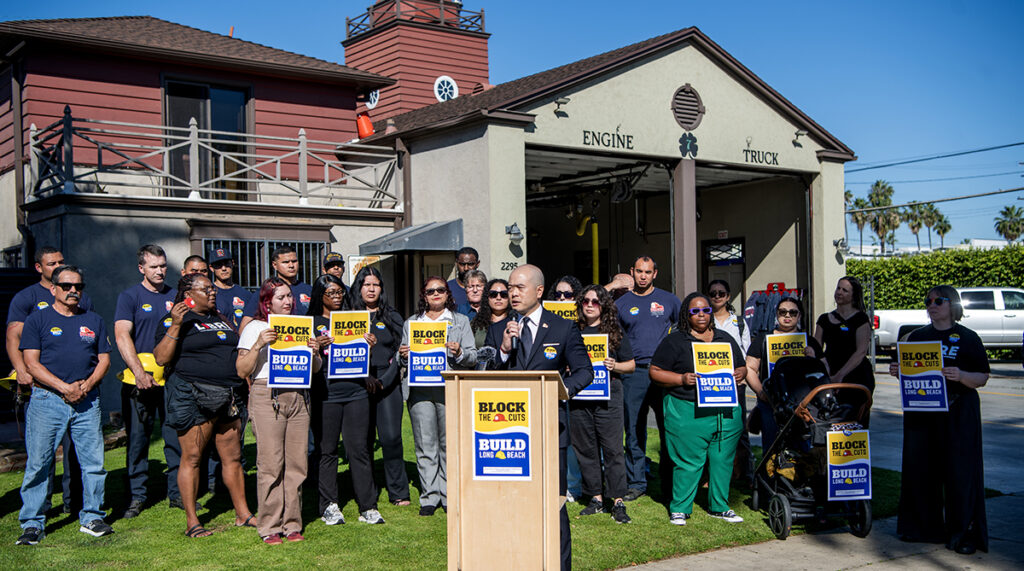
Stations are replaced, he said, far too late and at the risk of people’s health, such as the 1930’s era Fire Station Nine’s closure in 2019 and eventual replacement over issues of black mold.
“That was forced upon the city because of the conditions,” Nguyen said. “Our members had to finally step up and say, ‘I’m sick, this black mold is actually causing some major issues.”
They say the measure’s strict limits on its use are a reflection of what they feel is an opaque spending by the city of Long Beach of Measure A, a sales tax passed in 2016, which nets $60 million annually for many of the same purposes.
Nguyen said he wanted to ensure the money is spent as intended, and not diverted elsewhere by the city.
“There’s a lack of transparency on it,” Nguyen said. “I can go up to ten voters right now, and seventy-five percent of them will tell me, ‘Yeah, I have no idea what that money is going to.’”
While handled by the city, the new tax’s use would be reviewed by an eight-person committee composed of area experts in each field. Members would be Long Beach residents, could not already hold public office and are confirmed by the City Council to either two- or three-year terms.
You can read the full ballot initiative here.