By: Jeff Kurtti
In 1989, Disney premiered The Little Mermaid, its first major animated hit in more than two decades. With this instant classic, Disney animation entered a new golden age, which would later be referred to as the “Disney Renaissance.” Not only did this film turn out to be hugely consequential for Disney, it would change the fortunes of the Broadway musical form and Broadway itself, while also paving the way for its Oscar®-Winning follow-up: Beauty and the Beast.
On the night of The Little Mermaid’s premiere at Walt Disney World, a young screenwriter, Linda Woolverton, was introduced to the film’s songwriters, composer Alan Menken and lyricist Howard Ashman. Woolverton had just turned in a draft of a non-musical screenplay of Beauty and the Beast, and that night began the trio’s collaboration to make the film a musical. “I was overcome with excitement to think how this amazing musical team would transform Beauty and the Beast,” she recalls.
Beauty and the Beast, in turn, transformed the medium of animated films and introduced the Broadway “book musical” – where characters convey plot and emotions via song – into the mainstream movie form. The next several Disney animated films continued this Broadway aesthetic. “We knew that what we were bringing to the animated musical was something closer to the process of writing stage musicals than to the music video format of 1980s movie musicals,” Menken says.
The animated feature Beauty and the Beast met with rave critical reviews–but one stood out. At the end of 1991, the tough chief theater critic of the New York Times, Frank Rich, announced that “the best Broadway musical score of the year” had not premiered on a stage – but in the animated film Beauty and the Beast. From that observation, a new Disney Company was born: Disney Theatrical Productions. Its first project? A stage adaptation of Beauty and the Beast.
In 1994, BEAUTY AND THE BEAST opened on Broadway and was an overnight success. The stage adaptation allowed the creative team to expand the score and deepen the story and characters. The stunning songs “Home”, “If I Can’t Love Her”, and – eventually – “A Change In Me” were added. Among many story changes, Woolverton made one ingenious alteration to the enchanted objects. In the film, they had been fully transformed into inanimate objects from the beginning. Onstage, they were still partially human, adding heartache to their cruel metamorphosis and solving the practical problem of scale for adults playing tiny objects.
The original Broadway production of BEAUTY AND THE BEAST received nine Tony Award® nominations, including Best Musical, winning one. The production ran for a remarkable 13 years and remains among the longest runs in Broadway history. It continued its success worldwide; the Broadway production was replicated in 34 productions in 16 countries on six continents, and the script has been licensed to professionals and amateurs an extraordinary 60,000 times.
But the show’s impact is greater still: by the time the Broadway musical opened in 1994, the Disney animated musicals had revitalized the obsolete book musical form and, ever since, generations have carried their love of movie musicals to stage musicals, paving the way for shows like DEAR EVAN HANSEN and HAMILTON to find commercial success. That’s due, in no small part, to Woolverton, Menken, Ashman, and the creative voices behind the original production of Beauty and the Beast.
In the decades since, Woolverton found enormous success with her work on the screenplays The Lion King, Mulan, Alice in Wonderland, and Maleficent, and co-writing the Broadway smash AIDA. The works that Menken and Ashman collaborated on, too, still have an outsize presence in film and stage musicals. All three of their Disney animated musicals were adapted into live-action remakes; and both ALADDIN and BEAUTY AND THE BEAST are among the Top 15 longest runs in Broadway history. The 2019 revival of LITTLE SHOP OF HORRORS continues its smash off-Broadway run.
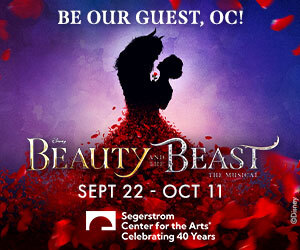
What makes this brand-new production of BEAUTY AND THE BEAST so special? Menken and Woolverton, two of that trio of creators, continue to evolve and develop the show, alongside original Broadway team members like director/choreographer Matt West. New dance arrangements, new choreography, and new scenes continue the show’s evolution, creating a theatrical experience that is faithful to the original while also breaking new ground in technology and modern storytelling. In this way, the award-winning collaboration of Woolverton, Menken, and Ashman endures to this day, leaving an indelible mark on the history of Broadway.