
Sponsored by Curtin Maritime
Curtin Maritime’s $200 million bet on the future of harbor tugboats
The Long Beach marine contractor is developing eight battery-electric tugboats designed to match the performance of diesel vessels without producing onboard exhaust during normal operations. Founder Martin Curtin believes the technology could change how ports operate nationwide.
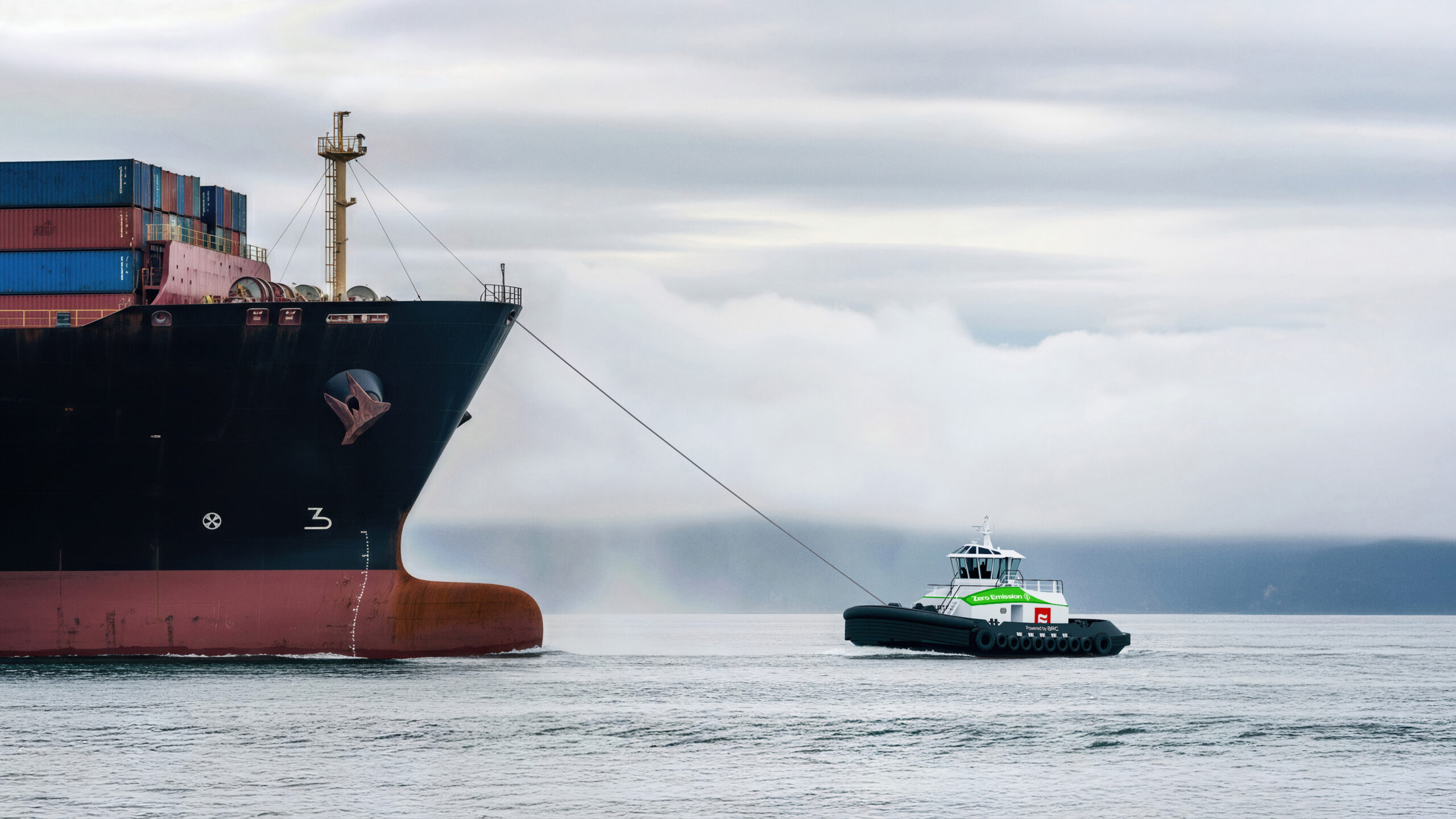
Rendering of Curtin Harbor Services’ first fully electric tugboat, Tuuli C, assisting a container ship. The vessel is progressing through final testing and regulatory approvals ahead of entering commercial service.
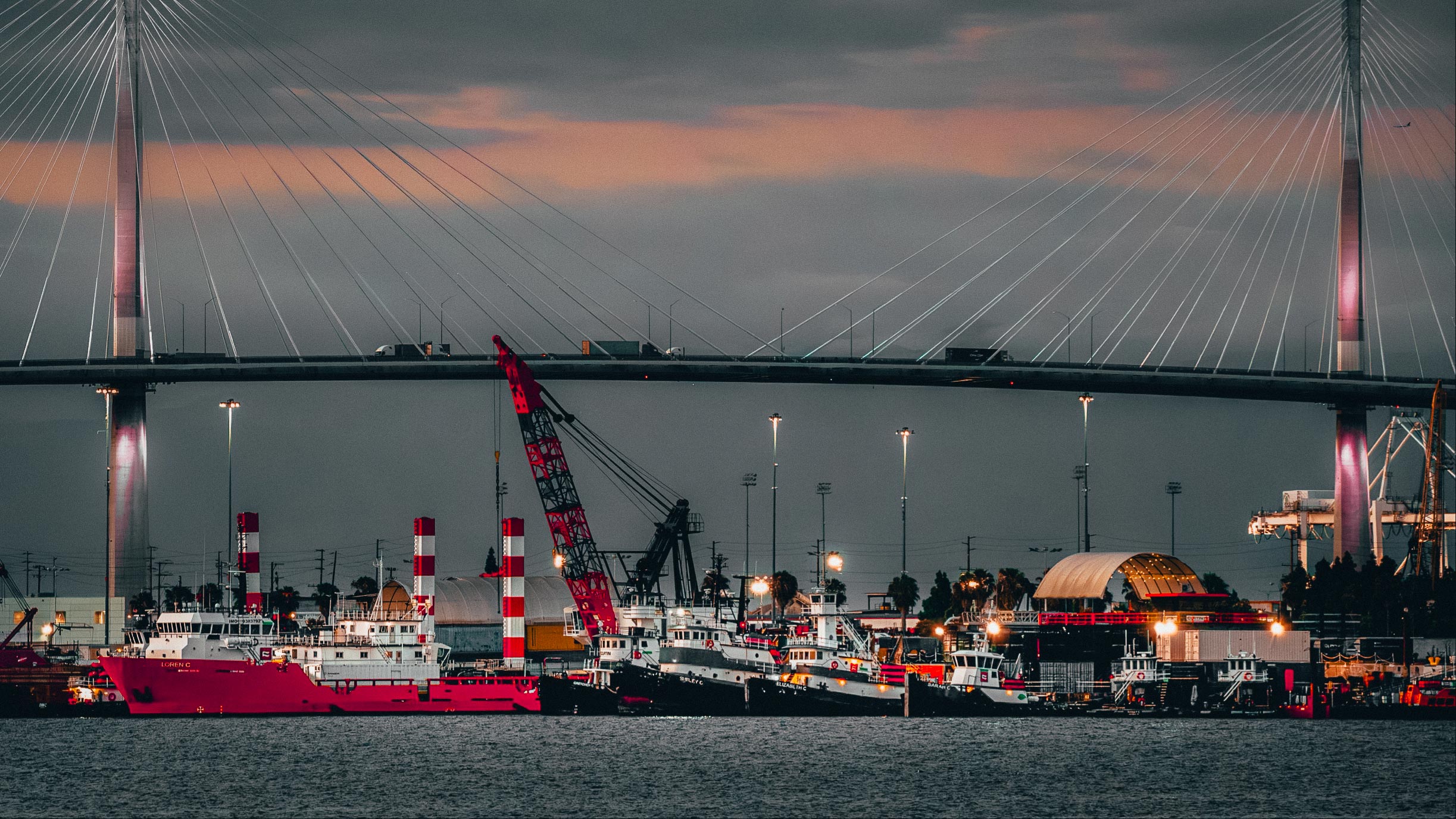
At Curtin Maritime’s headquarters on the docks of the Port of Long Beach, a conference room overlooks the sheltered waters of Pier T.
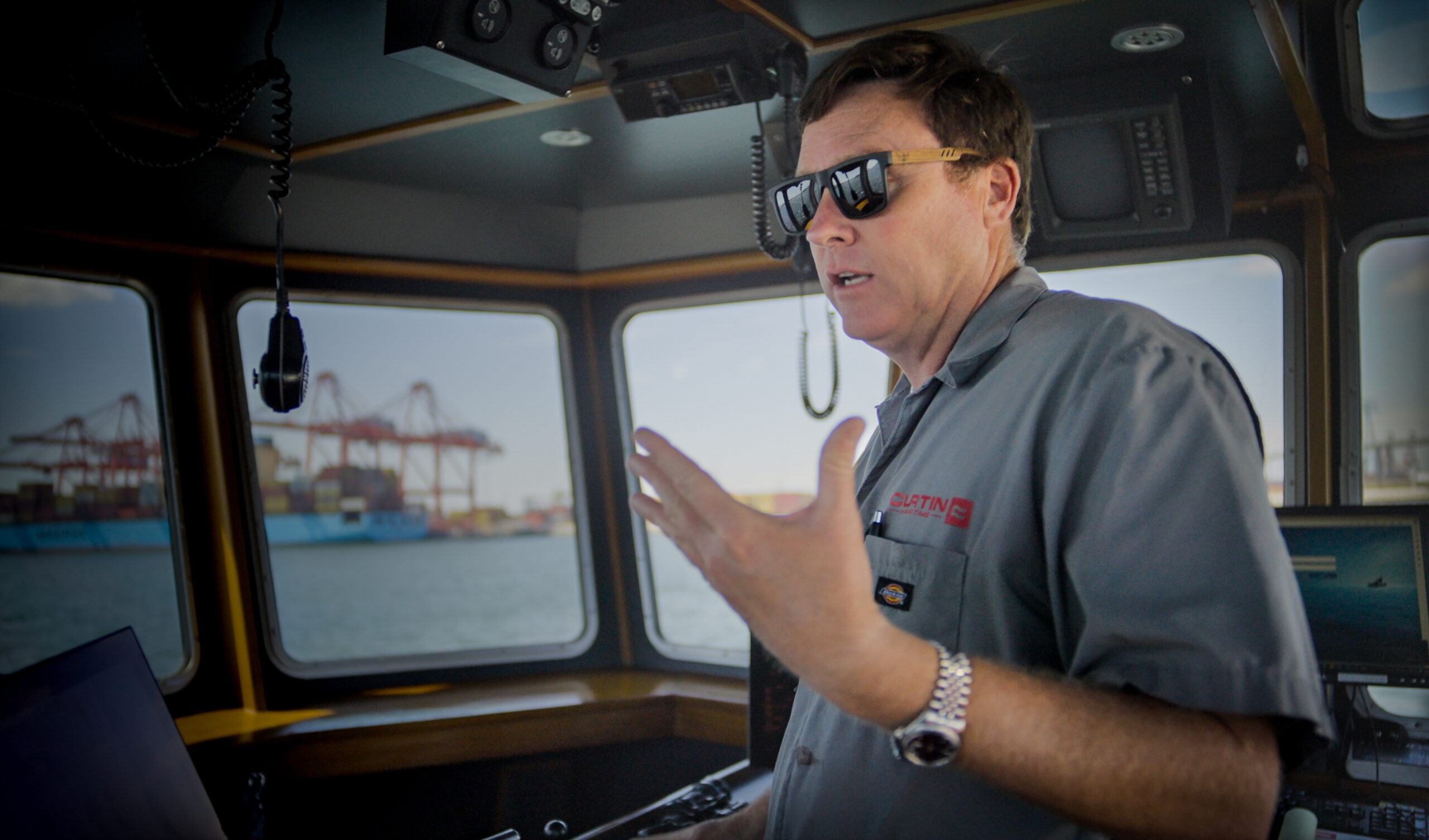
Martin Curtin, who founded the company 29 years ago, arrives in mechanic’s coveralls. Ask him why he’s investing $200 million in a new generation of eight electric tugboats and their charging infrastructure, and he reaches for a calculator.
“My whole world is problems and solutions,” he says. “That’s it.”
He punches in figures for the company’s hybrid dredges, to use one example: A conventional dredge might burn 2,000 gallons of diesel fuel per day, while Curtin’s hybrid system uses about 850. At $5 a gallon, the difference would exceed $2 million annually if the vessel operated every day.
One dredge, one day of diesel
Less diesel burned, less exhaust
The investment makes business sense.
But Curtin’s relationship with the ocean began long before he had a business to run. He grew up on Catalina Island, where boats are a way of life, and knew early on that he wanted to spend his life working on the water. His parents were entrepreneurs, and he grew up around people accustomed to building things and making a living on their own terms.
Today, Curtin lives in Long Beach with his wife and children. He gives to local causes, supports workforce training, and has supported youth and college sports. His connection to the ocean and the community around him remains personal, and he believes reducing pollution from the industry that has given him his livelihood is simply the right thing to do.
His life’s work has focused on figuring out how to accomplish that in an industry long dependent on high-horsepower diesel equipment — machinery powerful enough to excavate the ocean floor or maneuver cargo ships the length of a skyscraper on its side.
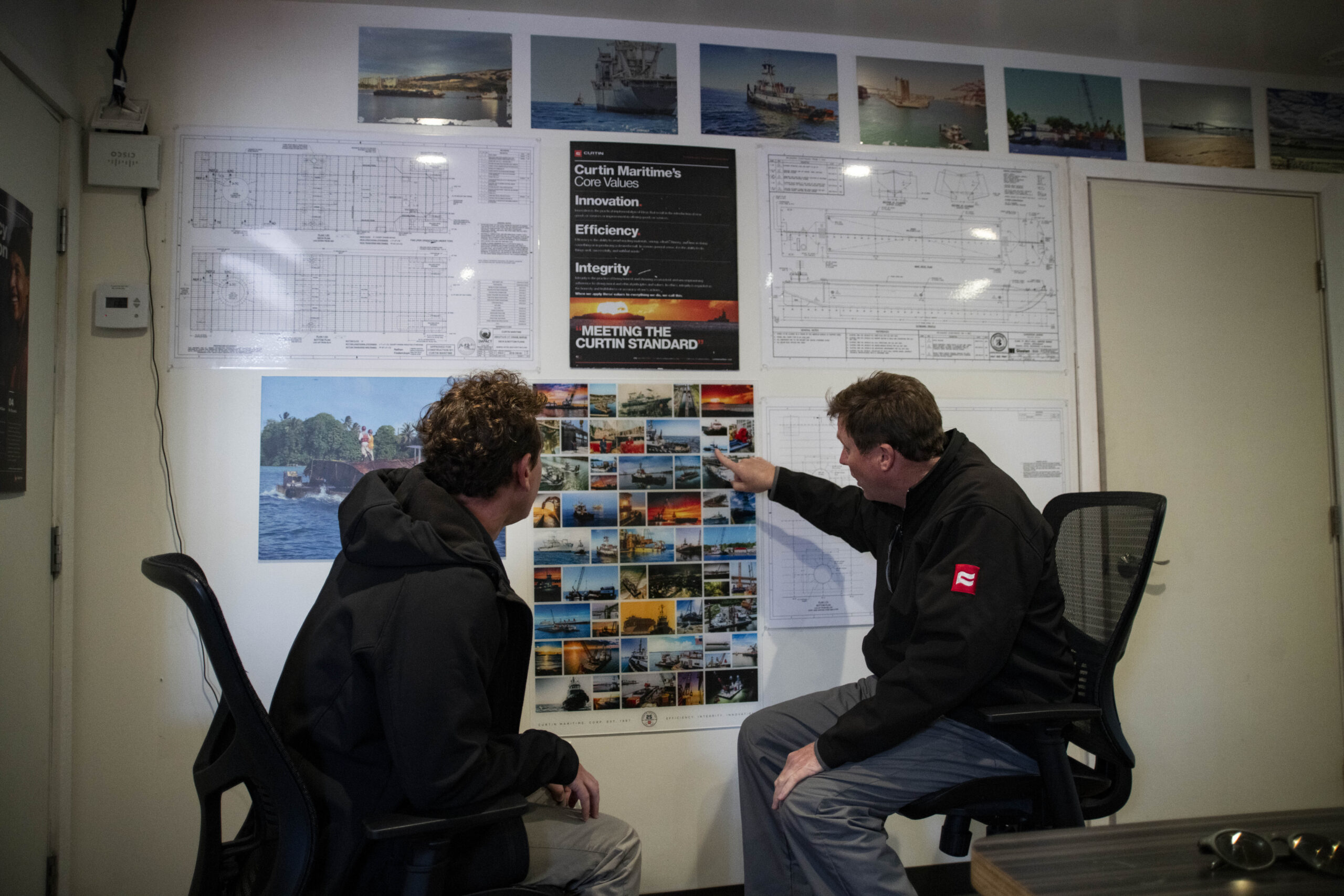
Curtin isn’t waiting for someone else to figure out how to build cleaner vessels. The walls of the company’s headquarters are covered with intricate drawings of the vessels and machinery used in its operations — evidence of a business accustomed to designing its own solutions.
His latest undertaking is also his most ambitious: Through Curtin Harbor Services, the company is developing eight purpose-built, battery-electric harbor tugboats. Powered by 6-megawatt-hour battery systems charged from shore, the vessels use entirely electric propulsion and produce no onboard exhaust during normal operations.
The $200 million program, which includes both the eight vessels and their charging infrastructure, is intended to establish a model for cleaner harbor operations that could be replicated at major ports across the country.
The problem has a solution in Curtin’s mind, and he will put his money on the line to demonstrate it. “Innovation is what we do at Curtin Maritime. We love looking at problems and figuring out the best way to solve them and executing.”
“These ports aren’t going anywhere,” Curtin says. “We need the ships, we need the tugs, and we need the jobs. But we’ve got people living right next door who are breathing dirty air. If we can do the same work without putting diesel exhaust into their neighborhoods, why wouldn’t we? That’s the problem we’re solving.”
A different way of building a maritime company
Curtin Maritime started in 1997 with a single tugboat. Nearly three decades later, the Long Beach-based company employs more than 500 people and provides marine transportation, dredging, salvage and construction services essential to maritime commerce.
Its operations extend across the country, taking on projects that require enormous equipment and specialized expertise. Curtin’s work ranges from towing rockets for aerospace companies to dredging shipping channels for the U.S. Army Corps of Engineers.
It’s a capital-intensive business, with equipment expected to perform under demanding conditions. Curtin calls dredging a “gladiator sport,” where the ability to bring sufficient equipment and capacity to a job can determine who wins the contract.
What distinguishes his company, he says, is its approach to designing machinery by combining technologies that already exist.
A shipyard might build the hull. A manufacturer in Japan might collaborate on a specialized crane. Curtin’s team brings the pieces together, drawing on the experience of the crews who will ultimately operate the vessel.
“We design, build, operate,” Curtin says.
That approach gives the company an opportunity to rethink established designs.
“How do we simplify this?” Curtin asks. “Where are other examples? Where did they go wrong?”
Cleaner equipment, without sacrificing performance
That philosophy has already reshaped Curtin Maritime’s dredging fleet.
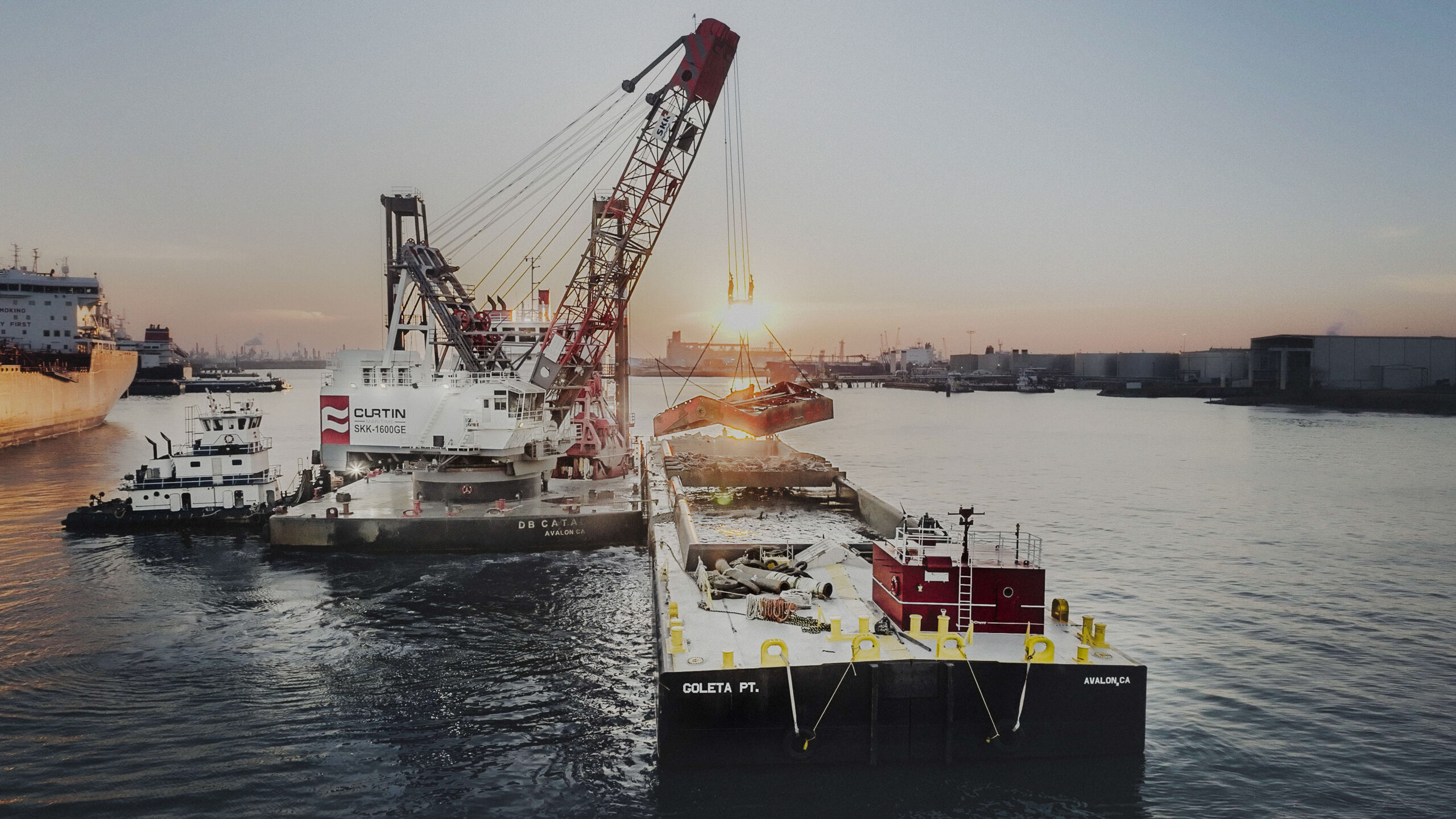
In 2022, the company introduced the DB Avalon, a hybrid dredge that uses battery storage and regenerative energy recovery to reduce fuel consumption. The larger DB Catalina followed in 2025, with a hybrid system that captures and reuses energy during dredging operations.
Both vessels can also operate without onboard exhaust emissions when connected to shore power.
The company has also introduced the Isla C, an all-electric dredge tender that supports its larger vessels.
Curtin says the fuel savings and operating efficiencies made the hybrid dredges financially worthwhile without government subsidies.
But replacing diesel-powered harbor tugboats with battery-electric vessels presents a different challenge.
The economics of an electric harbor
Harbor tugs perform one of the waterfront’s most demanding jobs. They maneuver enormous container ships and other commercial vessels through crowded harbors, guiding them safely into and out of berths.
They must deliver tremendous power on demand, operate reliably and remain available around the unpredictable schedules of international shipping.
Curtin Harbor Services is working with electric marine technology company Arc, shipbuilder Snow & Company and charging infrastructure provider Motive Energy to develop its new fleet.
Diesel and electric, same job
Diagram, not to scale. Both tugs are designed to do the same work; the race shows the goal, not speed. Cost figures from Martin Curtin. Per-tug estimates are Curtin’s preliminary planning assumptions.
The goal is to prove that electric tugs can meet the industry’s performance demands while eliminating onboard exhaust during normal operations.
But building a vessel that works is only part of the challenge. Making it competitive is another.
Curtin offers a comparison: An established tugboat operator might have a diesel vessel that’s 20 years old and fully paid off. Its original construction costs have long since been absorbed.
A newly built electric tug, by contrast, could cost approximately $25 million.
The older vessel has an immediate financial advantage, even if the electric tug offers environmental benefits and potentially lower operating costs over its lifetime.
Curtin Harbor Services expects those operating savings to be substantial. Under the company’s preliminary planning assumptions, annual maintenance costs for an electric tug could be about $150,000, compared with approximately $400,000 for a comparable diesel vessel — a reduction of roughly 60%.
The company also projects that each electric tug could replace approximately 140,000 gallons of diesel fuel annually with electricity. Its planning model assumes off-peak charging rates of about 15 cents per kilowatt-hour.
A model for other ports
The Port of Long Beach has spent two decades pursuing cleaner maritime operations through its Green Port Policy, reporting substantial reductions in air pollution even as cargo volumes have grown.
In June, the Port approved a $58.2 million clean-technology investment package through its SWIFT program, including support for six zero-emission and five cleaner harbor craft, along with other equipment.
For Curtin, projects like these illustrate the importance of collaboration among private operators, ports and regulatory agencies. Bringing battery-electric tugboats into widespread commercial service will require coordination with organizations such as the California Air Resources Board, the South Coast Air Quality Management District and the Port of Long Beach — not only to support cleaner technology, but to help establish the infrastructure and economic conditions needed for it to succeed.
The implications extend beyond Long Beach. If Curtin Harbor Services can demonstrate that electric tugs perform as well as their diesel counterparts, the vessels and the partnerships supporting them could provide a model for other major ports.
For Curtin, the technology itself is not the most daunting part. Batteries, electric motors and charging systems already exist. The challenge is bringing them together in vessels capable of doing some of the waterfront’s heaviest work.
For a company that began with a single tugboat, the next undertaking is considerably larger.
But Curtin has never been particularly interested in accepting the way things have always been done.