Steven and Victoria Mendoza were thrilled to be expecting their first child. For the first several weeks, their pregnancy was marked with morning sickness and routine checkups. But everything changed at their 20-week anatomy scan.
At the scan, they received devastating news: their baby boy had gastroschisis, a rare birth defect in which the intestines develop outside the body due to a hole in the abdominal wall. Alongside her son’s diagnosis, Victoria was also diagnosed with preeclampsia, a serious pregnancy complication marked by high blood pressure.
Specialized Support Begins
Victoria was immediately referred to the specialized care team through the High-Risk Pregnancy Programat the Cherese Mari Laulhere BirthCare Center at Miller Children’s & Women’s Hospital, where her pregnancy would be closely monitored by maternal-fetal medicine specialists—obstetricians who complete three extra years of training to care for high-risk pregnancies.
After Victoria and her son’s diagnosis, Victoria and Steven met with Annie Pettey, a fetal care coordinator from the Perinatal Connections Program at Miller Children’s & Women’s. The program supports families whose babies are diagnosed with medical conditions that require specialized care before, during and after birth. Whether the condition is relatively simple or highly complex, the care team provides personalized support tailored to each baby’s needs and each family’s situation.
Building a Care Plan and Emotional Support
The team includes the mother, her obstetrician, pediatric specialists, and other health professionals who work together to create a detailed care plan. Their goal is to ensure every baby receives the right care from day one—and that parents feel informed and supported throughout the process.
Annie helped organize Victoria’s care and guided the couple through the many decisions ahead, offering reassurance and clarity during an overwhelming time.
Victoria and Steven also met with a psychologist at Miller Children’s & Women’s, who offered a safe space to share their hopes and fears and provided tools to help them navigate the emotional challenges of their son’s diagnosis. The support helped them feel heard, understood, and more equipped to face the journey ahead.
A Sudden Turn and Emergency Delivery
As Victoria’s pregnancy progressed, new concerns emerged. Sunny’s abdomen measured larger than expected, and an irregular heartbeat was detected. At 31 weeks, her care team admitted her to the Perinatal Special Care Unit (PSCU) at the Cherese Mari Laulhere BirthCare Center—a calm, private space equipped with advanced monitoring technology for mothers with high-risk pregnancies. What sets this unit apart is its direct integration with Miller Children’s & Women’s in-house maternal-fetal medicine specialists, pediatric subspecialists, and immediate access to a Level IV Neonatal Intensive Care Unit (NICU), the highest designation available by the American Academy of pediatrics and is equipped to care for the most critically ill and premature newborns in the region, which was just down the hall from mom, and pediatric surgical teams. This proximity allows for rapid clinical decision-making and seamless coordination across departments, ensuring that both mother and baby receive the highest level of care without delay. Just one week later, at 32 weeks, Victoria’s blood pressure spiked, and her water broke. She was rushed in for an emergency cesarean section.
Sunny’s Fragile First Moments
Steven, who had just finished his shift at work, raced to Miller Children’s & Women’s Hospital and arrived just in time to prepare for the operating room. During the cesarean section, Victoria remembers the steady, comforting presence of the nurses.
“I just remember squeezing their hands,” says Victoria. “They kept checking in on me. I was so scared, but they helped me through it.”
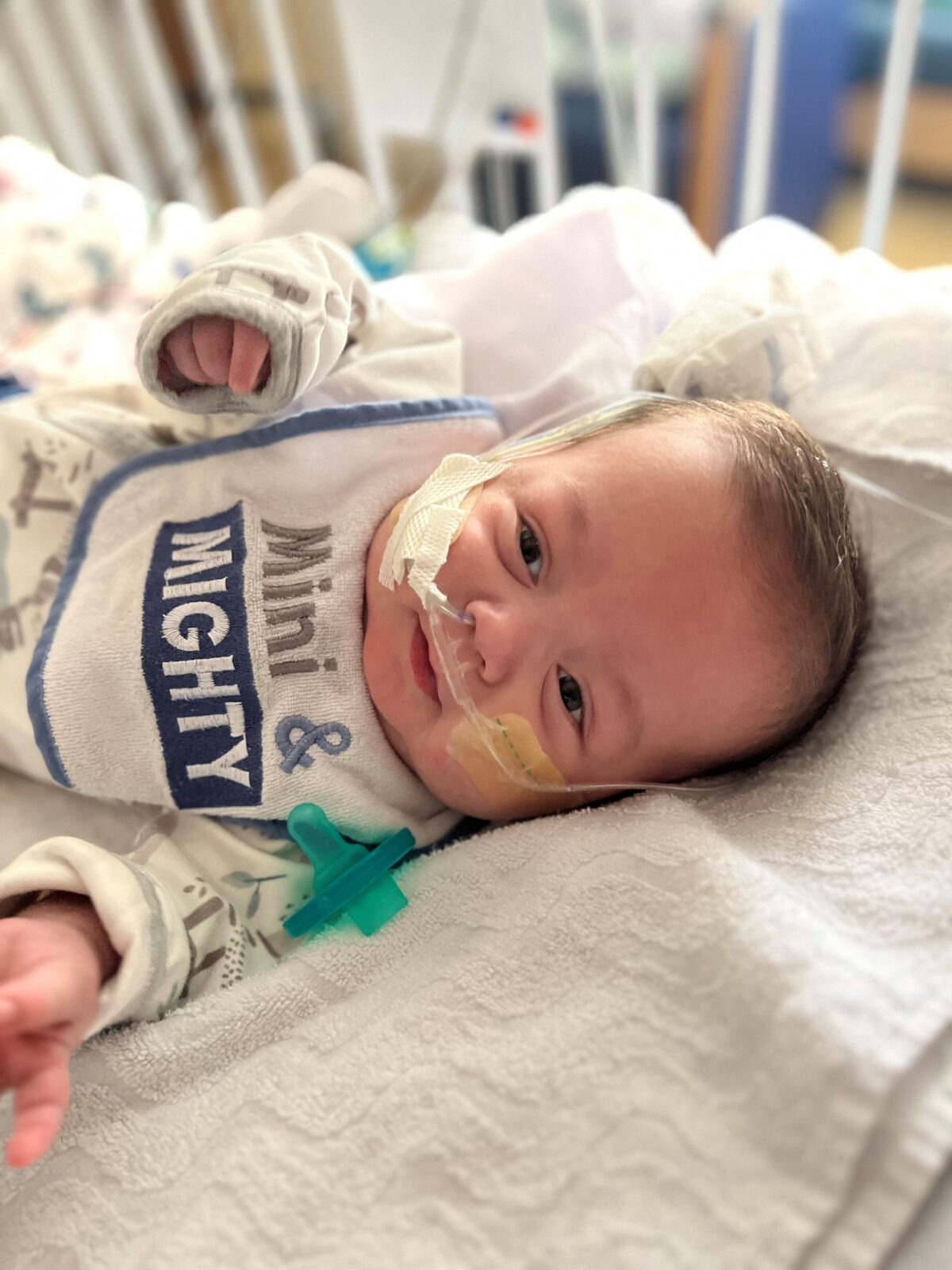
Sunny was born on Nov. 14, 2024, at exactly 32 weeks gestation. He didn’t cry. He wasn’t breathing. He was immediately transferred to the NICU for resuscitation and intensive care and support. Because of his prematurity and medical complexity, Sunny was admitted into the Small Baby Unit—a specialized section of Miller Children’s & Women’s NICU designed specifically for the tiniest and most vulnerable infants. This unit provides highly individualized care with advanced monitoring, neuroprotective strategies, and a developmentally supportive environment.
While Sunny was taken to the NICU, Victoria, still recovering, received more tough news—she had tested positive for rhinovirus. Because of Sunny’s fragile condition, she wouldn’t be allowed to see him for an entire week.
“That week was incredibly difficult,” says Victoria. “Not being able to hold him or be by his side was heartbreaking. I focused on pumping and Steven brought milk to the NICU every day—it was our way of staying connected. Even though it felt overwhelming at times, I held onto the hope that I’d be with him soon.”
A Team of Experts Steps In – the Value of Delivering at a Hospital for Children & Women
When Victoria was finally able to visit Sunny, she found him surrounded by a dedicated team of compassionate and highly skilled specialists. In those critical first days, Sunny’s immediate stabilization and daily care were managed by the expert physicians and nurses of the NICU, who ensured he received the highest level of attention during his most vulnerable moments. At the same time, Peggy Chen, M.D., director, NICU surgical program, took charge of Sunny’s post-operative management from the outset, guiding his complex recovery with seamless continuity. As Sunny’s primary neonatologist and lead NICU physician, Dr. Chen provided steadfast dedication and expertise, supporting Sunny and his family through each step of his hospitalization.
Dean Anselmo, M.D., a pediatric general surgeon, led the complex surgical journey required to treat Sunny’s gastroschisis—a condition where the intestines develop outside the body. From the start, his case was among the most severe the team had encountered. Sunny’s abdominal wall was underdeveloped, and his intestines required multiple staged repairs to preserve as much bowel function as possible.
Over the course of his hospitalization at Miller Children’s & Women’s, Sunny underwent 18 complex surgeries. These procedures addressed the severe damage caused by gastroschisis and supported his gastrointestinal system. Surgeons performed multiple bowel resections to remove non-functioning sections of intestine and carried out staged repairs to safely return his intestines to his abdomen. Because his abdominal muscles were underdeveloped and unable to close early on, the team utilized a silo bag to gradually guide the intestines back inside—a delicate process requiring precision and patience. The final milestone was the placement of a specialized mesh closure, reconstructing his abdominal wall and marking the completion of his surgical care. This achievement reflects the depth of expertise and collaboration that defines Miller Children’s approach to treating the most complex neonatal cases.
“Sunny’s case was one of the more complex presentations of gastroschisis we’ve seen,” says Dr. Anselmo. “His abdominal wall was severely underdeveloped, and his intestines required multiple staged repairs. We worked to preserve as much bowel function as possible while gradually reintegrating the intestines into the abdomen. It was a long journey, but Sunny responded remarkably well to each step.”
In addition to surgical care, a multidisciplinary team—including respiratory therapists, developmental specialists, and neonatal and pediatric nurses—supported Sunny’s growth and development, tailoring every aspect of care to his unique challenges. For Victoria, these efforts meant her son was finally ready to thrive at home.
Therapies That Made a Difference
While Sunny was in the NICU, he received music therapy, physical therapy and oral therapy—key pieces of his healing journey. Music therapist Laurel Terri visited Sunny bedside with a guitar, playing gentle melodies for him and his parents.
“It didn’t feel like a hospital when she was there,” says Victoria. “It brought light into a really dark time.”
Another key part of Sunny’s progress toward discharge was the developmental support he received throughout his hospital stay—especially from speech-language pathologist Becky Coti, who began working with him early in the NICU.
“Becky has been reading to him, helping him smile, teaching us how to interact with him to help his development,” says Victoria. “You get so caught up in the medical stuff, you forget he’s still a baby who wants to play and learn.”
Support Beyond Medical Care
Victoria also worked closely with lactation consultants and child life specialists from the Cherese Mari Laulhere Child Life Program—especially Erin, who helped make the hospital feel a little more like home. Erin documented Sunny’s milestones through photos and memory books—precious keepsakes for a family who had to celebrate so many “firsts” in a hospital room.
“He was spoiled in the NICU,” says Victoria. “Everyone cared so much—it really shows.”
From NICU to PICU: Sunny’s Next Chapter
After months in the NICU, Sunny began his next chapter in the Cherese Mari Laulhere Pediatric Intensive Care Unit (PICU)—a space designed for healing and family connection. Here, he had his own private room, complete with sleeping accommodation for Steven and Victoria so they could stay close. Around-the-clock care came from board-certified pediatric intensivists, specialized nurses, and respiratory therapists, all working together to monitor every breath and heartbeat.
The PICU at Miller Children’s & Women’s is one of only eight pediatric critical care centers in Los Angeles County and holds the highest Level I designation by the American Academy of Pediatrics. Beyond advanced technology, the unit offers a child-friendly environment with colorful city-themed décor and open nurse stations that keep families connected. For Sunny’s parents, this wasn’t just a hospital—it was a safe haven where hope grew stronger every day.
A Bittersweet Goodbye
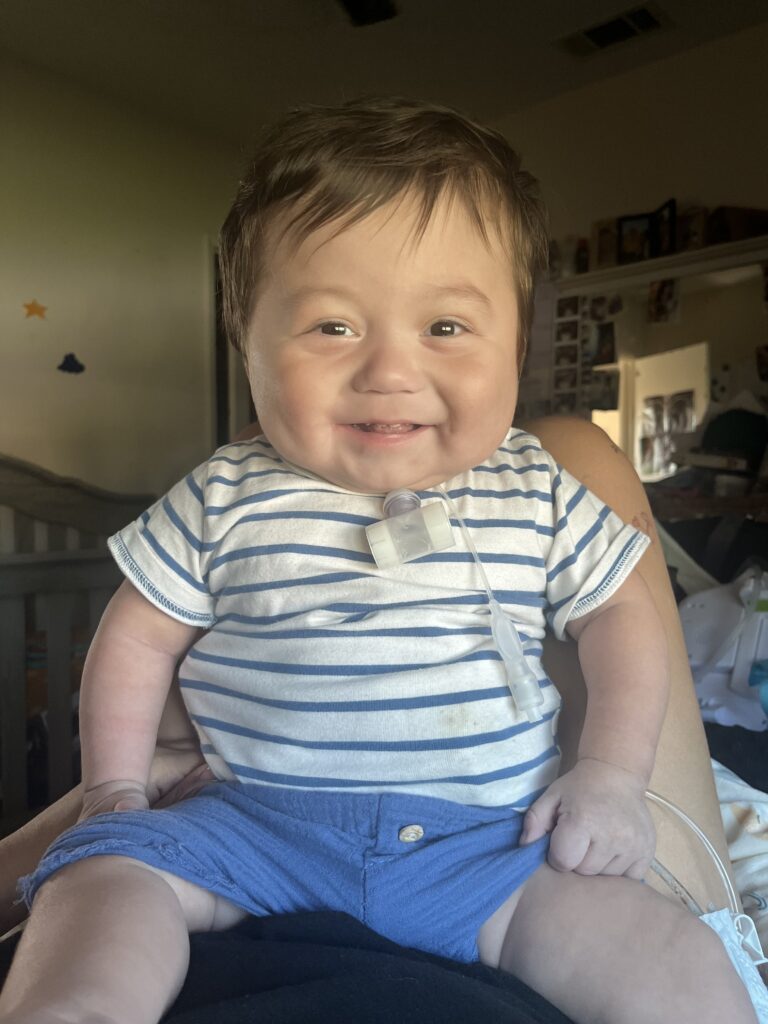
After nine months of intensive care, 18 surgeries, and developmental therapies, Sunny was finally strong enough to go home. His discharge day was filled with emotion—not just for his family, but for the care teams who had been by his side since birth. Nurses, therapists, and physicians from both the NICU and PICU gathered to send Sunny off, lining the hallway with smiles, hugs, and even a few tears.
“It was a moment of joy and bittersweet pride,” says Dr. Chen. “We had watched him fight through so much. Seeing him healthy enough to go home was everything we hoped for—but it’s hard to say goodbye to a baby you’ve cared for like your own.”
The hallway was filled with applause as Victoria and Steven wheeled Sunny out of the hospital for the first time. Many staff members had become like family, and their farewell was a celebration of Sunny’s strength and the deep bonds formed during his hospitalization.
“It was hard not having him home,” says Victoria. “But one thing that helped was knowing he had a family within his care team at Miller Children’s. They loved him like their own. But now, we’re just so grateful he’s finally home.”