

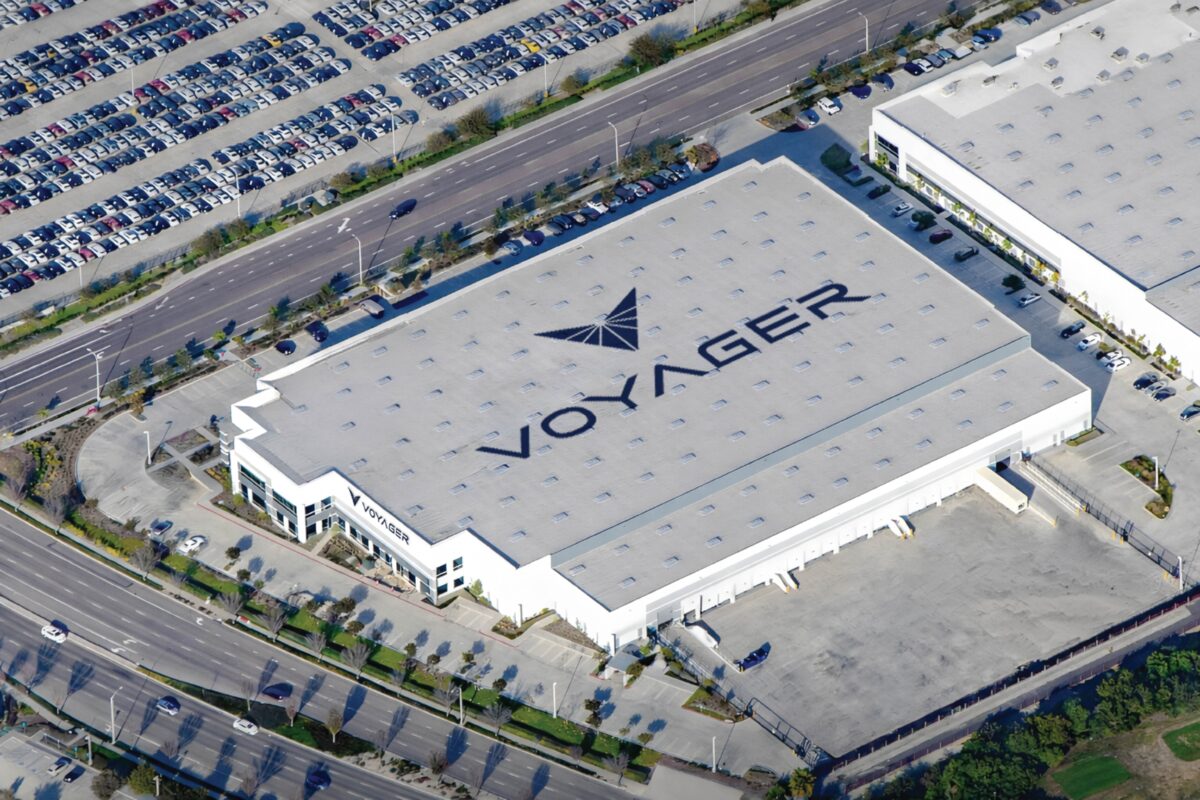
Voyager Technologies unveiled a 140,000-square-foot facility Tuesday in Long Beach that will be used for designing and producing parts for missiles and commercial spacecraft.
The company wrote in a news release that the facility, which will employ 150 to 200 people, will be used to advance a number of the company’s ventures into aerospace and defense for the U.S. military and other clients.
“We are standing up capacity at Space Beach for one purpose: to deliver for our customers,” Matt Magaña, president of Space, Defense and National Security at Voyager, wrote — using a nickname for Long Beach’s burgeoning space industry.
The Denver-based company, which launched in 2019, has nearly a dozen locations across Ohio, California, Colorado and Texas. This announcement comes two months after it opened a 150,000-square-foot facility in Pueblo, Colo., also focused on missiles, defence and weaponry.
Through a network of former companies it has purchased, Voyager has researched and designed a variety of parts for spacecraft or rockets, from long-range radios and GPS guidance systems to commercial airlocks and propulsion systems.
It’s known for its Starlab project, a venture propelled by a $217 million NASA contract to replace the International Space Station, which is slated to retire in 2030.
But a majority of the company’s business is in defense. The net sales last year for its defense and national security program jumped 59%, making up $123 million of the $166 million it made. In the last quarter of 2025, the category made up nearly two-thirds of its sales.
By contrast, the company’s sales for “Space Solutions,” which designs spacecraft for commercial and research purposes, declined by 36% in 2025.
The company is working with Lockheed Martin to develop a new missile interceptor system — coined the “Next Generation Interceptor” — and has contracts to build parts for hypersonic missiles and military-grade payloads. Top officials at Voyager say they have a strong interest in competing for contracts on Golden Dome, a 10-year, $151 billion missile defense program.
It’s unclear whether the Long Beach facility will focus on a particular program or take on work as it is needed. In a release, company officials wrote it will help design A.I. software and other parts for “next-generation propulsion and defense systems and integrated sensing, communications and autonomy technologies.”
The company said it is working with neighbors Anduril Industries and True Anomaly, who recently set up facilities in Long Beach, to meet some contracts, but did not specify the venture.
It’s the latest in a wave of space tech companies to join “Space Beach” by moving to the 430-odd acres of industrial and warehouse space once used to build cargo planes outside Long Beach Airport.
In January, Anduril, an artificial-intelligence-backed weapons manufacturer, announced that it was building a $1 billion campus nearby to make drones and other A.I.-enabled weapons.
It’s an industry where successful businesses often curry favor with the federal government and military, and local representatives are eager to attract defense tech firms to create high-paying jobs.

“We’re proud to welcome Voyager to our growing Space Beach ecosystem with a 140,000-square-foot facility advancing aerospace innovation, domestic manufacturing, and national security capabilities,” said Mayor Rex Richardson. “This investment brings high-skilled jobs, strengthens our local economy, and further establishes Long Beach as a national hub for the industries shaping our future.”
These companies are in tight competition to take advantage of a growing national defense budget — $895 million in 2025 from $816 in 2023 — while taking advantage of the large pools of talent near existing research and military facilities like JPL in Pasadena, Mojave Air and Space port in Kern County and Vandenberg Space Force Base.
While the budget was shrunk to $838.7 billion in 2026, U.S. Defense Secretary Pete Hegseth has placed an increased priority on spending on U.S.-made drones and autonomous weapon systems. Buoyed by global conflicts, defense companies in Long Beach and across the region are anxious to accelerate their designs and production of weapons and defense systems.