

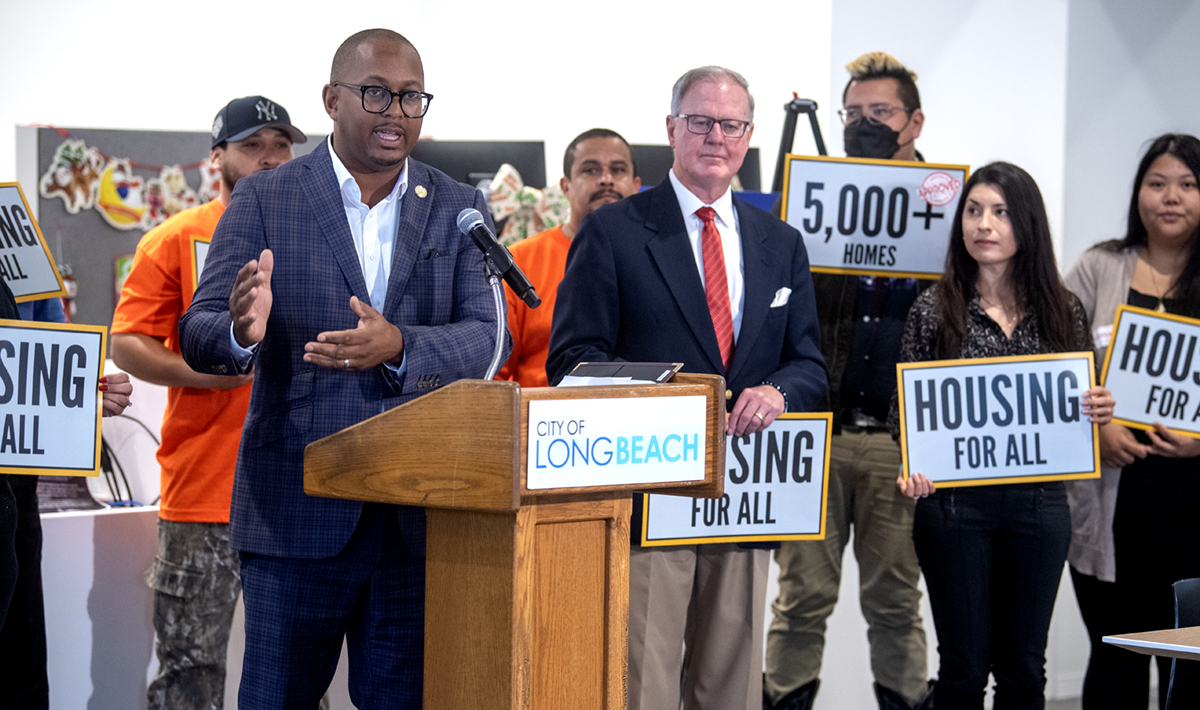
Despite rising interest rates and a regional decline in construction, city officials are rushing to allow so many houses, apartments and condominiums that they have surpassed a whopping 5,200 entitlements in Long Beach since 2023, statistics show.
Figures compiled by the city’s Community Development Department reveal that 5,210 have been entitled from January 2023 through the end of November 2025. About one-fifth of those are affordable units. Building permits, meanwhile, rose each year between 2021 and 2024, with 4,416 issued in the four-year span. Permits for accessory dwelling units also rose consecutively in the same period, from 280 in 2021 to 747 in 2024.
It’s cause for celebration, Mayor Rex Richardson said at a Tuesday press conference, hitting a posterboard with a ceremonial stamp of approval.
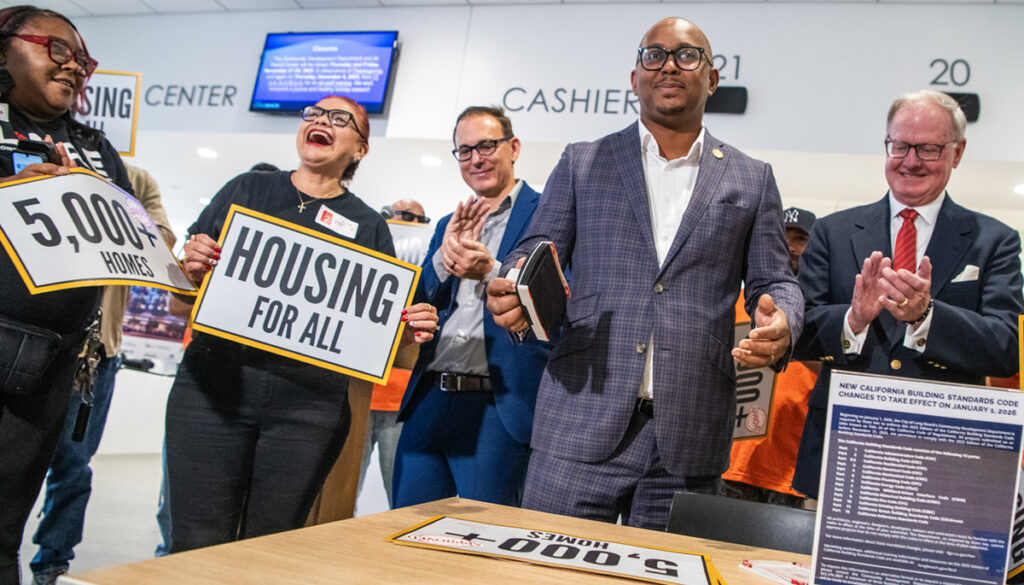
“That’s 5,000 families who will have a new place to call home,” Richardson said, adding that homes are being pushed forward at a pace not seen since the boom years of the 1980s.
“In fact, many of the projects, affordable housing projects, are being approved within 60 and 90 days in the city of Long Beach,” he continued. “We’ve never approved plans that fast.”
One woman at the event, Cheryl Neal, spoke of her apartment at the newly opened Heritage Gardens with jubilation.
“It’s like living in Hollywood, what more can I say?” Neal said.
But the data also anticipates a nosedive in new buildings: Nearly 3,000 of the units entitled were in 2023, while another 1,788 were given the same OK the year after. In 2025, only 488 homes were entitled, more than half of which were affordable units, which rely heavily on public grants.
In many ways, the number of entitlements and building permits is considered an indicator of how strong the local economy is and will be over the next five to seven years — the time it takes for a typical apartment to be built, from planning to opening day.
Long Beach Community Development Director Christopher Koontz linked the decline to high interest rates, a sluggish economy and federal tariffs that, while not the worst seen in respect to the region, have played a detrimental role in the cost of building materials.
“Real estate is a sector (where) you build things with borrowed money, and when the interest rate is high, that cost of borrowed money is much more expensive,” he said.
The greatest difficulty remains in getting developers to build more homes and apartments for families, Koontz said, connecting the steady decline in citywide school attendance.
“Long Beach has some amazing single-family homes, but we also have a lot of them with one bathroom,” Koontz said. “And I don’t know how people raise a family with one bathroom.”
But despite a “brutal year for real estate,” it’s been a good year for Long Beach, Koontz said.
Builders are expected to have started on more than 1,000 homes this year citywide, many of which are in North or East Long Beach.
“Ten years ago, which was not very long ago, we were producing between 70 and 300 units a year in housing,” he said.
Three affordable housing projects totaling 140 units — including those for seniors, families and the formerly homeless — are expected to finish next year, while five more projects offering nearly 400 units are to break ground.
Richardson said the city technically has the space for another 26,000 units, according to its housing element, which guides the planning process, and Long Beach must continue at a pace that “outstrips the problem.”
This city needs to approve at least 3,300 units annually to meet goals established in the state’s Regional Housing Needs Assessment.
“There’s a whole lot more applications and entitlements, a whole lot more plans to check, a whole lot more inspections, a lot more groundbreaking, and we look forward to doing that,” Richardson said.