

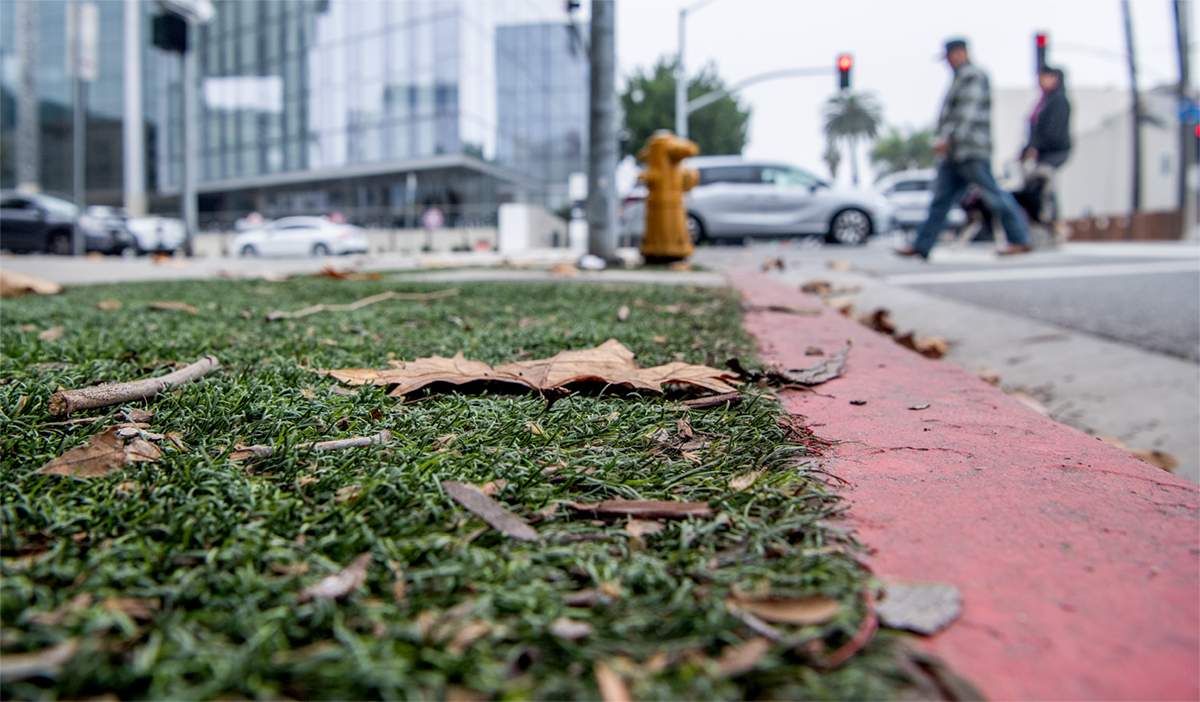
A battle is being waged in Long Beach, held on the small strips between the sidewalks and streets. The sides: plastics versus grass and dirt.
The city may soon develop guidelines to regulate the makeup of these public parkways, with a stricter policy around the use of artificial turf. In a unanimous vote Tuesday, the City Council directed officials to report back with an outline on what’s possible and what it might cost.
Any plan will tackle two main points: the removal of artificial turf and the need for more trees citywide.
According to city municipal code, artificial turf is allowed to cover up to 50% of a person’s yard under certain conditions meant to manage runoff. But it’s officially not allowed along public rights-of-way like medians and parkways, the strip of lawn between a sidewalk and street that private property owners must maintain.
Despite these prohibitions, city officials say they lack the time and staffing to enforce the parkway provision or regulate yards of single-family homes.
“We don’t have a mechanism to enforce it today,” said Christopher Koontz, director of Long Beach Community Development.
Decorative turf became popularized statewide as Californians were told to cut back significantly on water use, pitched as a cheap route to an eternally green lawn that saved water, but it’s brought other problems, neighbors say.
Some residents, environmentalists and coaches urged the city to take action, claiming turf — which is made of plastic blades that mimic the look of grass and often sit on a layer of crumb rubber — is expensive to maintain, fails to collect groundwater and exposes children and pets to harmful “forever chemicals” that break down into microplastics that enter storm drains.
It also raises street temperatures, they wrote, contributing to the prevalence of “heat islands,” or stretches of land with little to no shading or natural grounds to absorb sunrays. Some cited research that artificial lawns can reach temperatures in excess of 160 degrees — hot enough to burn skin or paws.
Residents in the Willmore City neighborhood say they’ve spotted nearly 50 areas where artificial lawn has been rolled out on a parkway.
Ryan Wolfe, president of the neighborhood’s association, said they have brought 120 new trees to Willmore City using funds through the Inflation Reduction Act. There are another 450 spots, he said, where they could really use a tree for shading.
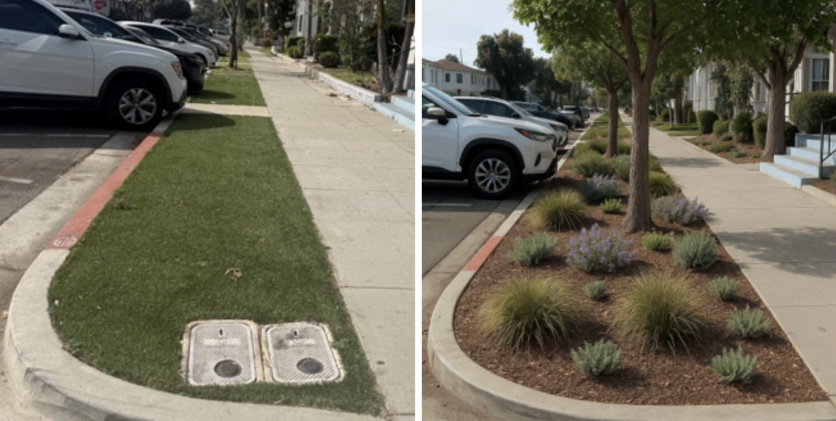
Trees planted under or near artificial turf have died, Wolfe said, as the plastic covers the critical root zone of a tree, robbing it of water. “Now there’s just tree stubs left over,” he added.
“This is a big issue for us,” Wolfe said. “Our community is 80% renter, it’s a disadvantaged community by the city’s classification, the state’s classification. It’s old building stock (and) many of our neighbors are elderly, low-income or disabled and do not have air conditioning in their homes.”
Upon approval of a plan, local environmentalists say they would hope to incentivize landlords to swap out their artificial lawns with real ones using subsidy programs like the city’s native plant parkway program.
“And we could go to these property owners, and say, let’s take out your artificial turf,” Wolfe said.
Up until 2023, California law protected artificial turf as a form of drought-tolerant landscaping that cities and counties could not prohibit. Following a change in legislation that year, cities now have the opportunity to set their own ordinances and enforce at their own discretion.
The plan in Long Beach, according to Tuesday’s agenda item, would be similar to ones already used in cities like Culver City, Santa Monica, Pasadena and Los Angeles.