


This story was originally published by CalMatters. Sign up for their newsletters.
Gov. Gavin Newsom has threatened many times to withhold state homelessness funds from cities and counties that aren’t doing enough to get people off the streets.
This year, those threats seem more real than ever.
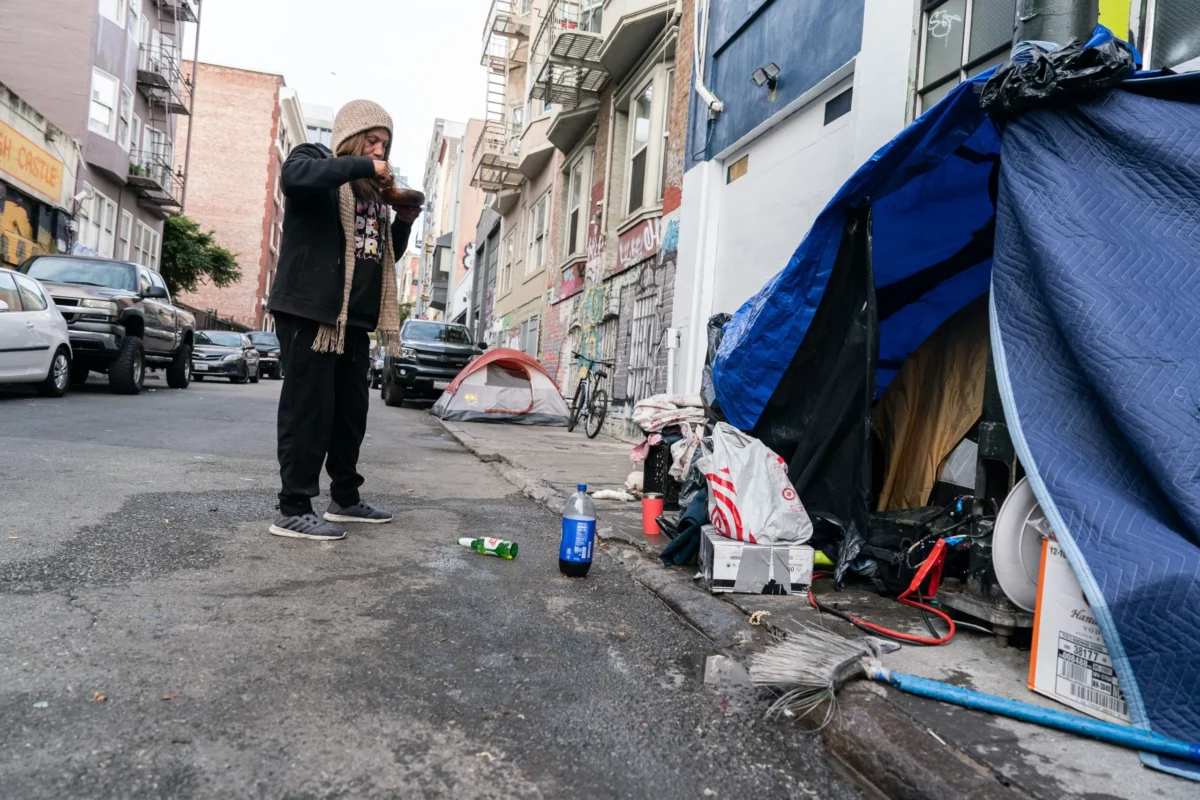
Newsom’s administration and the Legislature are adding new strings to that money, which they hope will help address one of the state’s most obvious policy failures: Despite California’s large recent investments in homelessness, encampments are still rampant on city streets. But cities and counties already are chafing under the tightening requirements, which they worry will make it harder to access crucial state funds without directly improving conditions on the street.
To access state Homeless Housing, Assistance and Prevention money, cities and counties are being pressured to enact a policy regulating homeless encampments that passes state muster – a potential challenge in a state where local jurisdictions’ rules on encampments vary greatly, and many localities have no policy at all. The state also wants localities to get a “prohousing designation” – a special status awarded to places that go above and beyond to build housing. It’s a distinction that only 60 of California’s 541 cities and counties (home to just 15% of the state population) have achieved so far.
Newsom, the Legislature, local officials and other stakeholders likely will spend the next several months fighting about those terms, and hashing out the conditions for the $500 million in homelessness funding proposed in this year’s budget.
Until those details are resolved, exactly what standard cities and counties will be held to – and what will happen to those that don’t comply – is unclear. But one thing is clear: The state is done freely handing out cash.
Some counties are already feeling the heat. They report increased scrutiny as they apply for the homelessness funds already approved in the 2024-25 budget (which, thanks to lengthy bureaucratic delays, have just been made available.)
“They’re holding the counties’ feet to the fire,” said Megan Van Sant, senior program manager with the Mendocino County Department of Social Services.
Newsom’s administration and legislators in favor of the new accountability measures say cities and counties for too long have been scooping up state funds without proving that they’re using them wisely. The new message to locals is clear, said Assemblymember Sharon Quirk-Silva, a Democrat from La Palma in Orange County: “The state has been moving forward, not only with the investment in dollars, but also with legislation. Now it is your time to show that if you want these dollars…you have to show us what you’re doing.”
But the new requirements may make it more burdensome to access crucial homelessness funds.
“I worry that, one, we may leave more cities out,” said Carolyn Coleman, executive director and CEO of the League of California Cities, “and, two, that we may cause delays in the ability to get more people housed sooner, which I think is the goal.”
A tougher application process
Applying for state homelessness funds “absolutely” feels different now than it did last year, and the state is asking tougher questions, said Robert Ratner, director of Santa Cruz County’s Housing for Health program.
Fortunately, the county just approved an encampment policy in September, and has started working on getting a pro-housing designation, he said. But the state still returned the county’s application with plenty of notes.
“It has felt, at times, like the goal post keeps moving a little bit,” Ratner said.
The county’s application still hasn’t been approved, but it seems to be getting close, Ratner said.
In Mendocino County, the state appears to be holding funds hostage until the county can explain its plans to pass an encampment ordinance, said Van Sant. The county board of supervisors is working on such an ordinance, though it hasn’t come up for a vote yet.
But the state’s requirement puts Van Sant and her team in an awkward position. As housing administrators, they have no say in any rules the county passes that regulate or prohibit encampments on local streets.
“I wanted to stay out of it,” Van Sant said. “I still want to stay out of it. We’re housing providers. We try to figure out how to provide people housing. We don’t want to weigh in on enforcement. At all.”
This year, the requirements may get even stricter. Under the current rules, the state seems to be satisfied as long as a city or county can show how it plans to get a prohousing designation or pass an encampment policy. In the next round of funding, local leaders worry the state will withhold funds unless cities and counties have actually achieved those benchmarks.
It’s all about accountability
At issue is the state Homeless Housing, Assistance and Prevention program, which provides the main source of state money cities and counties use to fight homelessness.
Though Newsom introduced the first round of funding, $650 million, as a “one-time” infusion of cash for local governments in 2019, it became a recurring feature of his administration’s strategy to reduce homelessness over the next five years.
For four years in a row, the state awarded $1 billion a year to be divvied up between counties, big cities and federally-recognized regional homelessness funding groups known as Continuums of Care. Each round of funding was described as “one-time.” Even so, at least a quarter of the money has gone to day-to-day operating programs, according to data collected by the state.
Last year, things changed. The budget lacked any extra cash for grant funds, and the state’s main homelessness program received no new money. Instead, the Legislature committed to spend $500 million — a 50% reduction from the last round of funding — in the coming fiscal year contingent on “clear accountability requirements.”
Those requirements for localities, spelled out in a follow-up budget bill signed into law last fall, include:
- Having a state-approved housing plan, known as a housing element
- Having a “Prohousing Designation” from state housing regulators
- Having local encampment policy “consistent with administration guidance”
- Ponying up some local funding to match the state contribution
- Demonstrating “progress” and “results” on housing and homelessness metrics
These new demands didn’t come out of left field. For several years now, “accountability” has been one of Newsom’s favorite words when discussing homelessness funding. “People have just had it,” he said in 2023. “We want to see these encampments cleaned up.” He has repeatedly threatened to withhold funds, and has gradually ramped up the strings attached to homelessness dollars.
But the current list represents an especially stringent set of requirements for locals hoping for a cut of what has been one of the state’s signature funding sources to combat homelessness.
Quirk-Silva noted that the current list of requirements is not final. She expects the administration to release additional legislative language in February. Legislators will fight over the details through the June budget deadline.
She expected particularly fierce pushback over any kind of “prohousing designation” requirement.
Revoking funds from areas of the state that lack such a designation would be “penalizing service providers for something that is outside of their control,” said Monica Davalos, a policy analyst with the California Budget and Policy Center, a left-leaning think tank.
San Jose Mayor Matt Mahan wishes the state would focus on more concrete measures of success, such as the number of people housed using state dollars, instead of things like a “prohousing” stamp.
“We’re making this way too complicated,” he said.