

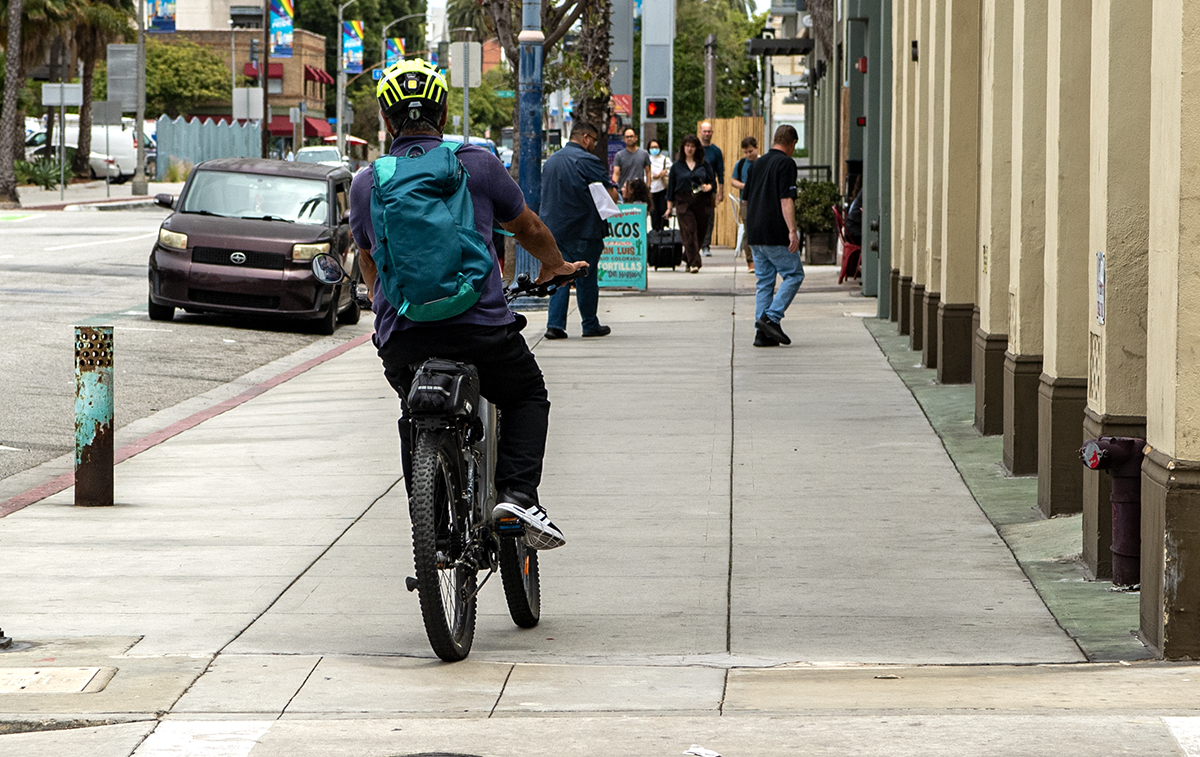
The Long Beach City Council on Tuesday agreed to draft a law banning higher-powered electric bikes from all city sidewalks, saying they pose a threat to pedestrians and should be used elsewhere.
The ban, proposed by Councilmember Daryl Supernaw, would still allow slower e-bikes that max out at 20 mph on residential sidewalks, but Class 3 e-bikes, which are capable of speeds up to 28 mph, wouldn’t be allowed on any sidewalks.
The originally proposed ban would have also extended to the city’s multi-use pathways, such as the shoreline path and those along the Los Angeles and San Gabriel rivers, as well as those that cut through El Dorado and Heartwell Parks, but the council agreed to scale back that proposal for now and reconsider in six months.
Councilmember Megan Kerr said a blanket ban would unfairly penalize those who ride the higher-powered Class 3 e-bikes on paths to ferry children and their belongings to work or home. She urged the body to pause adoption until a later date, to allow the city to gather data and recommend which paths should be exempt.
“I hesitate to go to the most restrictive in this moment when we can step up to more restrictive as we get additional information,” Kerr said. “I would hate to limit a safe form of travel for folks with a blanket that we’re not so sure about.”
The ordinance follows the growing prevalence of electronic bikes and motorcycles, and complaints about their use on sidewalks and footpaths, where an increasing number of pedestrians worry about being struck.
Supernaw brought the item forward in October, after being inundated with complaints about dangerous riding along the San Gabriel River pathway.
“I didn’t realize it could devolve to where it is now,” he said. “It certainly didn’t get better on its own.”
Electric bikes, motorcycles and dirt bikes have surged in popularity in recent years, especially among teenagers who see them as a new means of freedom and adrenaline.
But the vehicles’ high speeds come with real dangers. From 2023 to 2025, Long Beach Memorial Hospital’s trauma department alone has seen 168 e-bike-related injuries.
Edna Transon, a nurse and program manager at MemorialCare, said their trauma bay has seen a spike in serious injuries — skull fractures, brain damage, broken ribs and lacerations — that require multiple surgeries and longer recovery times.
“They’re not scrapes, they’re not bumps, they’re not bruises, they’re not even a regular fracture, they’re way more serious,” Transon said. “You’ve seen loss of legs, loss of life.”
City and hospital data show that a large number of riders are teens, especially those aged 10 to 17, though those coming into trauma bays — riders and pedestrians alike — are as young as 5 and old as 92.
Most of the effort to regulate e-bikes has been fought at the state level and in schools. Under California law, e-bikes and e-motorcycles are separately classified by motor power, top speed and whether the bike has working pedals. Class 1 and 2 e-bikes, which go up to 20 mph, don’t require licenses or insurance, while Class 3 riders need to be at least 16.
Last month, State Attorney General Rob Bonta issued a consumer alert to retailers, parents and manufacturers that warned of the current laws and pending legislation around the devices. At his prodding, Amazon last week also announced it would stop selling higher-powered e-bikes in California.
But the danger around the bikes has prompted nearby cities, counties and school districts to take strong stances against their usage, especially around Class 3 e-bikes.

San Diego bans all e-bikes on sidewalks and near businesses, and requires riders to be at least 13. Manhattan Beach and Hermosa Beach prohibit Class 3 e-bikes on their beach bike paths and often require riders to power down the motor or walk their bikes in high-traffic areas near the piers.
Starting next year, elementary and middle school students at the Newport-Mesa Unified School District are banned from commuting on e-bikes, following a school board vote last month. School districts in Palos Verdes and Redondo Beach require safety courses for students.
And Huntington Beach, which bans e-bikes on sidewalks and requires riders to dismount in some areas downtown, has used child endangerment statutes to go after the parents of minors who injure or kill someone with e-motos or overpowered e-bikes.
Long Beach police say they have limited enforcement options for law-flouting cyclists and won’t pursue riders for a simple traffic violation, saying a serious crime needs to have been committed.
LBPD Commander Shaleana Benson said the department is capable of using a drone to follow cyclists until officers can either divert them from a high-traffic area or issue them citations and potentially impound the bike if it can go over 20 mph.
But police say they would rather help start a diversion program, citing data that a large swathe of problematic riders are teenagers at local schools. But they said that would require new funding and additional staffing. City officials also warn they can only control where these bikes are used, and cannot outright ban their sale, classification and power limits.
“A lot of things are being tested out right now,” said Paul Van Dyk, a city traffic engineer with Long Beach Public Works.
You can find Long Beach’s current bike, e-scooter and pedestrian laws here.