

City officials are advancing a plan to open a $50 million line of credit backed by three municipal properties, a short-term borrowing tool meant to fund capital projects while the city works toward a larger bond sale later this year.
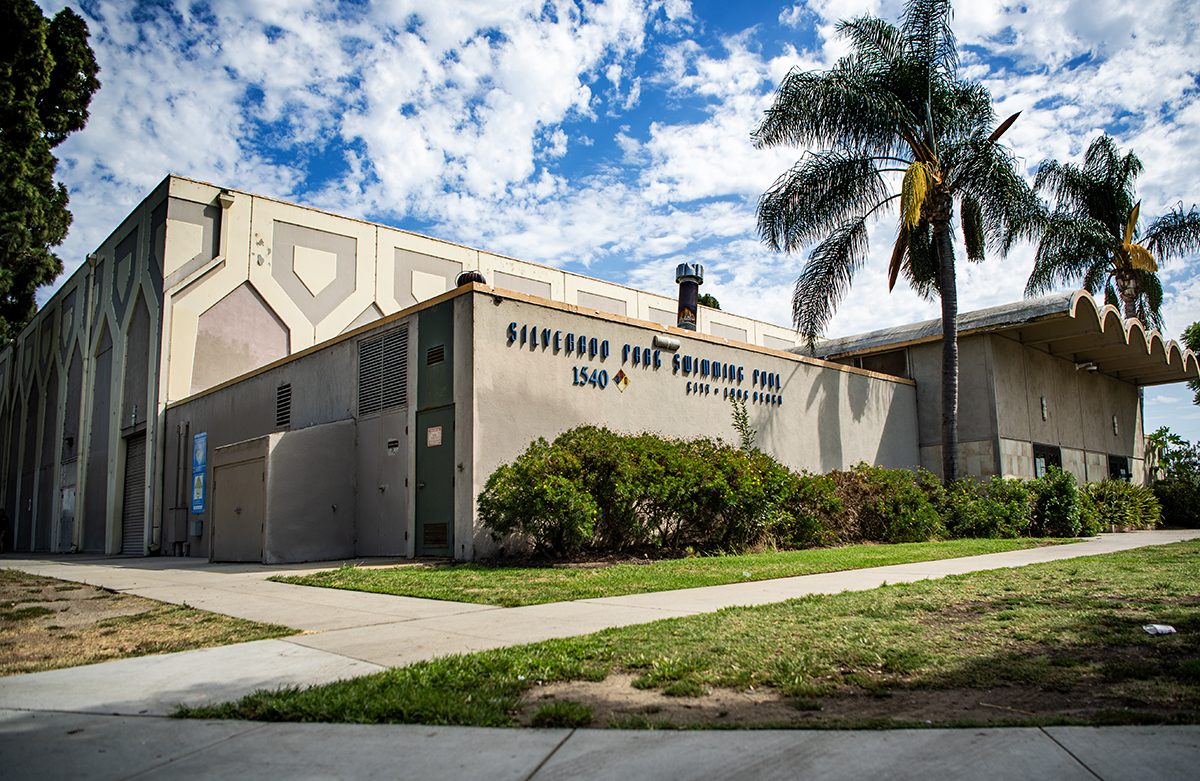
The Long Beach Finance Authority — a joint powers agency formed between the city and its housing authority — advanced the plan Wednesday that, if approved by the City Council, will temporarily transfer leasehold rights of the Lincoln Parking Garage at 33W. Broadway, the Broadway Parking Garage underneath the main library and the pool building at Silverado Park to the authority, which would then lease those properties back to the city.
The Finance Authority, overseen by Long Beach’s Financial Management Director Kevin Riper, City Manager Tom Modica and Treasurer Hank Kim, would then relinquish its right to collect the lease payments to Wells Fargo, which would advance the city up to $50 million, functioning much like a corporate revolving credit line. The city would make payments structured as rent but calculated like loan payments, with principal and a floating interest rate tied to the Secured Overnight Financing Rate, a common lending benchmark.
It’s a standard lease-and-leaseback agreement, city officials say, one that California cities have used for decades to borrow money without voter approval.
Why the complicated financial maneuver?
State law bars municipalities from pledging future tax revenue to secure a loan without voter approval — a threshold that became especially difficult to clear after a two-thirds voter approval for general obligation bonds was enshrined in the state constitution in 1978.
In response, cities and school districts statewide have turned to lease-leaseback arrangements, which financial experts describe as a back-door mechanism for funding capital projects without formally taking on voter-approved debt.
Goleta, in Santa Barbara County, financed the purchase of its City Hall through a lease arrangement with the state’s infrastructure bank, then later used its library and public works yard as collateral. Los Angeles has used a similar setup for years through its Municipal Improvement Corporation.
Long Beach used a similar 12-month line of credit in 2020, pledging its Emergency Communications Operations Center and West Long Beach Police Substation as collateral.
The city never drew on that line, according to an email response gathered by city spokesman Laath Martin, because federal American Rescue Plan Act funding arrived before it was needed; had it been used, the debt would have been fully repaid within a year, he added.
Why now?
It remains unclear how exactly the city will use the current line of credit should it be approved. A resolution outlining the plan said only that the intent is “to finance the acquisition and improvement of various capital projects and equipment.” City spokesman Laath Martin said a list of specific projects or acquisitions hasn’t yet been finalized. The city Financial Management Department was not available for an interview.
The credit line would let the city draw money over roughly a year, then require it to begin paying down the balance annually until it’s paid off by 2036, with some ability to extend if needed.
The three properties would remain in daily public use throughout, and the financing is structured so the bank could never seize and sell the garages or the pool building outright. If the city defaulted, Wells Fargo’s recourse would be to sue to compel payment or to take over operating the properties until the debt is satisfied, rather than foreclose as it would with conventional collateral.
Martin said more information on the financing plan will be available next month ahead of a presentation to the City Council on Sept. 15.
The bigger picture
The borrowing comes as Long Beach works through a separate fiscal squeeze. City Manager Tom Modica unveiled a proposed fiscal year 2027 budget on July 30 that closes an estimated $58 million shortfall largely through layoffs and service cuts, after the city already drained $27 million from four reserve accounts — including $16.5 million from its $50.1 million emergency reserve — to close out the current fiscal year.
The moves would save $55.9 million, allowing the city to add $9.8 million back to reserves. It currently has $33.6 million in emergency reserves.
Officials have cited lagging tax revenue, rising labor and insurance costs, and reduced federal health funding as key drivers of the gap, and have warned that another projected $27.3 million shortfall looms for fiscal year 2028.
Editor’s note: This story was updated to more properly describe the transaction as a lease-leaseback agreement, not a sale-leaseback agreement. It was also updated to show the correct timeline and mechanism for the two-thirds voter requirement for general obligation bonds.