


The city of Long Beach has proposed cutting library hours and laying off librarians to help balance its budget. In response, educators, the local library foundation and union leaders are pushing back, saying the city can’t afford to lose a vital service for kids and families.
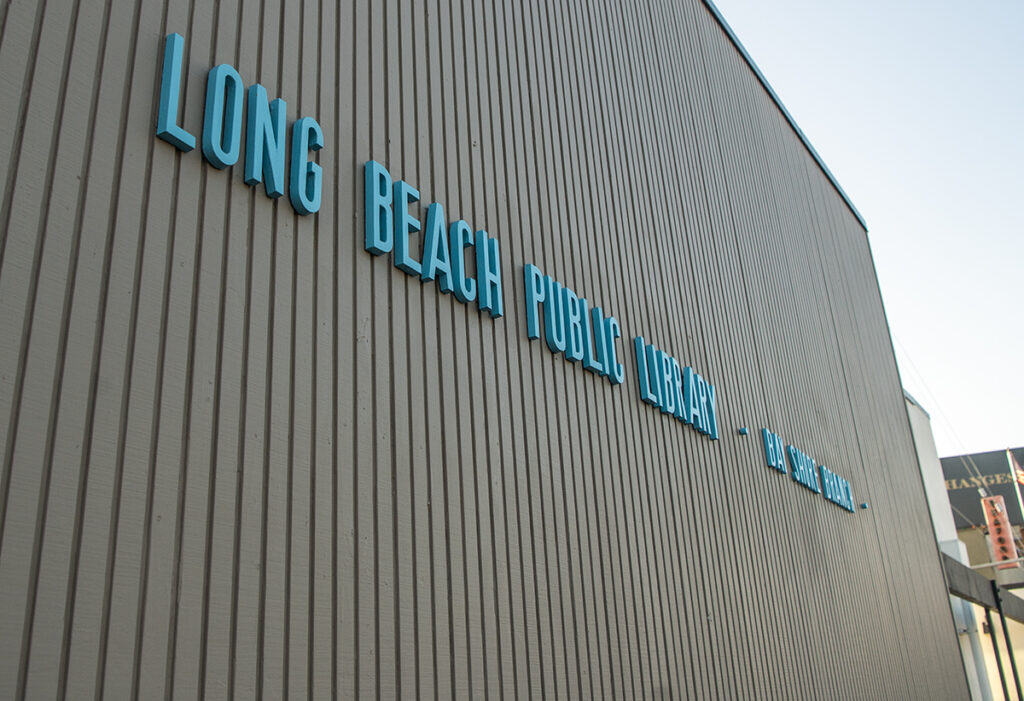
Under the budget proposal, five of the city’s 12 libraries — Bay Shore, Burnett, El Dorado, Harte and Michelle Obama — would drop from six days of service back to five, losing their Monday hours just a few years after those hours were added. (The city’s other libraries were already closed on Mondays, and all are closed Sundays.)
On an average Monday, those branches see a total of more than 1,000 visitors, according to city data.
“In a city the size of Long Beach, and with our population, we could be seeing a 2027 where there are no libraries open on Monday. I think that’s pretty crazy,” said Kristen Hernandez with the Long Beach Public Library Foundation. The nonprofit, which raises money for the local library system, is gathering signatures on a petition protesting the cuts. As of Friday, it had more than 1,800 signatures.
Changes to the city library system are a sliver of the cuts unveiled last week by Long Beach City Manager Tom Modica as part of a citywide winnowing in programs and services to close next year’s expected $58 million deficit.
Beyond cuts to programs and facility hours, Modica proposed laying off more than 260 city workers and cutting more than 200 additional vacant positions — about 4% of the city’s roughly 6,000-person workforce.
The proposed library cuts
Local libraries would lose 14 positions, 11 of them currently filled, including five library clerks, four library assistants, a vacant general librarian position at the Billie Jean King Main Library, and a mental health associate who serves as the library’s teen specialist. The plan also cuts funding for library pages who stock books and funding for security services, as well as nearly all print and digital newspaper subscriptions.
The combined cuts would save the department a little more than $1.4 million.
Elizabeth Cespuglio, a librarian at Billie Jean King Library, said that the library assistants at risk of being cut are responsible for planning and running workshops and programs at the branches, pulling materials, tracking which books and genres are most in demand, and staffing the information desk. Clerks handle check-outs, check-ins and library cards, while pages keep the shelves organized.
Perhaps most at risk, Cespuglio said, is the library’s mental health associate, Jasmin Flores, who spends her days building rapport with teens in need. Losing that specialist, she said, leaves her “quite fearful” for the patrons and staff alike, since the library’s other social worker focuses on unhoused adults and doesn’t have the time and energy to build the same relationships with youth.

Each day, Flores is the calming face for more than a dozen kids. Many of them are in and out of homelessness; some have been in juvenile detention. Others are LGBTQIA and struggle to find friends; others struggle to find food. She’s already told some that she may not be showing up anymore. It’s a difficult conversation, she said, having to console others for the loss of her job.
“It honestly breaks my heart that I probably will not be in that position anymore,” she said.
Flores’ main worry is that some of them will stop showing up. “We’ve built that rapport, and it hasn’t been easy to build,” she said. “It’s taken a while to get there, and I just hate to see all that go to waste.”
Librarians say they’re already stretched thin
The real problem, Cespuglio said, is that libraries are losing funding even as they’re increasingly in demand — more than 2,800 patrons visit daily across Long Beach’s 12 branches, an 8% rise since last year. The number of programs offered has increased by 50% in the past year, with more than 1,000 adult participants.
Annually, city libraries have continually climbed in foot traffic since the onset of the pandemic, though averages are still lower than in 2018 and 2019.
Branches have been understaffed for more than a decade, Cespuglio said, at least since the last time the city announced library layoffs in 2012.
“There’s still an expectation on the system for us to be doing all of these things and continue the same level of service as we’ve done,” she said. “Cutting those hours, or those Mondays, not only does it impact the public’s access to the library all over the city, but it has these other ramifications in the rest of the five days that the rest of us are working.”
The looming cuts have created an “undercurrent of anxiety” among staff who still don’t know who may lose their jobs, according to Cespuglio. Her own position is not at risk, but her partner’s is, and she said the possibility of losing half her household income is real. She said that rent in Long Beach has outpaced her pay raises for the 12 years she’s lived and worked in the city.
The bigger budget picture
The library cuts are part of a far larger fiscal reckoning for Long Beach.
The proposed layoffs stretch across more than a dozen departments and offices, hitting fire, police, homeless services, parks and libraries alike, as the city grapples with rising personnel costs, mounting legal payouts, the loss of federal grants and a local economic slowdown that has weighed on tax revenue.
City officials have said the strategy of previous years — pulling from cash reserves to delay layoffs — is no longer sustainable; the city drained tens of millions of dollars from its reserves, including its emergency fund, just to close out the current fiscal year.
Sashi Muralidharan, a labor representative with the city’s largest union, IAM Local 1930, said they will “fight for every job,” even as labor negotiations — which coincide with the budget talks — are looking grim.
Eighty percent of the positions proposed to be cut are represented by IAM, including 209 filled positions.
“Anything that does result in a layoff, we will be bargaining over those impacts to make sure that we lessen the negative impacts,” Muralidharan said.
At a Long Beach City Council meeting this week, nurses, union shop stewards, library staff and other city workers turned out to protest the cuts, arguing they would bring greater ramifications to the public’s quality of life and further enervate its remaining staff, pushing them to look for work elsewhere.
Nate Kim, a city nurse and negotiator with IAM Local 1930, told the council that while his own position had been renewed, many of his colleagues had not been so fortunate. “Many have been laid off already,” he added. Emily Quest, a resident who uses the library’s free craftspace, begged council members through tears not to cut the hours or the staff who run it.
Mayor Rex Richardson has proposed restoring 70 of the positions slated for elimination and says the city remains on track for its first structural budget surplus by 2028, even as another deficit, projected at $27.3 million, looms for the following year.
The City Council is expected to hold public hearings on the budget through the summer before a final vote in late September. You can find a schedule of hearings to attend here or fill out an online survey to share your priorities with the City Council, which must debate and pass the budget by Oct. 1.