This story was originally published by EdSource. Sign up for their daily newsletter.
Cal State unions representing workers ranging from plumbers to professors are turning to legislation to strengthen their hands in disputes with the university system’s leaders.
One bill sponsored by the California Faculty Association would cap executive pay at Cal State in response to recent salary increases for university presidents and top administrators. A second bill, sponsored by the Teamsters, is intended to prevent Cal State from reopening wage negotiations, a maneuver the union says allows Cal State to avoid paying the raises in their contract.
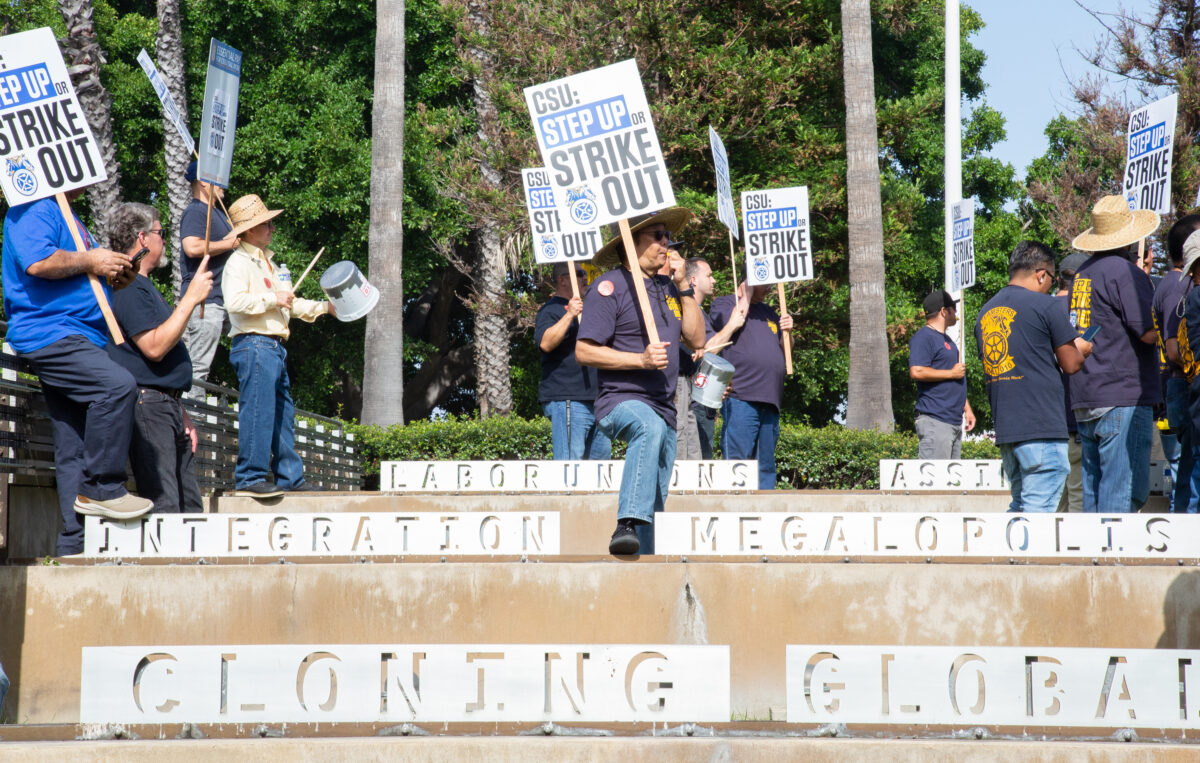
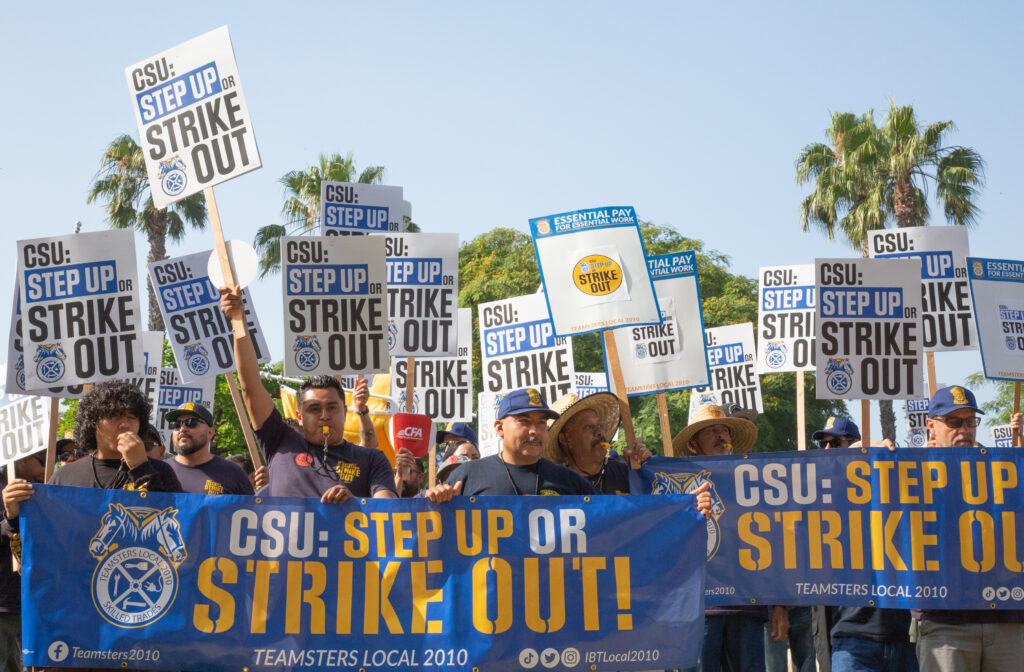
The proposals add a new dimension to recent conflicts between the unions and the leaders of the 22-campus Cal State system at a time when CSU is navigating a mounting deficit, scrutiny from the Trump administration and uncertain federal funding. Tensions climaxed during a recent four-day strike by Teamsters Local 2010, which represents 1,100 CSU skilled trades workers such as electricians and mechanics. (In a written statement, Cal State said the Teamsters were “advancing false claims to justify a strike.”)
Michelle Ramos Pellicia, a professor at Cal State San Marcos and vice president of the California Faculty Association, said Cal State faces a trade-off: They can pay presidents and executives more, but that leaves “no funding for departments, no funding for hiring the high-caliber faculty members who are going to be in the classroom teaching our students.”
David Alvarado, a spokesperson for the Chancellor’s Office, said it is reviewing the legislation and does not comment on newly introduced bills before completing such reviews.
Assembly Bill 1831: Capping executive pay
In November, Cal State approved base salary increases for 13 of its 22 university presidents, a decision framed by its board as “investing in the success of its students, the strength of its campuses and the future of California.”
The highest earner of the bunch — Jeffrey D. Armstrong, the president of Cal Poly San Luis Obispo — now has a base salary of $611,203. The lowest-paid president — Susan A. Andrzejewski, the interim leader of CSU Channel Islands — now has a base salary of $370,251. Those increases were followed by another round of raises for four Cal State vice chancellors, who now earn between $368,433 and $466,400 in base salary.
But under Assemblymember Patrick Ahrens’ Assembly Bill 1831, those university leaders could see salary cuts of tens, if not hundreds, of thousands of dollars. The Sacramento Democrat’s bill would cap pay for Cal State administrators, contractors and managers at 125% of the governor’s salary, which is $245,929. That’s the same benchmark used in a California law that limits some high-level state employees’ salaries. At the current level, that would mean CSU administrators could earn a base salary of no more than $307,411 annually.
Ahrens’ bill would also require the university system to repeal the November pay increases and block Cal State from increasing executive pay during the same year as a tuition hike. In 2024, Cal State launched 6% annual tuition increases, which will continue through the 2028-29 academic year.
The bill was prompted by Cal State’s new executive compensation policy, which removes some caps moderating how quickly presidents’ salaries can rise.
CSU’s updated policy also makes executives eligible for additional performance-based pay totaling up to 15% of their base salaries, to be financed from sources other than tuition, student fees and state funding.
Despite union-led criticism, Cal State has defended rising administrator pay as key to competing with better-paying universities. Cal State’s presidential pay structure skews lower than at the University of California, for example, where campus chancellors’ regular pay in 2024 ranged between $512,000 and $1.1 million.
“The CSU’s own compensation levels currently sit at just 84% of the market median — 16 percentage points below peers,” a Cal State frequently-asked-questions document about the new executive pay policy says. “If we do not act now, we risk being unable to recruit qualified new presidents or retain our current leaders.”
EdSource asked spokespeople at the 10 CSU campuses with the highest-paid presidents whether their leaders would continue in their jobs if their salaries were reduced under AB 1831. Each declined to answer the question or did not respond. Alvarado said the Chancellor’s Office “would not disclose information regarding individual presidents, personnel communications, or specific recruitment candidates.”
Assembly Bill 1818: Shielding union raises
Since last summer, Cal State leaders and unions representing thousands of workers have clashed over whether the employees are guaranteed raises. Under union contracts, some workers’ salaries increase if Cal State receives full funding from the state Legislature.
Cal State officials maintain that the workers were not fully funded in the 2025 state budget because lawmakers cut the university system’s funding by $144 million while providing a one-time, zero-interest loan to fill the gap. University officials have proposed one-time bonuses — not the ongoing raises unions argue they should receive.
Assembly Bill 1818 tries to prevent a similar showdown in the future. Assemblymember Liz Ortega, the bill’s author, said the university system “exploits a loophole in the law” to avoid paying workers’ promised raises. Teamsters 2010 members earn an average of $86,055 annually, according to the union.
“This legal loophole has allowed CSU to fail honoring bargaining agreements while blaming the state,” Ortega, D-Hayward, said in a speech announcing the bill posted on Instagram. “But here are the facts. The state has honored our end of the deal. I’ve done my job. We’ve made sure that they’ve received money in the state budget to be the California State University that we all know.”
Mary Virginia Watson, Ortega’s chief of staff, said the bill language is still being developed. Alvarado said it was premature to discuss how the bill would affect Cal State’s collective bargaining agreements if it were enacted.
In addition to the Teamsters, who sponsored the bill, the bill has won support from unions representing other Cal State workers. “It’s a matter of showing that solidarity for us, because whatever happens to them could happen to us,” said Ramos Pellicia of the California Faculty Association.
Catherine Hutchinson, the president of the California State University Employees Union, said Cal State has “used this statutory loophole to not hold up our contract” and back out of full salary steps. She said that some members expected a $700 per month salary increase, but have only added $40 to their monthly salaries.
“Some of us work two to three jobs. We will not give up the CSU job, because we love our students and where we work so much that we are willing to sacrifice our health, our well-being, our self-care, to keep the job we love,” said Hutchinson, whose union represents 35,000 employees at CSU, including custodial workers, administrative staff and academic support staff. “But unfortunately, it does not pay a livable wage.”