


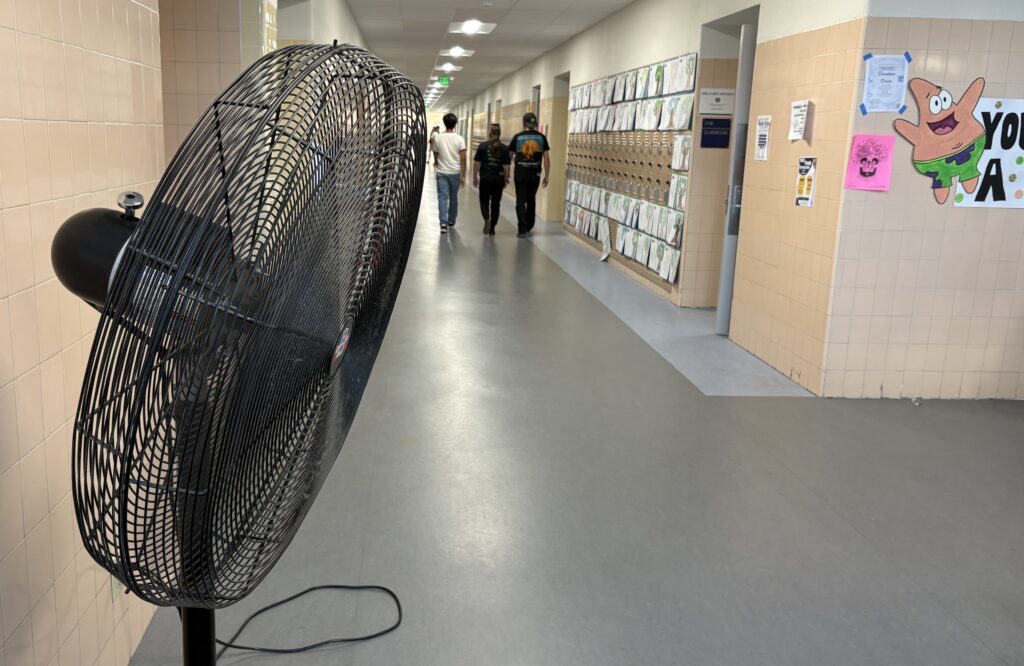
Hand-held fans, donated swamp coolers and popsicles are just a few of the stopgap measures Long Beach students, parents and teachers have employed to keep cool recently on campuses without air conditioning.
After multiple sweltering heatwaves since school began in August, some parents say they’re tired of sending their kids into hot classrooms — even keeping their kids home to stay cool.
Although 90% of Long Beach Unified schools are fully air-conditioned, eight campuses are still awaiting updated HVAC systems, expected to be completed by the end of 2027, with the exception of Poly High School, which will be completed the following year. Amid record-breaking temperatures that reached 107 degrees this week, parents and teachers told the Long Beach Post that students’ health and education are suffering at schools without air conditioning.
Six parents and teachers reached out to the Post to discuss health and educational concerns related to the heat. They described stifling classrooms, limited access to cooling stations and a lack of clarity about how student and staff safety would be protected.
The Long Beach Unified School District issued a heat mitigation memo this week, which said that students and teachers had access to chilled water dispensers, portable fans and shade structures. The memo also said that strenuous activity would shift to cooler hours, students would be encouraged to drink water and rooms without AC would be ventilated.
Eight Long Beach Unified schools are still awaiting air-conditioning: Millikan High School, Poly High School, Sato Academy, Hoover Middle School, Marshall Academy, Carver Elementary, Henry Elementary and Los Cerritos Elementary
Yet those measures haven’t prevented the effects of heat, parents said. Katie Jakemer, a parent of a student at Henry, has noticed the physical toll on her daughter, who has expressed anxiety and dread about the heat at school, Jakemer said. “If you have a kid that comes home red-faced, falling asleep at the dinner table, has headaches, you can’t just stay quiet,” she said.
On Tuesday, she posted a video to Instagram expressing her frustration that students are being asked to sit in blistering temperatures and urging the district to consider modifying the school day.
LBUSD spokesperson Eric Mitchell said schools would only close for extreme weather if directed to by city, county or state authorities. He said the district has nothing further to add about why it made that decision.
The state’s funding formula incentivizes Long Beach Unified and other districts to keep kids in class even on hot days. The district loses approximately $75 for each day a student isn’t in class, according to a December budget update.
Yet the heat may be affecting attendance anyway. The district’s attendance tracker on Thursday showed it dipped by about one percentage point over the last five school days when compared to overall attendance since school began.
The effect is slightly more pronounced at some campuses without air conditioning, including Patrick Henry and Carver Elementary Schools, which each dipped by about 1.5% from their respective baselines.
Miguel Lozada, whose child attends Henry Elementary, bought a $330 swamp cooler, which he donated to the school, according to an email reviewed by the Post. But the cooler was only used for a day before Lozada was told he needed to come pick it up, he said. He still doesn’t understand why.
Parents and teachers said the heat was directly affecting learning. One parent said her son had to undergo standardized testing without air conditioning on some of the hottest days, and she worried he had underperformed as a result.
Annette Quintero, a teacher at Poly High School, said that even though her classroom is air-conditioned, students must walk outdoors across campus during passing periods. Some arrived tired and angry after sleeping poorly in the heat, Quintero said. “I’ve seen more heads down in the last few days.”
Experts have warned these hot days may soon be the norm. The mild, dry summers that Southern California has historically enjoyed — thanks to a protective marine layer, cool ocean temperatures and a high-pressure system — may be in jeopardy as meteorological patterns are disrupted by climate change, the Los Angeles Times reported.
According to Long Beach’s Climate Change Assessment, the city could experience an average of 11 to 16 days of extreme heat (above 95 degrees) by midcentury. Southern California was not built for this, and many homes and buildings still lack air conditioning — though Long Beach Unified is racing to catch up.
Quintero has spoken before the school board in the past, urging them to consider a more proactive approach to extreme weather days, similar to how some districts cancel school for heavy snow, she said.
Long Beach will continue to experience extreme weather, from poor air quality to fire to heat, she said. “Given climate change, we need to have policies on the books” — ones that address problems proactively, not reactively, she said.
Editor’s note: This story was corrected to show Quintero said students must walk outdoors to get to other classes, not that they must attend some classes outdoors.