

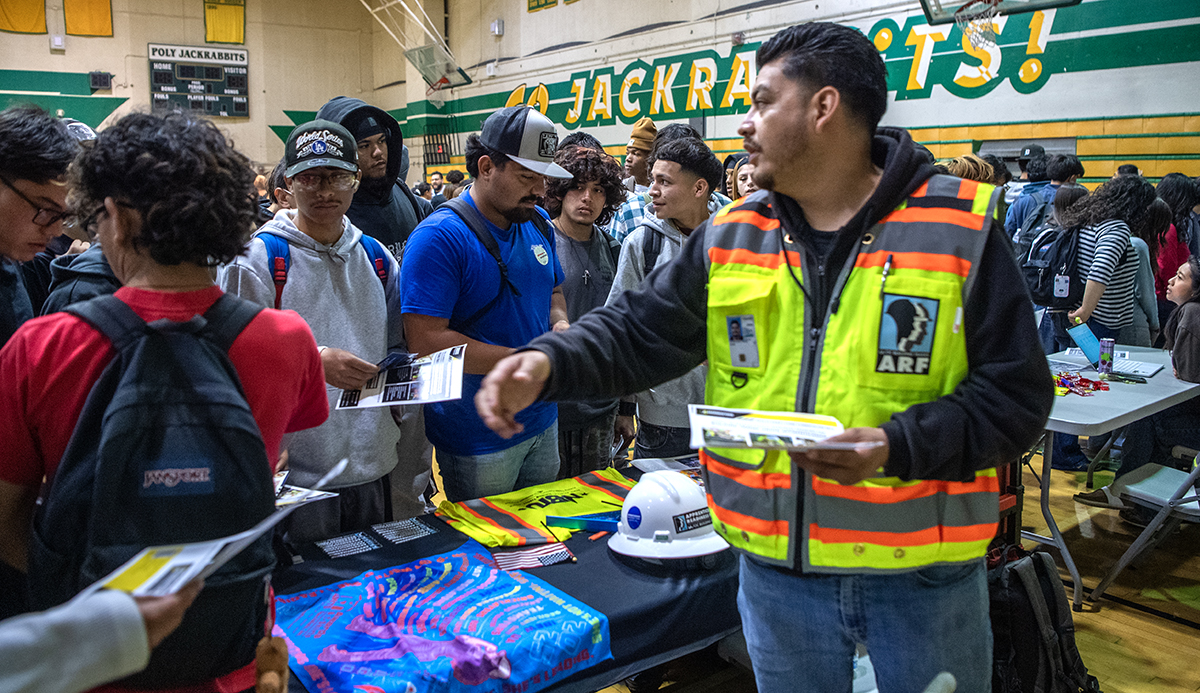
Hundreds of students filled Long Beach Poly High School’s gymnasium Thursday to hear labor organizers, a certified nursing assistant and a former firefighter lay out different paths after graduation — jobs that start with union membership and a paycheck, rather than a college degree.
Labor panelists offered an alternative to rising college costs: the “earn while you learn” model of apprenticeship. An electrician might make $62 an hour after four or five years of paid training, one panelist said.
“Imagine being a homeowner by the time you’re 23 or 24 while most of your colleagues are barely getting out of college with debt and trying to find their first job,” said Irvin Barragan of the apprenticeship readiness fund, a nonprofit connecting people to skilled trades, from plumbing to welding.
The panel and apprenticeship fair began when Annette Quintero, a social studies teacher at Poly, noticed many of her seniors panicking as the end of the year approached. Some knew the college route wasn’t for them but hadn’t been exposed to the trades.
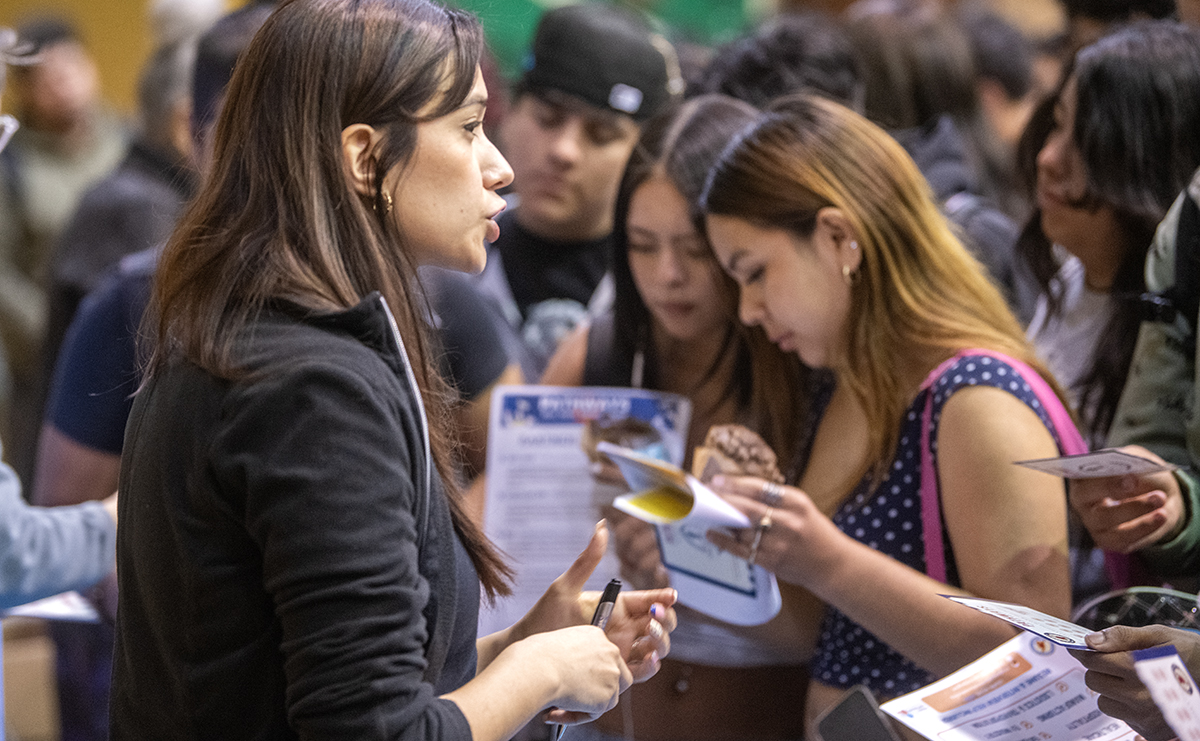
“I think a lot of kids can get lost at school,” she said. “I want to see options available to all students.”
Quintero got to work. Last year’s inaugural event was so popular that many Poly students were left with standing room only. This year, she moved the event to the school’s big gym.
Students listened as panelists traced their own paths into the workforce. Anginette Morgan was inspired by her high school classmates who donned scrubs and boarded a bus to work at a skilled nursing facility nearby. They made enough spending money to frequent a hamburger stand, and Morgan soon took the plunge to become a CNA — a stable, well-paying career that students can access after a four-month program, she said.
Valerie Macias grew interested in labor organizing when her siblings began helping unionize Mother’s Market & Kitchen in Signal Hill. She came to the event at Poly “to learn more about what unions are and how they get started.” Panelists delivered: explaining the power of unions to negotiate for workers and protect their rights. While a non-union security guard might make minimum wage, unions fight for pay increases and fair benefits, they explained.
“The earlier we can expose them to this the better,” said Florence Rivkin, of the Miguel Contreras Foundation, a nonprofit that aims to advance the rights of working Angelenos. At a recent visit to another school, Rivkin said students had only considered the options of college or military after graduation. Because that was all they knew of, “it was so exciting” to introduce them to the trades and other labor pathways, she said.
Before attending events like this one, Rivkin said about 10% of students know what a union is. Afterwards, 90% of students understand the power of unions, according to polling data collected by the Miguel Contreras Foundation.
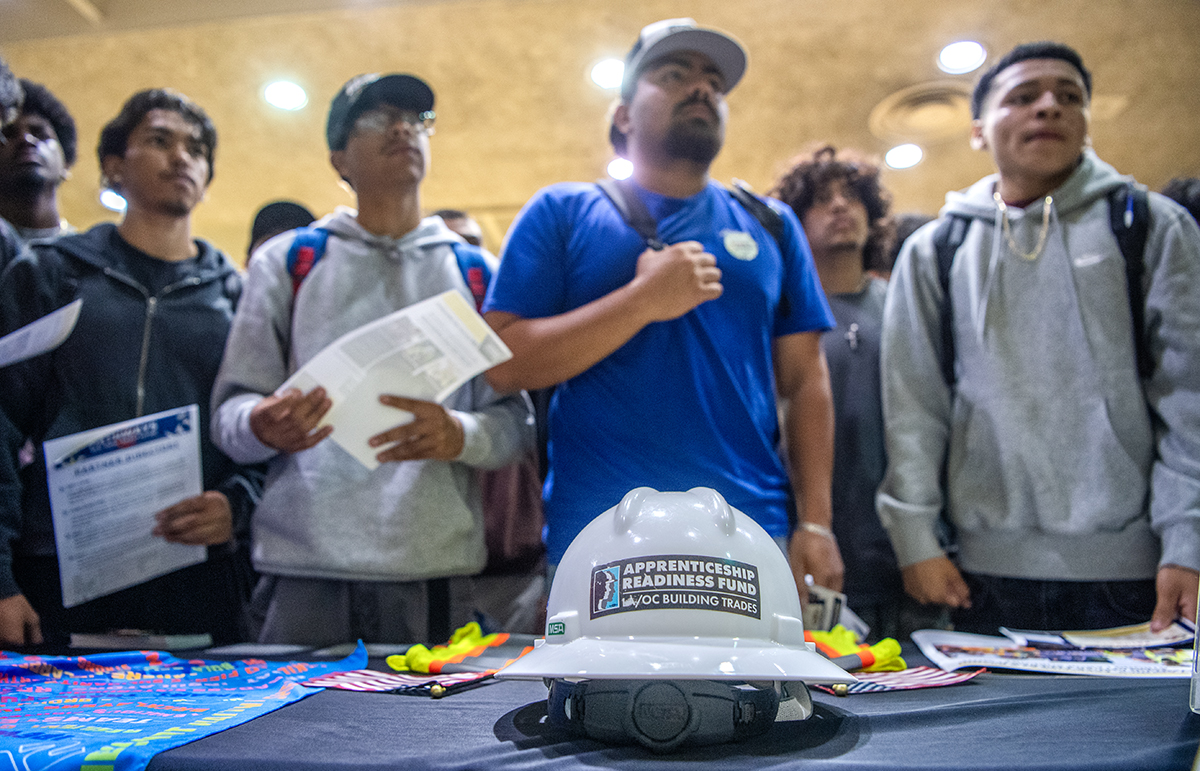
School board member Erik Miller, whose district includes Poly, explained to students that his father’s decision to take a union job at a post office was “the biggest catalyst to who I am today.” The stability unions provide “is what helps the middle class continue to thrive,” he said.
Miller asked students to stand if any family members work as teachers, custodians, police officers, firefighters, public servants or at phone companies. Students rose across the gym. “Look around,” he said, “at the impact labor unions have” had in our communities.
Quintero hopes that one day, the district will offer a labor studies pathway that pairs coursework with apprenticeships. “Right now it’s a pipe dream,” she said.