

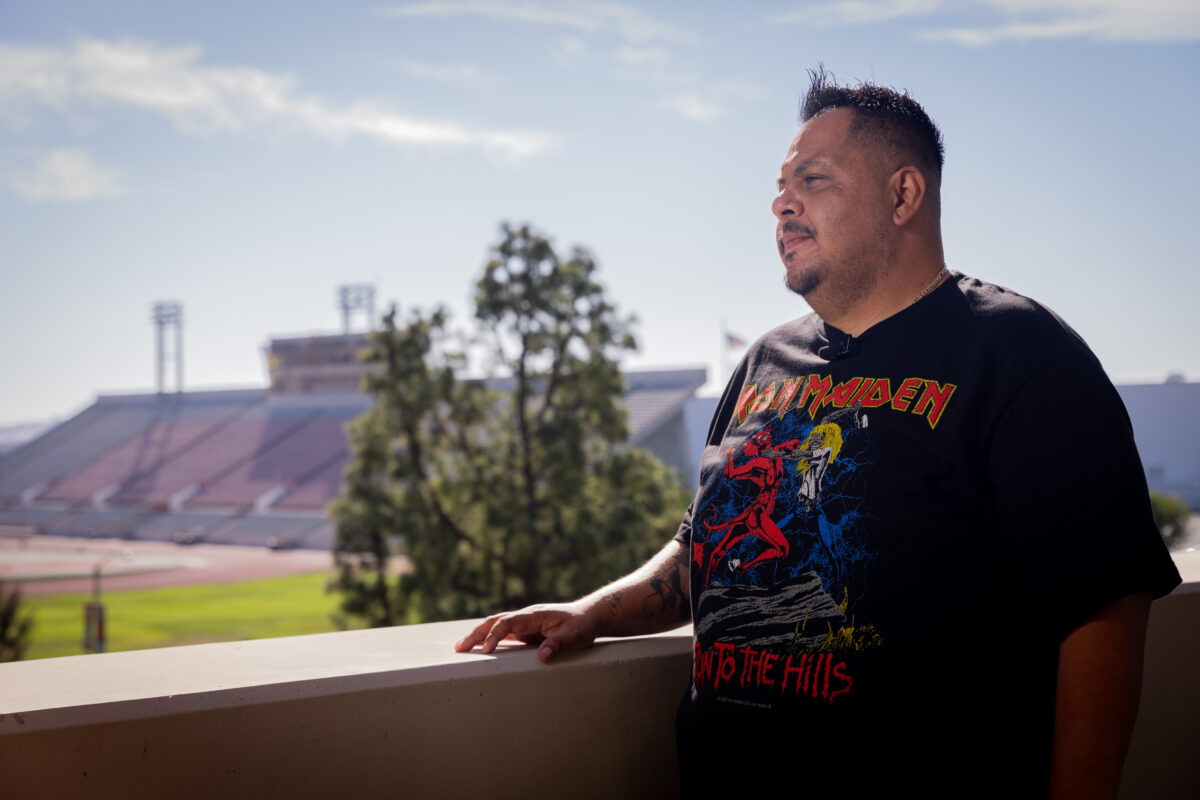
Edgar Rosales Jr. enrolled at Long Beach City College with a secret: he was sleeping in his car.
As demand for his job as a trucker waned, Rosales, 40, returned to school in 2024 seeking a more stable career. He first pursued nursing before pivoting to public health and political science. But balancing classes, part-time work and the immense burdens of homelessness became too much to bear, especially without help.
Rosales’s LBCC peer mentor called to check in. “I’m gonna drop out. I can’t do this,” he remembered telling her. When he revealed he was homeless, his peer mentor recommended the safe parking program, which began in 2021. Now the program serves 45 students, who can sleep in their cars on campus overnight with the protection of security and access to amenities like bathrooms, showers, electricity and Wi-Fi.
Rosales was initially hesitant. “You get stuck in survival mode for so long … you don’t know who’s there to help you,” he said. He picked up the phone anyway and filed his paperwork the same day. That evening, he drove his car to the safe parking lot and slept, the first night in a long time without fear of police or break-ins.
Sleeping in the lot nightly, Rosales felt solidarity with his peers “trying to make it to the next day.” He understood many of the challenges of homelessness, yet LBCC clubs specifically for unhoused students didn’t exist, he said.
So in fall of 2025, he created his own, Voz, a student group aimed at amplifying the voices of unhoused and low-income students. Already, 15 students have joined the club, Rosales said.
According to a student survey LBCC conducted in 2025, nearly 12% of respondents reported experiencing homelessness in the last year. Close to 800 students said they were housing insecure, and 80 students reported sleeping in their vehicles.
Clearly seeing the need, Rosales immersed himself in the work, organizing toy and makeup drives, handing out food and water to safe parkers and serving as the student liaison for the LBCC basic needs program.
Rosales remembered how scary and shameful it felt to ask for help, and he continues to work to destigmatize homelessness. “People just need to ask for help when they need it, not when it’s too late, when the situation is dire,” he said. By then, many feel it’s too late and give up, he said.
“His leadership has helped elevate the needs of our most vulnerable students and has pushed us to continually improve our support systems,” LBCC Superintendent-President Mike Muñoz said. “Edgar embodies the spirit of resilience and community that defines LBCC.”
Rosales applauded the college for the work it’s already doing to support students’ basic needs through the Viking Vault food pantry, monthly hot breakfasts and housing resources. He’s eager to see the college do more to support students like him, he said.
In December, Rosales was selected as a 2025 honoree of the Courage Project, a new national initiative that honors “everyday acts of bravery,” according to the program’s website. As one of five awardees announced last month, Rosales received $25,000 for a nonprofit of his choice as part of the project’s “pay it forward” approach. Rosales donated the money to the Long Beach City College Foundation, intending that the funds support the basic needs program, which addresses housing and food insecurity.
Rosales wants to effect change on a scale that is both realistic and local, and he illustrated his approach with members of the Justice League: Superman has strength and powers that allow him to “take care of the entire world. But Batman’s human. He can only take care of one small city,” he said.
Rosales freely admits he is human and sometimes needs help. Yet he knows he has the power to support his local community, too. One day, he hopes to run for office to address homelessness on a larger scale, but for now, he’s focusing his energy on his campus. “I’m an LBCC student,” he said. “My world is here.”
In September, Rosales, who had resigned himself to living in his car indefinitely, received news that changed everything: The college had helped him secure housing. Rosales was in “complete shock,” he said, remembering how he had initially turned it down, saying he could get by in his car for a few more weeks. Instead, he drove his things over and began settling into his new home. Months later, he said, “I can’t sleep because I think it’s still a dream.”