


This story was originally published by EdSource. Sign up for their daily newsletter.
Gov. Gavin Newsom will announce Thursday that he will ask the Legislature to shift the operation and control of the California Department of Education from the state superintendent of public instruction to the governor and the State Board of Education.
More than a half-dozen study commissions and reports dating back to 1920 have urged the idea’s adoption to eliminate confusion and conflicts over who in California is ultimately accountable for education policies and programs.
All have agreed that competing and overlapping authorities — a governor and state board that create programs and policies, and an independently elected state schools superintendent who oversees and implements them and is answerable to voters, not to governors — makes it unclear who’s in charge.
Newsom will disclose his plan in his State of the State address on Thursday. A press release from the governor’s office explaining why the idea makes sense contains few details. These will be fleshed out in a preliminary budget “trailer” bill in February, said Brooks Allen, executive director of the state board and an education adviser to the governor.
The release indicates Newsom has already lined up support from key education groups, including leaders of the associations of school administrators, county superintendents, and school district business officers, along with children’s advocacy groups Californians Together and EdTrust-West.
State Superintendent of Public Instruction Tony Thurmond could not be reached for an immediate comment.
The proposal will not call for eliminating the state schools superintendent as an independent constitutional officer, a role that dates back to the 19th century. Four times voters have rejected that idea.
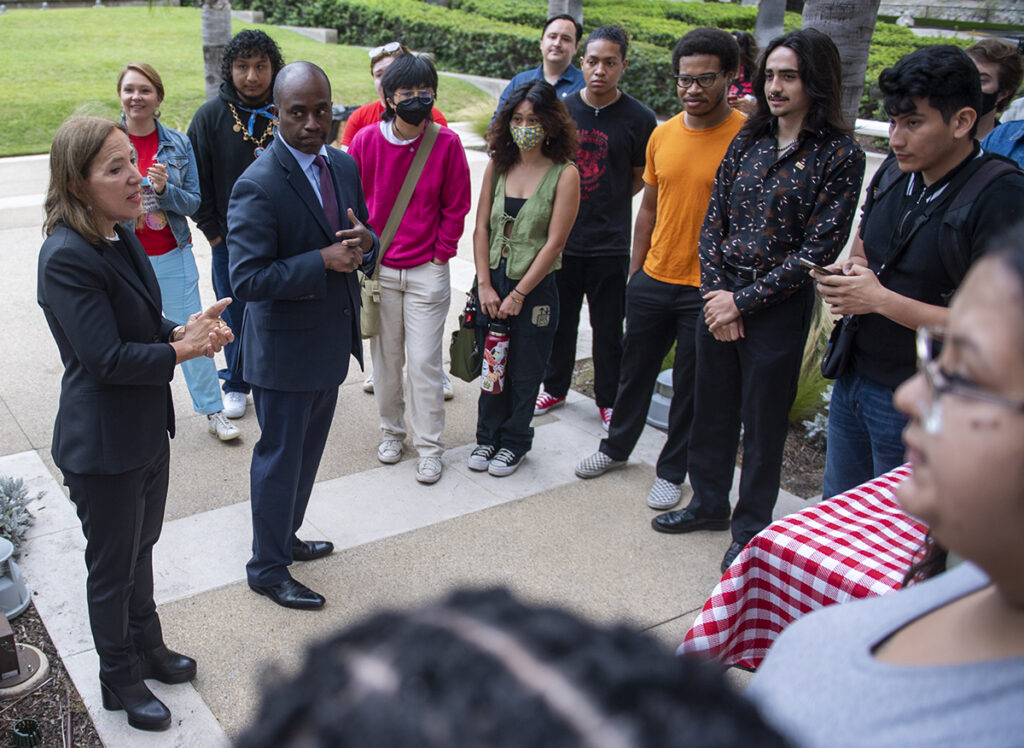
Instead, department management would be shifted by statute to the governor, who, under the direct authority of the state board, would hire a director of the Department of Education. That person would be comparable to a cabinet secretary — a manager, presumably with knowledge and experience of running educational systems.
The state schools superintendent, in turn, would act as an “independent champion” and ombudsman for education from early childhood through higher education, under the plan that Newsom proposes. The position would gain responsibilities as a voting member of the State Board of Education and the Board of Governors of the California Community Colleges system.
“This is not a referendum on the current superintendent, but the recognition of historical truth,” said Allen. “Structurally, the system is set up for conflicts.”
The idea of realignment gained traction last month with the endorsement of the concept by the research center Policy Analysis for California Education, or PACE. Its lengthy report said that California’s education governance “is fragmented by design, with a double-headed structure that divides authority” and “blurs policy-setting and implementation roles.”
A 2006 report for Getting Down to Facts, a series of studies commissioned by the governor and the Legislature, reached a similar conclusion, calling the state governance system “a remarkably crazy quilt of interacting authorities that are not aligned, for the purpose of accountability or action.”
“Kudos to Newsom for pushing for realignment,” said Ted Lempert, president of Children Now, a research and advocacy organization, who is lining up backers of the proposal and is finding considerable interest and support for clearer accountability.
“Experts say governance affects outcomes in the classroom,” said Lempert. Educators and Californians want to know where the buck stops when programs are poorly implemented or promised payments for grants are late, he said.
Currently, only eight states have a governance structure similar to California’s, while in 14 states, including Connecticut, Florida, Illinois and Massachusetts, the governor appoints an education board that in turn appoints the chief school officer, according to Newsom’s office.
For the past three decades, state school superintendents, including Thurmond, have been legislators without experience running school districts or large organizations.
“We see the benefit of democratic elections, but also the benefits in appointing leaders with expertise. Those who best lead organizations often do not want to run a statewide campaign,” said Jeannie Myung, the director of policy research at PACE and the lead writer for the PACE report.
It’s why, she said, “we elect school board members but let the superintendent run a school district.”
In the governor’s press release, Yolie Flores, president and CEO of Families in Schools, also praised Newsom for advancing the proposal.
“For too long, a fragmented and inefficient system has limited schools’ ability to partner meaningfully with families and has created barriers to equitable student success,” she said. “Thoughtful, systemic reform is essential to ensuring that every child thrives — and that families are empowered as true partners in their children’s education.”
In a PACE release Thursday, Michael Kirst, whom former Gov. Jerry Brown appointed as president of the State Board of Education during Brown’s four terms in office, called Newsom’s proposal “a new vision and a dramatic overhaul” that the Legislature should enact.
“California’s education governance system was created in the 19th century. The lack of fundamental change since then has hindered education progress,” he said.
Myung cautioned that passing statutes will be only the first step for improving a department that studies have shown has been underfunded and overly focused on meeting federal programs’ compliance requirements.
“Change will not be overnight. It will take time to build its capacity,” she said.