


Ajala Sen is a natural performer. The rising senior at Poly High School got her first taste of the stage when she played Tom Petty’s “Free Fallin’” at her third-grade talent show, she said.
“It was exhilarating, and the audience loved it,” she said.
Since then, she took up drums, began writing songs and poems and formed her own punk band, Sugar Skulls. She creates because she feels compelled to translate emotion and reactions to her world into language and music — and to share her creative work with an audience, she said.
“She owns the stage,” said Xóchi Salas, coordinator for the Long Beach Youth Poet Laureate program.
In recognition of her poetry and performance, Sen was named the 2026 Youth Poet Laureate of Long Beach, an honor intended to help showcase and mentor the city’s young artists. As Youth Poet Laureate, Sen receives a $1,500 scholarship and poetry training. She will also promote poetry through service, representing Long Beach youth at public events and helping organize workshops and panels for community members.
Sen’s work stood out because it “uplifts a lot of raw, honest and vulnerable truths,” Salas said, adding that Sen’s ability to harness that, especially at such a young age, is a “powerful gift.”
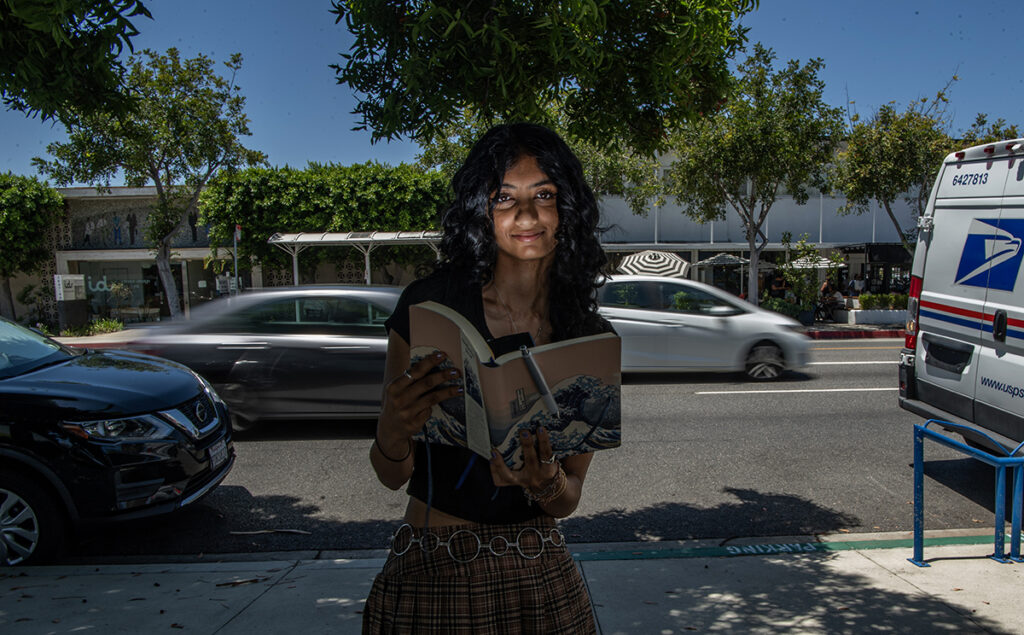
Much of Sen’s poetry centers on her home in Long Beach and the forces, people and events that shape the city, she said. She does not shy away from disparities between neighborhoods, federal immigration crackdowns and the school-to-prison pipeline, she said. Rather, she said she feels an obligation to bear witness and to share her observations.
In January, Sen performed her poem, “Who Built This?” for Poly High School’s annual poetry slam contest. Her poem explores the dissonances within Los Angeles, “A city built by Brown hands,” filled with people who “Do nothing when bullets go right through / The people that gave you this country,” she wrote.
Her work is personal. Sen’s own father is an immigrant from Bengal, and her grandfather fled Punjab during the 1947 Partition of India, she said. (“Stepping off a plane or ship / Fresh from the South Pacific / Into the unknown / With nothing but their skin, bone and hope,” she wrote of those who made her life possible in Southern California.)
Sen had entered Poly’s contest in the past and had taken a copy of her poem onstage in case she forgot it. But this time, she took the stage with her poem memorized, allowing her to feel “it from inside rather than from the page,” she said.
Her craft and delivery were suffused with music — evidence of her years of training, from her father teaching her guitar as a child, to her practice of Kathak, a form of classical dance from Northern India. And she approaches her poetry like she’s performing music, using rhythm, dynamics, rhyme and rests for emphasis, she said. She pays attention to how the audience interacts, listening for applause but also silence.
Even her movements evoke music and dance — she raises her hands as she speaks, stressing certain words and phrases. “She excels at bringing in body movement while also verbalizing,” Salas said, a skill that “captivated the audience,” they added.

Sen took home first prize at the poetry slam and would go on to repeat that performance for the judges, who would name her Youth Poet Laureate.
Many audience members have told Sen how much the poem meant to them, how deeply they were moved. And that is her ultimate goal, she said: to get people to feel, to build shared understanding.
“Poetry is community-based,” she said. “You do it for a community. You do it with a community.”