

This article was originally published by LAist on Wednesday, May 20, 2026.
More than 600,000 Californians are at risk of losing CalFresh food benefits after expanded work requirements imposed by the federal government go into effect next month, state and county officials warned Wednesday.
The “One Big Beautiful Bill,” signed into law by President Donald Trump last summer, included “multiple significant changes to CalFresh,” the state’s version of SNAP that serves about 5.4 million people, according to the Legislative Analyst’s Office.
They include requirements that some adults work, volunteer or participate in a school or job-training program for 20 hours a week.
People who don’t meet the expanded work requirements will be restricted to three months of CalFresh benefits every three years, according to the state Department of Social Services. CalFresh benefits can be used to buy almost any food, as well as seeds or plants that can grow food.
The new federal rules will now affect people experiencing homelessness, veterans and former foster youth, unless they are excused for other reasons.
About 260,000 people in L.A. County are at risk of losing CalFresh benefits under the new requirements, according to Hilda Solis, chair of the L.A. County Board of Supervisors.
“These expanded work requirements are going to create more barriers for people who are already struggling to meet ends,” she said at a briefing Wednesday. “It’s not about creating opportunity, it’s about making it harder for people to keep the benefits that they already qualify for.”
About 108,000 people in L.A. County have already lost their CalFresh benefits since the bill was passed last July, which Solis said is putting more pressure on local food banks and community-based organizations that are already operating at capacity to meet residents’ needs.
What are the changes to CalFresh?
Three main changes to CalFresh are planned for this year: expanded work requirements, disqualification of some people without U.S. citizenship and a new funding model that will pull more money from state and local sources instead of the federal government.
The work-requirement changes go into effect in June and are expected to affect about 665,000 Californians, according to the Legislative Analyst’s Office. The rules will be expanded to include people up to age 64. Previously, it applied to those up to 54 years old, according to officials.
There are some exemptions, including people who would be unable to meet the necessary hours because of a physical or mental illness and those caring for children under 14 years old.
Back in April, eligibility guidelines changed for certain Californians without U.S. citizenship. They disqualified some groups from being eligible for CalFresh, including refugees and victims of trafficking, according to the Legislative Analyst’s Office.
An estimated 72,000 people were expected to lose benefits because of limited eligibility.
In October, the way CalFresh is funded is expected to change, shifting more costs to states and counties. California could face roughly $480 million in new annual costs and $190 million for counties, according to the Legislative Analyst’s Office.
How could it affect LA County?
The roughly 260,000 Angelenos likely to be affected by the expanded work requirements may not lose their benefits immediately. People will be evaluated on the new rules when they apply or recertify to keep their CalFresh benefits, according to Jackie Contreras, director of the county’s Department of Public Social Services.
Contreras said people don’t need to take action today, and the department will notify Angelenos directly before any changes affect their case. She encouraged residents to keep their contact information up to date, carefully review all notices and contact the department for questions or assistance.
What if I need assistance now? LAist, the Long Beach Post and Boyle Heights Beat compiled a list of food resources in L.A. County, Los Angeles, Orange County and Long Beach last fall: Need food assistance? Where to go when CalFresh and WIC benefits are delayed. You can also find a flyer from Nutrition Access LA in English and Spanish here.
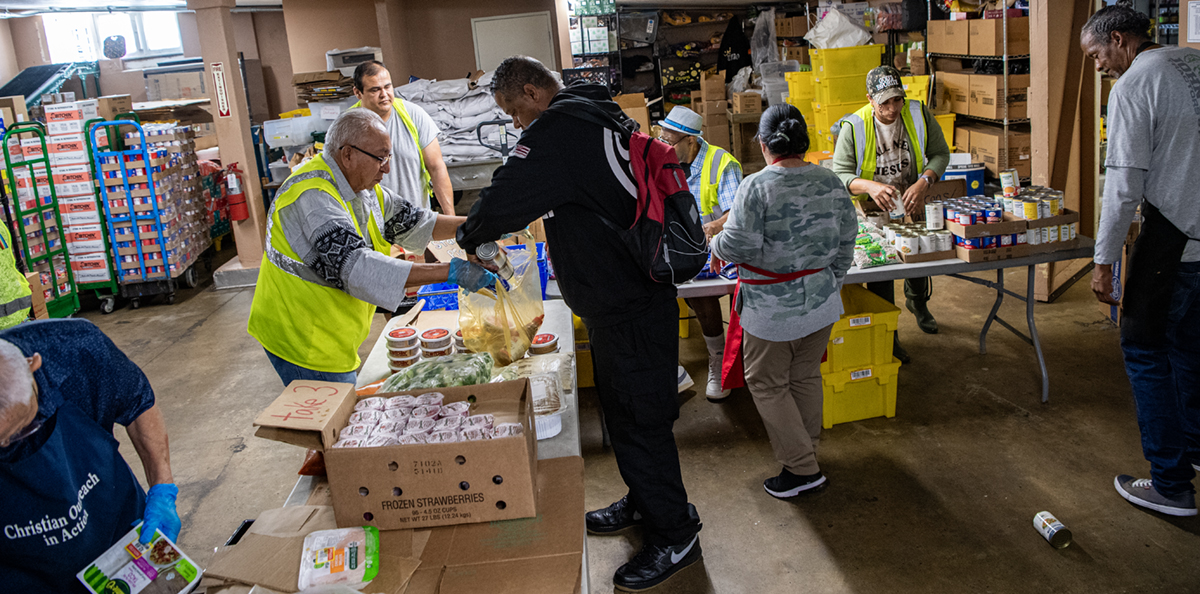
The Los Angeles Regional Food Bank is preparing to see people lose their benefits in the fall as recertifications roll in, according to CEO Michael Flood. The organization has been shoring up the supply through private donations from farmers and manufacturers, as well as purchasing food with funding from the county.
L.A. County committed $12 million to the Food Bank during the federal government shutdown last fall, which translated into about six million pounds of food, or roughly 5.5 million meals.
Flood said the organization was able to stretch those resources into this year, distributing some of the purchased food now and in the coming months to help offset the loss of CalFresh benefits. But the L.A. Regional Food Bank is already seeing an increased demand for food assistance, which he said has been driven primarily by higher prices and inflation.
“We all see it … shopping in a grocery store, those who, you know, need to fill up the gas tank to get to work,” Flood said. “That is something that’s coming through loud and clear and really is causing … challenges for people’s budgets here locally.”
During a recent distribution in Baldwin Park, for example, food provided for about 2,000 households ran out half an hour before the event was slated to end, Flood said. He added that it’s likely the surge in demand will continue through the end of this year and into the next, and that the L.A. Regional Food Bank is “doing everything we can to try to increase resources.”
On the state level, $20 million has been deployed to help counties prepare for the expanded work requirements, according to Assemblymember Alex Lee, chair of the Assembly Human Services Committee.
Lee co-authored a bill that aims to exempt former foster youth from the expanded work requirements. The bill is pending in the state Legislature.
How to help: To support the Los Angeles Regional Food Bank’s work, you can: volunteer, donate financially, donate food — depending on a food bank’s ability to accept and coordinate. More information can be found at lafoodbank.org