

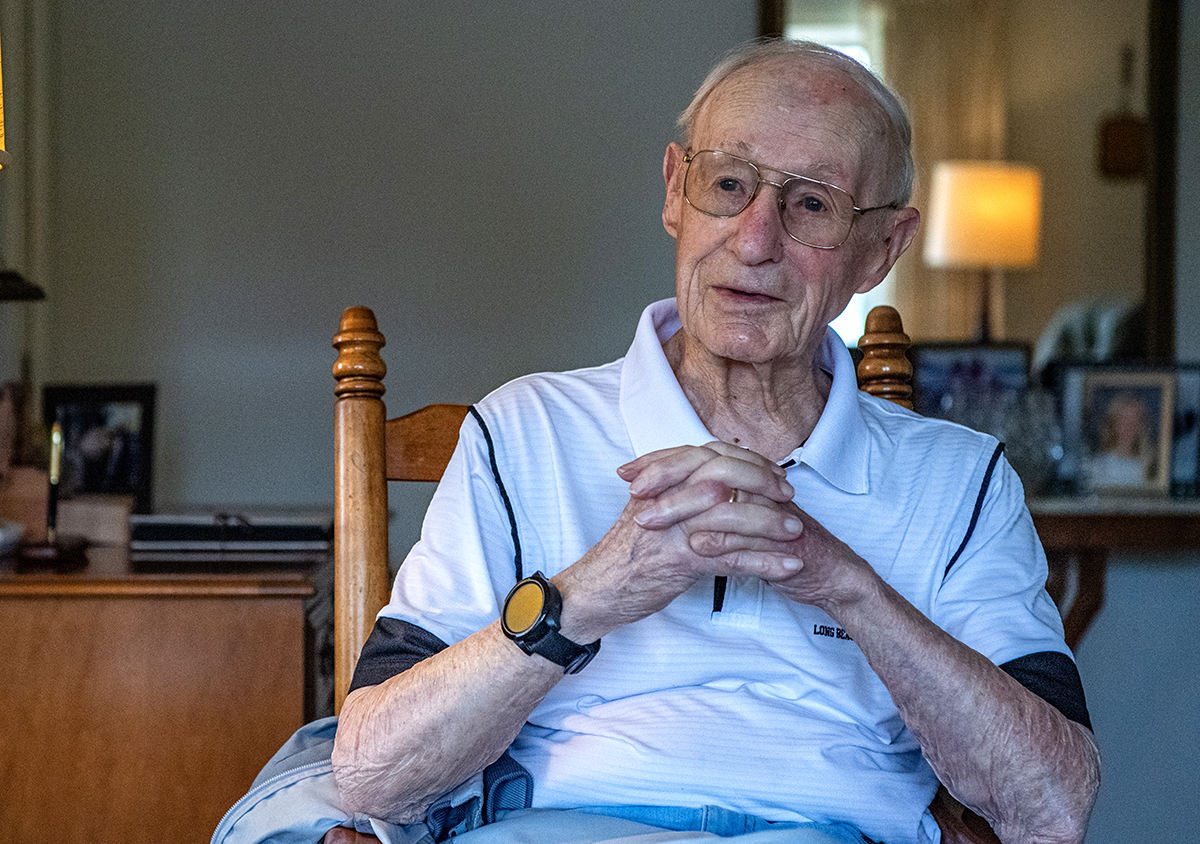
John McConnell was running laps on the track at Thornton Township High School outside Chicago in 1942 when an alumnus and football star he knew from the neighborhood pulled up and started running alongside.
Bob Baumann was a star tackle on spring break from the University of Wisconsin and was set to play for the Chicago Bears. McConnell, a senior on track, was flattered to have such company.
“He came over and said, ‘Let’s run a mile,’” recalled McConnell, who was the fastest miler at the school. “Here was this guy, 60 pounds heavier, running with this punk kid. It was the toughest mile I ran all season.”
McConnell, now 102 and living in Long Beach, was thrilled then to share a few laps with such an athlete clearly on his way to a pro football career and more.
It was the last time McConnell would see him.
With World War II raging, Baumann enlisted in the Marine Corps in 1942 while still a student and was killed in Okinawa. Before that battle, he and 64 other star athletes-turned-Marines had engaged in a pickup football game called “The Mosquito Bowl.” Their stories and that devastating Okinawa campaign became the subject of a bestselling book and movie released Oct. 30. Baumann was played in the movie by Bill Skarsgård.
Fifteen Marines from that game died in Okinawa, the last Pacific land battle of World War II. The touch football game played in Guadalcanal on Christmas Eve 1944 between two Marine regiments was immortalized for its tragic subsequent events as well as the specter of star athletes with promising careers trading football uniforms for Marine camouflage.
McConnell, three years younger than Baumann (sometimes written as Bauman), did not see combat, but he had a front-row seat to some of the devastating effects of one of the most consequential World War II campaigns. He is one of the last living veterans to be in such a position.
While the former Marine said he sees Veterans Day mostly as “just another day,” McConnell remembers well the events from 80-plus years ago.
The Okinawa battle from April 1 to June 22, 1945 claimed 250,000 American, Japanese troops and Okinawans. The horrendous casualties — including 50,000 Americans, 12,000 of whom were killed in combat — prompted military leaders to rethink plans to invade Japan, believing that would lead to hundreds of thousands, possibly millions, more U.S. and Japanese deaths. Instead, military leaders would turn to a top secret and ultimately devastating new tool: the atom bomb.
McConnell was best friends with Baumann’s younger brother, Frank. Right after getting commissioned in June 1945, he and Frank grabbed a flight home to Illinois from Washington D.C. for a 10-day leave.
“We got off the bus at 154th Street and had a couple blocks to walk home,” McConnell recalled. Buoyant and eager to get home, the two “walked past the local pool hall and some guy came out. I didn’t know him. He said, ‘Oh, Frank, you don’t know. Bob was killed in Okinawa.’”
The pair’s joy quickly evaporated.
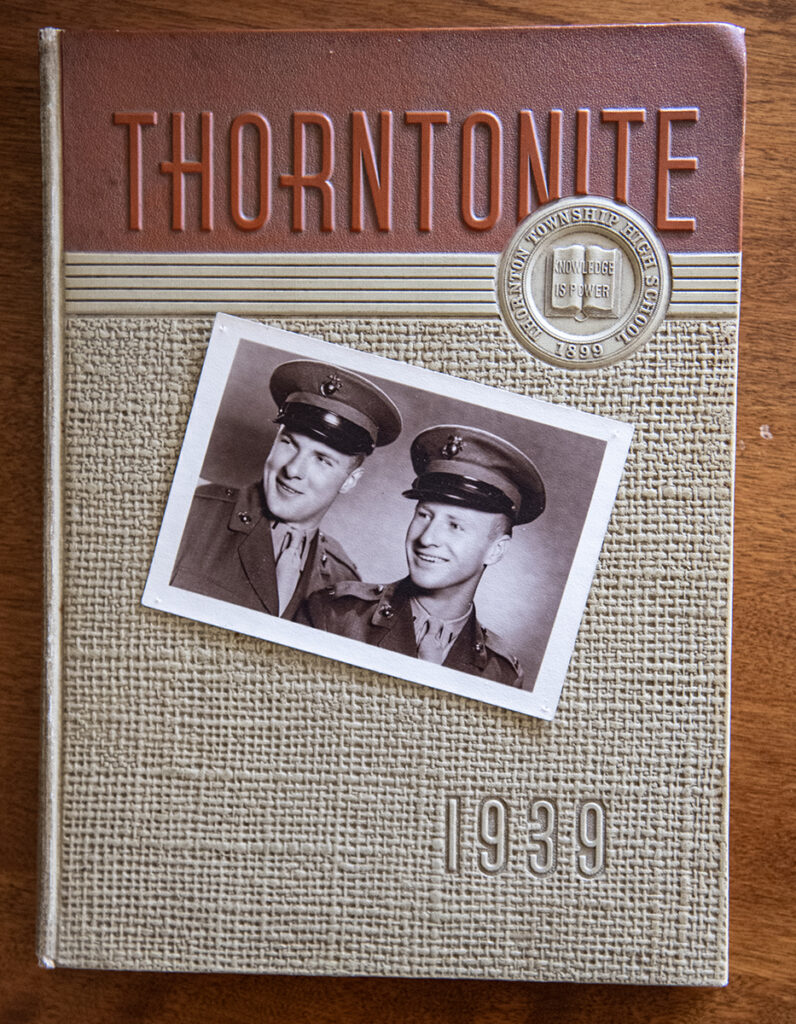
“Frank and Bob’s mother was widowed; his mother was really a wreck. She was asking me, ‘Does Frank know?’ I said, ‘Yes, he knows.’ It was a terrible, tragic scene.”
Baumann and his Wisconsin teammate Dave Schreiner, a two-time football All-American, were platoon leaders engaged in a “mop-up event,” as much of the fighting had ended on Okinawa. He is portrayed in the movie by British actor Tom Francis.
“This sniper was still hanging on and shot them both,” McConnell said. “It was so close to the end. I imagined if they had survived Okinawa, that would have been the end of the war for them.” They died in June 1945, two months before Japan surrendered.
McConnell, who would later move west in 1953 to the new Long Beach State College and a job as a physical education instructor and first baseball coach, said his own tour of duty “was nothing to brag about” and happened in the waning months of the war.
The U.S. had moved the draft age from 21 to 18, so McConnell and a couple of friends enlisted and enrolled in a joint Navy-Marines officer training program at colleges. They toured several before being sent to Camp Lejeune and Quantico, Virginia. McConnell eventually became a platoon leader.
“At that time, people were not volunteering for the Marine Corps because deaths were mounting. My platoon was filled with people who were told, ‘You are going into the Marine Corps.’ Here I am a 20-year-old ordering around 30-year-old guys to make them into a fighting machine.”
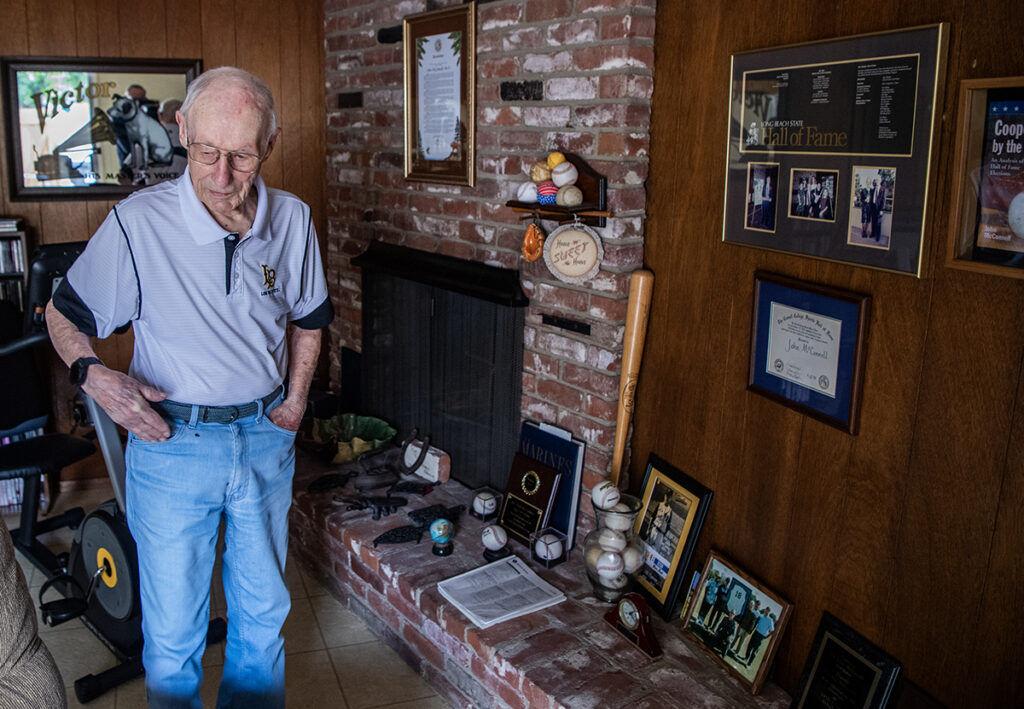
One day in August he heard guys shooting off their rifles and he learned the war had ended. “I was elated, to put it mildly.”
McConnell expects he would have been part of a Japan invasion had there been one. “I’m sure that’s where I would have wound up if the war hadn’t ended. I was training this platoon, all the island engagements had been cleaned up, I’m sure we would have been on the way to Japan.”
Instead, the U.S. dropped atom bombs on Hiroshima and Nagasaki in August of 1945, prompting Japan’s unconditional surrender. Guys like McConnell who would have been part of an invasion went home.
Today, McConnell said he’s in pretty good shape for someone turning 103 in February. Despite some eye and hearing issues, “I’ve been very fortunate; my health is relatively great.”
He said he doesn’t dwell too much on events from 80 years ago. He spends his day working the crossword puzzle, meeting up with friends at the El Dorado golf course and occasionally seeing his family, which includes three children, four grandchildren and two great-grandchildren.
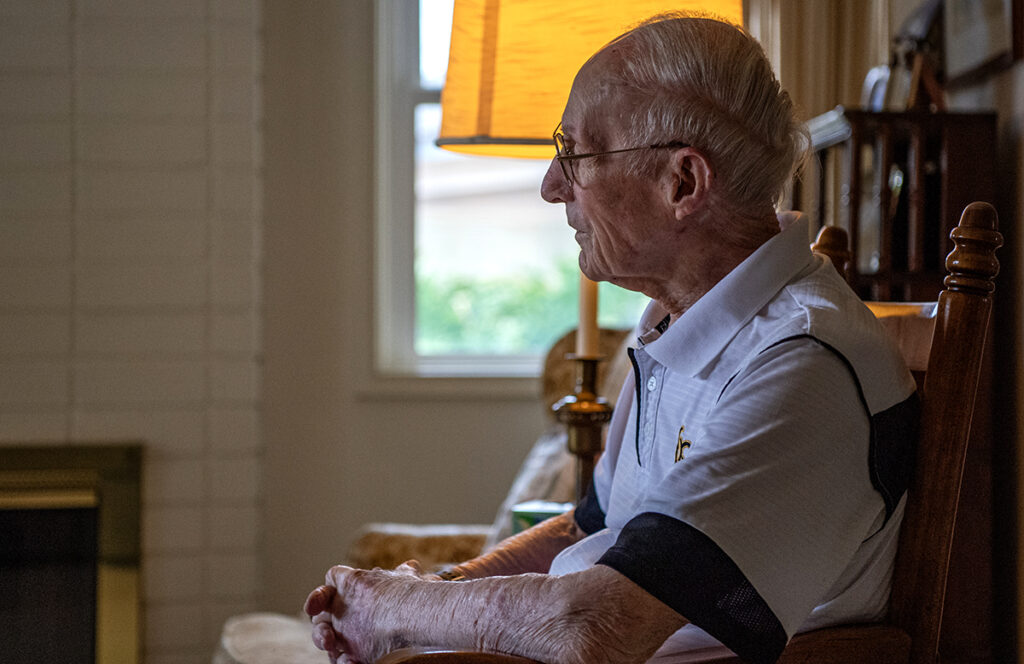
He said he “hadn’t thought about Bob Baumann until this came up with the Mosquito Bowl and it hit all of a sudden. Over the years you become immune, I guess.”
He plans to go see the movie with his son and said he usually doesn’t get emotional watching war movies. “If I had been in combat and gone through what some of those guys went through, I’d have a different view of it,” he said.
Years ago, the father of his son’s friend, a combat veteran, went to “Saving Private Ryan” and wept.
“I’m anxious about what my reaction will be too. You know, Bob was somebody as a kid, I just looked up to him. My goodness, he was a local hero.”