

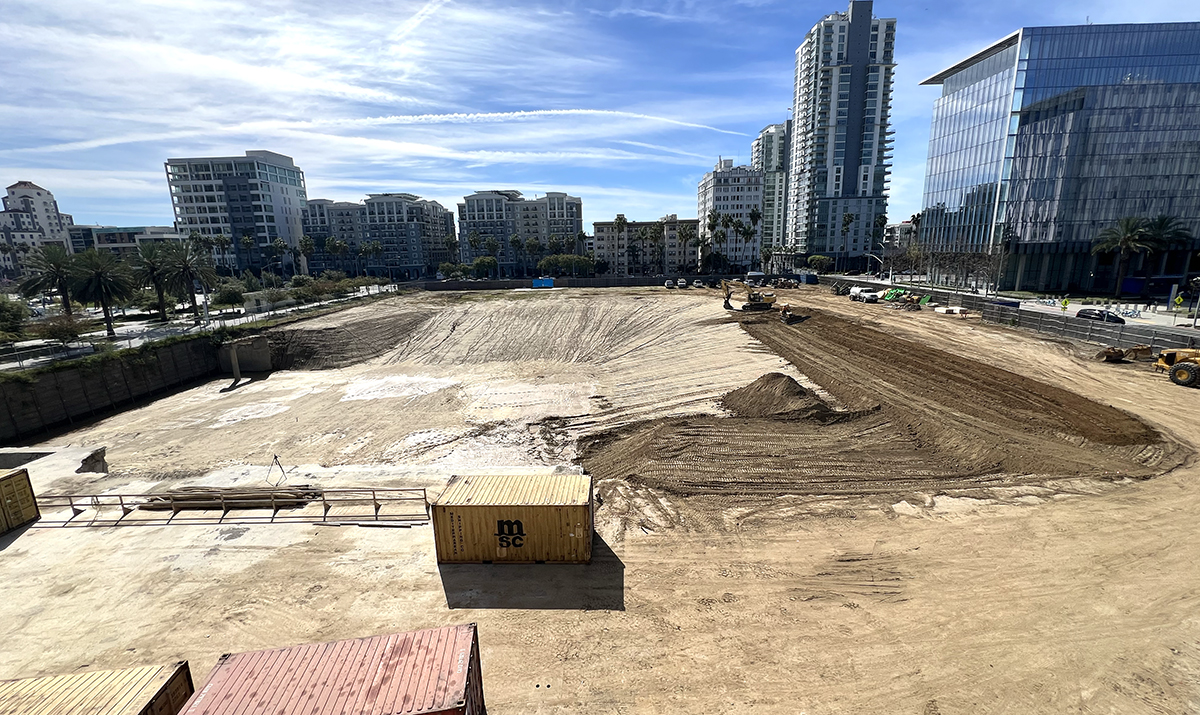
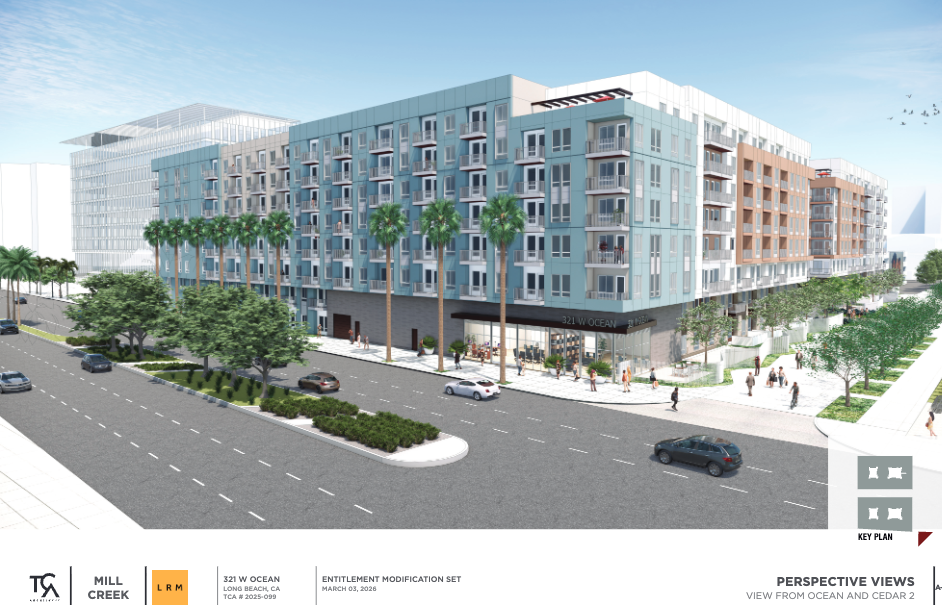
After years of delays, developers have brought forward plans they hope will reanimate efforts to build a pair of eight-story apartment towers on a massive dirt lot in the heart of downtown Long Beach.
The 4.6-acre site at Ocean Boulevard and Chestnut Avenue once housed the old Long Beach City Hall but has sat empty since its demolition was completed in 2022. Plans to build have been plagued by false starts and stops, protracted financing struggles and revisions over the scope of construction. The site has been in escrow with the project company since 2016. In the interim, it’s mostly been a home for runoff and overgrown vegetation. This weekend, it’s hosting a skateboarding competition.
Rising material costs and an inability to secure funding ultimately doomed original designs that called for 580 units, 40,000 square feet of retail space, a metal panel facade, and a two-floor underground parking garage shared by either building.
Officials on the city Planning Commission on Thursday will now review revised plans that include some major differences from the previous concept, ones the developer says should ensure its financial viability.
Under the new proposal, the towers will hold a combined 729 apartments — including ground-floor units — and only a 2,650-square-foot retail space in the northern building due to “a continuing weak retail market.”
Once built, they will be the final piece in an elaborate, years-long effort approved in 2015 to replace the city’s keynote buildings in downtown, including the aging city hall, courthouse, port administration building, library and centerpiece park.
Each apartment building will have a courtyard, pool, sky lounge, gym, inside parking and a half of the promenade that will cut between the two with a view of City Hall and the Harbor Department headquarters.
Parking will be separate and above ground — down from 885 to 817 parking stalls — and there will be far fewer studio units, to make room for more profitable apartments with bedrooms.
There would also be 365 bike spaces between the two buildings in the proposal.
Apartment size, on average, will be smaller than originally planned. Studios will lose about 50-square feet, while two-bedroom units will be cut down by about 300 square feet.
Apartments would range in size from 499-square-foot studios to 1,211-square-foot townhomes.
Citing a jump in the cost of labor and materials, the buildings will have a stucco facade and lobbies lined with porcelain tile and wood composite.
The proposal plans for 11 studios and 62 one-bedroom apartments designated for affordable housing.
Developers are also requesting the city to honor a 2016 agreement that only requires 10% of the units to be affordable homes, priced at a moderate income rate, or between 80% to 120% of the area’s median income.
Current local housing laws would typically require that a project like this have 12% of units priced at low- or very-low income levels.
City planners say this would address the city’s growing need for moderate-income affordable housing, and have entitled only 6.2% of the units it needs in this price category — the worst of any housing type. According to the proposal, the city has seen 21.3% of housing the state says it needs built by 2029.