


Alarmed by the number of traffic deaths along Pacific Coast Highway’s 8.5-mile stretch in Long Beach, state leaders and local officials want to install speed cameras they believe will deter dangerous driving.
A new bill, if passed by the state legislature, would empower Long Beach to install up to six “speed safety systems” along the segment of PCH in city limits. It would mirror a state pilot the city looks to implement by the fall, in which it will install 18 speed cameras along the city’s most nefarious streets. Because PCH is a state route, it was not included in that original pilot.
But State Sen. Lena Gonzalez said it’s clear something must be done about the highway that claims far too many lives: an unhoused man run over by the rear wheels of a semi-truck driving over the sidewalk; a 47-year-old Ontario man struck by consecutive vehicles; and Brandy Jackson, a 46-year-old woman killed in a hit-and-run in November, among others.
Since 2020, crash data shows one-fifth of Long Beach’s traffic deaths have happened on PCH, despite it accounting for less than 1% of the city’s roadways, according to Gonzalez’s office.
“We’ve just seen it every other week, it seems like there’s an unfortunate accident or a fatality,” said Gonzalez, who introduced the bill last week. It’s already received support from Long Beach Councilmember Suely Saro, whose district includes a large portion of the roadway.
“We have a responsibility to act with urgency,” Saro said in a release.
Cameras, once installed, would automatically issue tickets to the owners of vehicles spotted exceeding the speed limit by at least 11 miles per hour. Other cities that the state authorized to experiment with speed cameras have already begun seeing success, including notable progress slowing down drivers in San Francisco. Long Beach has been criticized for not moving swiftly enough to install its cameras even as fatal crashes spike.
Long associated with picturesque roads and spectacular scenery, PCH has earned a bedeviled reputation across the state for fast cars, sharp curves and unsafe crossings for pedestrians — many of whom risk life-threatening accidents each day just to pass.
A similar bill to Gonzalez’s was approved in 2024 to bring five cameras to a 21-mile stretch of PCH in Malibu, largely seen as a direct response to the deaths of four Pepperdine University students in late 2023.
In Long Beach, the road forgoes the coast and instead cuts across some of the city’s densest neighborhoods, with up to 62,500 cars each day passing by in close distance to nearly a dozen schools, a handful of medical clinics and several shopping centers.
Nearly half of drivers humming along PCH in Long Beach are driving at least 10 miles per hour over the speed limit, according to city data.
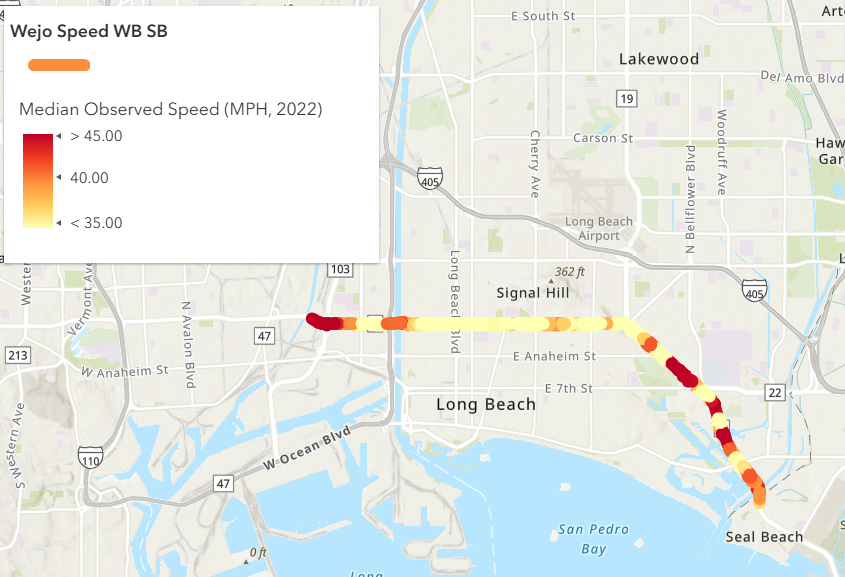
Gonzalez, a member of the local PTA, said she’s been inundated with calls and emails from parents asking for more safety measures like flashing beacons, speed bumps and crosswalks. Caltrans, the state transportation agency, manages the road and is responsible for any such changes. A Caltrans spokesperson said Monday it currently has projects underway to improve sidewalks, protected bikeways and crosswalks throughout the eight-mile segment.
Recent legislation will also allow Caltrans to install 35 cameras to ticket drivers speeding through construction and maintenance zones along PCH. Signed in October, it will run through 2032. Gonzalez’s bill, by contrast, authorizes Long Beach to install and operate the speed cameras itself, bypassing Caltrans.
Speaking to the number of cameras, but also other safety investments, Gonzalez says she doesn’t want to limit herself on what can be brought to the city.
“However much it takes to lower the rate of injury and fatality is what we’ll do,” she said. “And we’re in a situation now where state budget dollars can be appropriated to these safe traffic calming measures, and we would absolutely push for that as well.”