


To those barreling through city streets: your days of speeding are numbered.
Automatic speed cameras will start issuing tickets along Long Beach’s most nefarious roadways next year, in a bid to curb rising traffic fatalities and injuries.
This comes after the Long Beach City Council on Tuesday approved two plans that outline the locations for the cameras, explain their placement, chart the expected cost of the program and govern how data will be collected.
Officials expect to install the cameras in the spring and begin issuing warning citations for 60 days through the summer. Speeding drivers will begin receiving fines in the fall.
How will it work?
The 18 camera locations were chosen for their high rates of street racing, speeding and pedestrian collisions. Most locations are also in or near a school zone.
Cameras had to be placed within either a federally-designated safety corridor, school zone or an area that has received calls for enforcement for four separate incidents within the last two years.
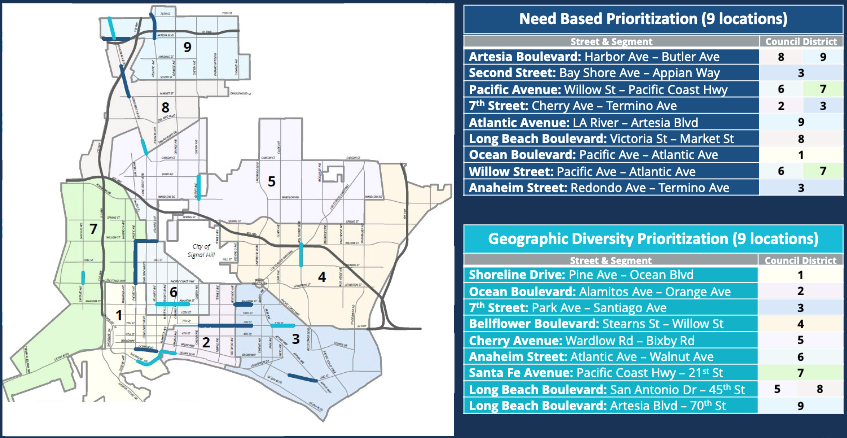
There is some overlap. Long Beach Boulevard, for example, will have cameras installed at three locations, each for different reasons: one between E. San Antonio Drive and 45th Street, due to being a high-injury network and a bustling truck route; another between Victoria and Market Street for its rampant street racing despite being a school zone; and a third one covering Artesia Boulevard to 70th Street, due to having the highest rate of street racing in the city. It is also a common route for trucks.
There will be warnings you’re approaching a speed camera, said Public Works Director Josh Hickman. Signage will be posted within 500 feet of the pole-mounted devices with “Photo Enforced” in bold below, with other signage posted further back to allow drivers a chance to decelerate.
The only data collected will be a photograph of a driver’s rear license plate. Using that, Public Works employees will issue tickets to their registered owners, who could be a different person than the driver. Cameras will not photograph people’s faces, and license plate data will not be shared with any law enforcement.
Drivers will have time to adjust. Tickets issued in the first 60 days will come only with a warning. Afterwards, owners of any car speeding over 11 mph face a fine of $50, with a cost escalator up to $500 for those driving 100 mph.
Tickets can be paid, negotiated down as much as 80% based on income level or swapped for community service. Data is erased once the ticket is resolved.
The program will cost $835,000 in the first year, with an annual operating cost of about $1.6 million. Over the five-year period it’s expected to run, officials estimate it will cost a total of $8.9 million, covered wholly by citations issued.
Any additional profits from citations will be used to pay for traffic calming improvements, like speed bumps, flashing beacons and lane narrowing.
How’d we get here?
This comes two years after the city was approved to join a state pilot for speed cameras alongside six other cities. But so far, only one, San Francisco, has launched the program, while others continue to lag behind.
Since the bill authorizing the pilot was signed in October 2023, there have been more than 3,200 crashes in Long Beach — of those, more than 20% resulted from speeding, according to state collision data. Of the nearly 3,000 people injured in traffic collisions in 2024, speed was the leading factor in a quarter of the crashes.
According to a 2025 report released last week by the Southern California Association of Governments. The city from 2014 to 2024 saw more than 400 people killed and another 40,000 injured by collisions.
Long Beach’s 55 traffic fatal collisions this year have outpaced homicides and exceeded last year’s total of 36 killed in crashes.
Erin Hoops, with the pro-street-safety group Carlite Long Beach, said this has been “the deadliest year since before the 1990s.”
What’s next?
The pilot will be deemed a success if it can bring a 20% reduction in excessive speeding or repeat offenses at the chosen locations, officials said.
“I know there’s a lot of enthusiasm here, on the public side, the City Council side, I think the timing couldn’t be better,” said Mayor Rex Richardson. “The traffic safety, the incidents of vehicle fatalities have increased post-pandemic and also fluctuate wildly.”
Depending on the pilot’s success, council members said they plan to push California legislators to bring additional cameras to nearby state roads, including Pacific Coast Highway.
Recent legislation will allow Caltrans to install 35 cameras to ticket drivers speeding through construction and maintenance zones along PCH. Signed in October, it will run through 2032.
How does the public feel?
Despite the public concern over fatalities, the camera’s introduction was received with mixed results. Surveys that ran from October to November found 48% of respondents opposed the cameras, while 41% supported them. Ninety-five of the 98 responses received focused on the city’s impact report, though officials were scant on details of what was said in the responses.
No changes were made as a result of the public engagement, officials said.