

Sign up to get this weekly briefing in your inbox at LBPost.com/newsletters.
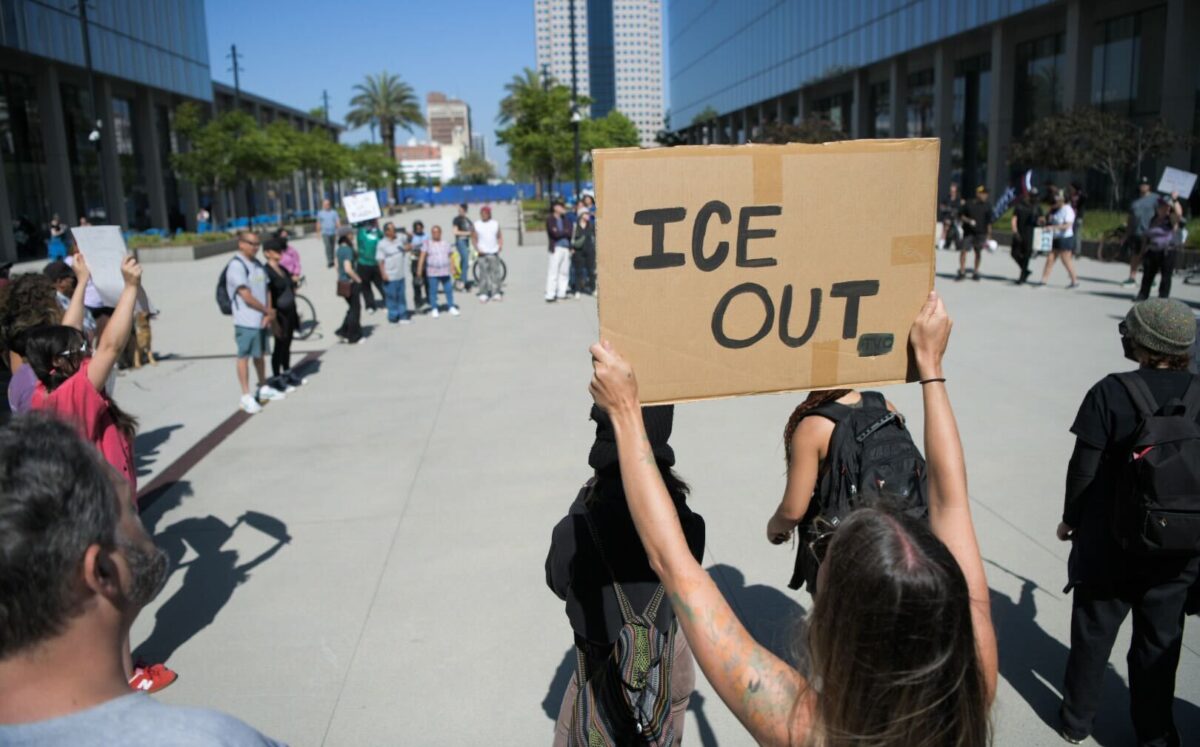
A coalition of immigrant rights groups wants Long Beach to redouble its efforts to protect residents from ICE raids and the threat of deportation.
In a press conference last week, they laid out six changes they want to the city’s already established sanctuary law, the Long Beach Values Act. They want Long Beach to stop using automated license plate readers or any facial recognition software, penalize or cut out any contractors who violate the sanctuary policies, and bar city police from taking second jobs or volunteering with federal immigration officials or their contractors.
They’re also revisiting two items that failed to get passed last time: an elimination of a carve-out in the current sanctuary law that lets police cooperate with federal immigration authorities for certain serious or violent offenses, and for the city to establish a private right of action that would let residents sue Long Beach directly if it violates the Values Act.
Anticipating the argument that these and sanctuary policies run afoul of federal law, advocates argued the city has more legal room now than ever to strengthen its stance.
Fernando Acevedo, of ÓRALE, said jurisdictions that adopted similar protections have largely avoided being sued, and those that were sued mostly won. He pointed to recent rulings against the Trump administration, including a June dismissal of its lawsuit over Los Angeles’ sanctuary policy and a July ruling that it couldn’t withhold public safety grants from California and Oregon cities.
“This isn’t just my read of the law,” said Shiu-Ming Cheer, of the California Immigrant Policy Center, adding the pattern goes back further: Federal judges in California, Illinois and Rhode Island — including some Trump appointees — have repeatedly struck down attempts to condition funding on sanctuary status as unconstitutional under the 10th Amendment.
She noted that Berkeley and Oakland have led the way in cutting or barring contracts with city vendors that share data with ICE, and none of those ordinances have faced a legal challenge. San Francisco, Oakland and Berkeley, among other cities nationwide, have restricted or ended the use of automated license plate readers due to civil rights concerns.
“Long Beach is not just morally right to protect its residents from mass, indiscriminate raids, detentions and deportations, it is standing on solid legal ground when it does so,” Cheer said.
In a response Friday, City Manager Tom Modica said Long Beach has already taken steps “to preserve the legal rights of our entire community,” starting with its inaugural sanctuary policy adopted in 2018 and expanded twice in 2025 — first in January and again in August.
In an Aug. 11 memo, the city said it has since been busy with implementation, from putting out signage to training employees.
Some pieces of it are taking longer than others. The city’s promised online complaint portal for Values Act violations has yet to launch more than a year after it was announced. Residents are still directed to a portal run by the state attorney general. When asked about the delay, Modica said the anonymous reporting system is simply “a large undertaking.”
But even with the changes, there are limits to what the Values Act can control, Modica said. The department has no authority over federal law enforcement and cannot bar agents from arresting people on the street, at work or at home.
It’s unclear how often ICE and Border Patrol are operating in Long Beach. LBPD does not document federal operations unrelated to its own activity “to limit liability,” Modica said. And a license plate reader ban on private companies inside city limits would “require some extensive legal analysis.”
Modica said the city intends to keep using license plate readers. He said the data is not shared with federal or out-of-state agencies, and they do not contract with Flock, whose cameras have become a point of emphasis for anti-surveillance advocates.
Lastly, the coalition also asked for $3 million allocated to the city’s Justice Fund, which pays for deportation defense and other aid to immigrant families. That’s up from a $2.2 million ask last year. That may be a tough sell given Long Beach’s $58 million shortfall. The proposed 2027 budget brings the Justice Fund to just $1 million, which Modica said matches current need.
“Going beyond the $1 million would require a funding solution, most likely reducing something else in the budget,” Modica said.


Quick sips of the latest news
How much funding for police?
At Tuesday’s City Council meeting, the Long Beach Police Department will present its proposed $310 million general fund budget (not including debt service and capital projects). It’s about $6 million slimmer than last year and pockmarked by 78 fewer positions — from special investigators to sergeants, motor detail to the SWAT canine unit. Proposed cuts will shave $20.9 million from the department’s structural budget, just as response times in the city have sped up and reported crimes dropped 17% in 2025 from the year prior. Some additions in the budget: money for the new crime lab, a new patrol specifically for the shoreline, $7 million for the department’s 101st academy, and a $6.5 million helicopter using a mix of cash from seized assets and grant money.
The lagoon is still closed, but Marina Vista Park has reopened
Or at least the portion of it that was closed. The city had a small celebration on Saturday for the space, which had been inaccessible because of construction on the multimillion-dollar Colorado Lagoon Open Channel Project. Officials noted in a release that while the park is fully open, the project trudges on. For updates on how work is going, follow here.
Some TLC for a playground entering its thirties
A $2.7 million facelift is expected for the playground at Houghton Park, which was last renovated in 1995 (I turned one that year), with play zones segmented for ages 2 to 5 and 5 to 12. There will also be sand (sweet) and nature play areas, an inclusive “We-Go” swing, a 26-foot climbing wall, universal carousel, swing sets, nets to climb, seesaw and a central stage. Furnishings will have musical ties to the park’s Uptown Jazz Festival; look for drums, sound cushions, chimes and music notation etched into the surfacing. The project is years in the making and a part of the city’s 2028 Olympics infrastructure plan.
Bills on speed cameras, flashbang bans and drink spiking all advance
A number of bills put forth earlier this year by Long Beach state Sen. Lena Gonzalez and Assemblyman Josh Lowenthal are alive and advancing through the halls of Sacramento.
This includes Lowenthal’s legislation that, if passed, would require bars and nightclubs to provide drink lids and drug testing kits upon request. Gonzalez, meanwhile, has three bills: one that would limit authorities’ use of military-grade disbursement weapons, like flashbangs; another that would greenlight speed cameras along Pacific Coast Highway in Long Beach; and a third that would require local agencies to disclose records of 911 calls at immigration detention centers to the public.
Each bill has cleared through its originating house, be it the Assembly or state Senate, and advanced through committee. They must continue through another round of legislating before reaching the governor’s desk by Aug. 31.
Headlines you shouldn’t miss
- Veterans Stadium is about to be demolished for a new sports complex. Here’s what it meant to Long Beach. (Long Beach Post)
- Almost nowhere in California is building enough, according to the state. Here’s why (CalMatters)
- Federal judge poised to restrict immigration arrest tactics in Los Angeles raids (CalMatters)
- Stingray lashings are up as marine heat wave draws more to shore (Associated Press)