
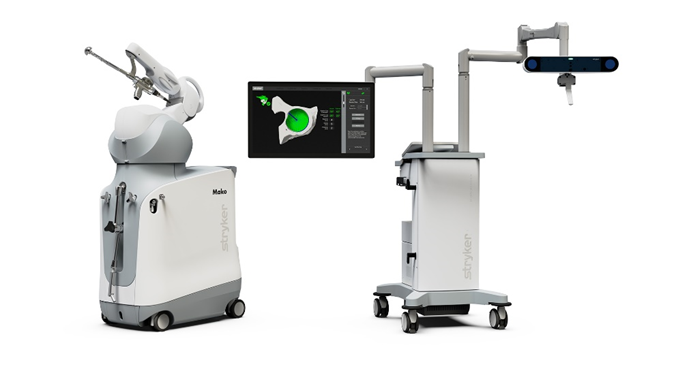
MemorialCare Long Beach Medical Center has made history by becoming the first hospital in the world to successfully perform a robotic hip revision surgery using Stryker’s Mako Total Hip with 5.0 Advanced Primary and Revision application, and the first in California to pair Mako 4 SmartRobotics™ with the Q Guidance System. These milestones represent a significant advancement in orthopedic surgery and reinforce Long Beach Medical Center’s 117-year legacy of innovation and leadership in complex orthopedic care.
“Hip revision is exactly what it says: a revision, replacing the current hip with new parts,” said Andrew Wassef, M.D., medical director, MemorialCare Joint Replacement Center, Long Beach Medical Center. “There are multiple reasons people need a revision. The current implant may have loosened or just worn out over the years. There might be a mechanical problem: one leg could be shorter than the other. Other reasons: pain, stiffness, or infection.”
Hip revision surgeries are often performed years or even decades after an initial hip replacement. While many implants last 15 to 20 years, factors such as age, activity level, or complications can shorten that lifespan. Revision procedures are significantly more complex than primary hip replacements, requiring surgeons to navigate existing implants, scar tissue, and compromised bone quality—making preparation and precision critical.
Mako 4 streamlines surgical workflow and supports the enhanced imaging and planning capabilities of Mako 5.0, enabling patient-specific 3D modeling, augment and screw planning, and intraoperative trajectory guidance. This integration allows surgeons to anticipate challenges before surgery begins that would otherwise only appear once surgery is underway.
“We can template everything, and if there is a potential problem, we see it before we begin the surgery,” said Dr. Wassef. “We can plan the cup size, rotation, the stem, and pelvic tilt, and a virtual range of motion. We can plan for every defect and know exactly what we need before the surgery begins.”
During surgery, the Q Guidance System and robotic platform work together to track anatomy in real time. As the surgeon positions the implant, the robotic arm helps ensure placement aligns precisely based on the surgical plan.
“We can hit the bullseye every time,” said Dr. Wassef.
This advancement marks a new era in joint replacement care, particularly for patients requiring revision surgery, a population expected to grow as more people undergo hip replacements earlier in life and seek lasting mobility as they age. For patients, this approach offers smaller, more targeted incisions, reduced pain, faster recovery, and improved long-term outcomes.
“If we could have seen 10 years ago what we are now able to do, it would have been mind blowing,” Dr. Wassef added. “And to be able to be the first says a lot about how well Long Beach Medical Center understands that new and innovative technology helps us take care of patients with some really tough problems.”
As the first surgeon in the world to perform a robotic hip revision using this technology, Dr. Wassef underscores the role of visionary leadership and institutional support in advancing patient care.
“I’m grateful that Long Beach Medical Center has a vision and supports the work to provide the best care to the surrounding community,” Dr. Wassef said.
This achievement further positions the MemorialCare Orthopedic & Spine Institute as a leader in advanced orthopedic innovation. In addition to Mako 5.0, the institute continues to advance patient care through technologies such as ExcelsiusGPS® navigation, advanced imaging systems, and California’s first Stryker Q Guidance System with CoPilot AI and Airo TruCTmobile imaging—setting new standards for precision, safety, and personalized outcomes.
Patients do not need to travel far to get expert care close to home. Learn more about the MemorialCare Orthopedic & Spine Institute by calling 562-933-4014.
