

Long Beach Unified special education teachers and parents say they’re scrambling in response to staffing changes that have shuffled classroom aides who provide critical support to students with disabilities.
Last month, Jacqueline Santos, a special education teacher at James Madison Elementary, learned that one of her aides had been reassigned, leaving her with reduced support in a classroom of students who sometimes self-injure or run away and need help with communication, toileting, staying on task and regulating emotions. Santos began “putting out fires,” she said, pulling in another aide to fill the gap and causing a “ripple effect,” throughout the school, which lost three special education aides that month, Santos said, which the district confirmed.
She wrote a letter to the district pleading for more support for her classroom. A district administrator responded, acknowledging that mid-year moves are never easy: “We were overstaffed as a district, and we had to let several agency people go to remain fiscally responsible across the district,” the letter said, according to Santos, who read an excerpt to the Long Beach Post.
A spokesperson for the district confirmed this, saying “staffing allocations for special education classrooms have not changed.” Yet as the district has hired more internal staff to replace agency staff, “there has been an overlap where classes have more aides than staffing allocations,” the spokesperson said. Every principal was notified in advance of the change and expected to notify their teaching staff, the spokesperson said. Several teachers told the Post they did not receive prior notice of this change.
This comes as LBUSD is tightening the belt in response to the district’s $70 million projected deficit and facing rising costs of special education services. “Costs associated with behavior intervention support for students, especially at the elementary level, have increased four-fold since 2021-22,” according to a recent memo from Superintendent Jill Baker and Chief Business and Financial Officer Yumi Takahashi. The average cost of one-to-one behavior aides is about $70,000, and demand for this support is increasing at an unsustainable rate, the memo said.
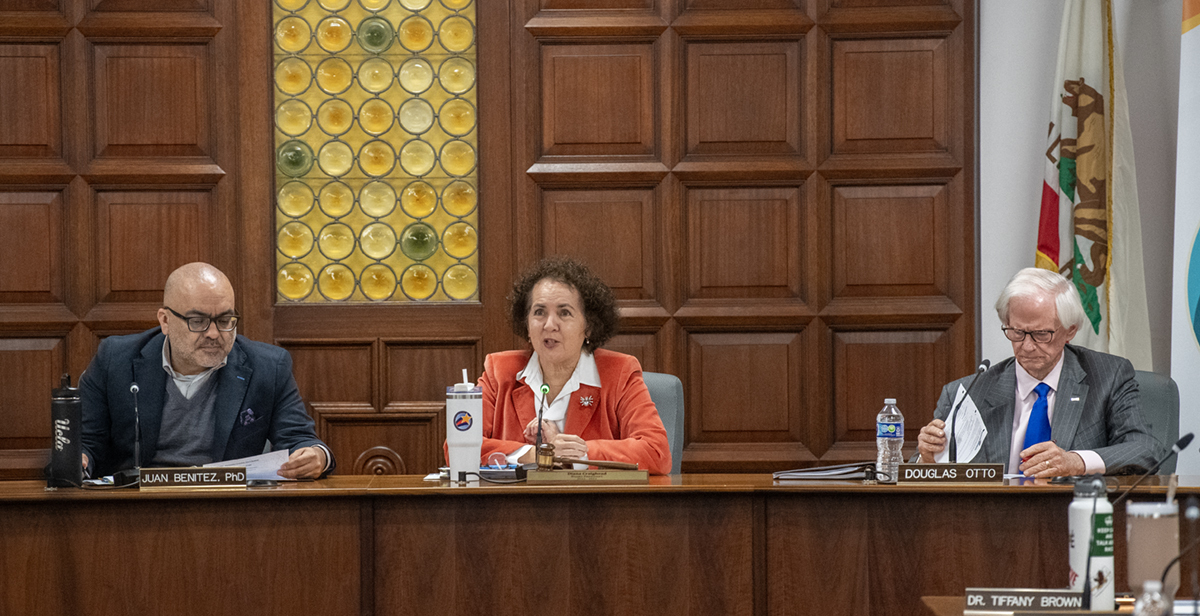
But shifts, cuts and reassignments have left teachers, parents and students reeling. Some of them attended the two most recent school board meetings to voice concerns.
Kecia Woods, who said she has taught at James Madison Elementary for 30 years, told school board members on Wednesday that she planned to skip a curriculum training scheduled for the next day because she couldn’t risk leaving her 18 special education students with one aide and a substitute who may not be equipped to handle the classroom.
LBUSD caps special education classes at 18 students, significantly higher than what Los Angeles Unified allows: 12 when students’ intellectual disabilities are “moderate,” 10 when disabilities are “severe” and eight when students have multiple disabilities.
Woods said she has been relying on parent volunteers to provide additional classroom support because “it’s impossible” to address student needs without that help and because her aide is exhausted. “She spent 45 minutes this morning changing 11 kids” out of soiled diapers, Woods said. “Our kids are the most needy, and we’re not getting the help we need.”
The issue is not limited to Madison Elementary. Mark Barone, who teaches fourth and fifth grades in a moderate-severe classroom at Oropeza Elementary, said he recently received a new student who needs a one-on-one aide as required by his Individualized Education Program.
When Barone reached out to the Office of School Support Services requesting staff to fill that position, he said he was told that he would have to reassign one of his two classroom aides to the new student, as only one instructional aide is allocated for all fourth and fifth grade moderate-severe classrooms, he said at Wednesday’s board meeting.
This change is “definitely going to result in a safety concern,” he said. In his 11 years of teaching, he said he has had three students elope from the classroom — all in the last six weeks. Given that his school is located near the busy intersection of Seventh Street and Long Beach Boulevard, he is worried that a student might wander off when no one is available to monitor that child.
In November, LBUSD parent Gabriela Armenta said her son, a student in Woods’ class, had gotten hurt as a result of the reduced support. Normally, Amenta’s son is assigned a one-to-one aide from an outside agency, she said, but when the agency is unable to provide support, which happened several weeks ago, the school must provide it. But Amenta said the principal told her that, because the classrooms are allocated only one aide, no one was available to fill in and support her son, who was injured by another student as a result, she said.
Armenta said she planned to keep her son home until the district could find a solution, even though this would mean he would lose critical learning time.
But multiple teachers expressed that in the current situation, very little learning is happening at all.
“I can’t even think about teaching,” Santos said, because she is so consumed with managing behaviors and getting more support. Without it, “we’re not giving them an equitable learning environment,” nor a safe one, she said.