

When a medical emergency forced a top Long Beach student to miss more than a year of high school, she found herself ineligible to apply for most four-year colleges, derailing her plans of attending a research university to study science.
“Watching my dream slip out of reach was pretty devastating,” said Elise Hastie.
Yet she enrolled in Long Beach City College, which gave her the chance to start over, she said, and in her first chemistry class, her path changed. “All of a sudden, I began to see chemistry in everything,” she said, adding that “the world made an awful lot more sense” once she understood the intermolecular forces that allowed insects to walk on ponds and caused water to boil faster at elevation.
LBCC chemistry professor Arlie Blanco noticed that Hastie possessed “an extreme passion and a curiosity that I didn’t see in very many students,” she said. Blanco encouraged Hastie to apply for a summer research program at Cal State Los Angeles, which Hastie said “changed the trajectory of my life.”
Since then, she has transferred to Cal State LA to major in chemistry and undertaken multiple summer research programs, including at the University of Washington and the California Institute of Technology.
Now, she is being honored as a Barry Goldwater Scholar, an award of $7,500 in recognition of her academic achievements and commitment to a career in scientific research. The merit-based scholarship and associated foundation was established by Congress in 1986 to honor Sen. Barry Goldwater, R-Ariz., and to support the next generation of research leaders, according to the scholarship website.
As a first-generation college student who is paying for her education on her own, Hastie said the scholarship helps her defray costs and could give her a leg up when applying for research fellowships to support graduate research.
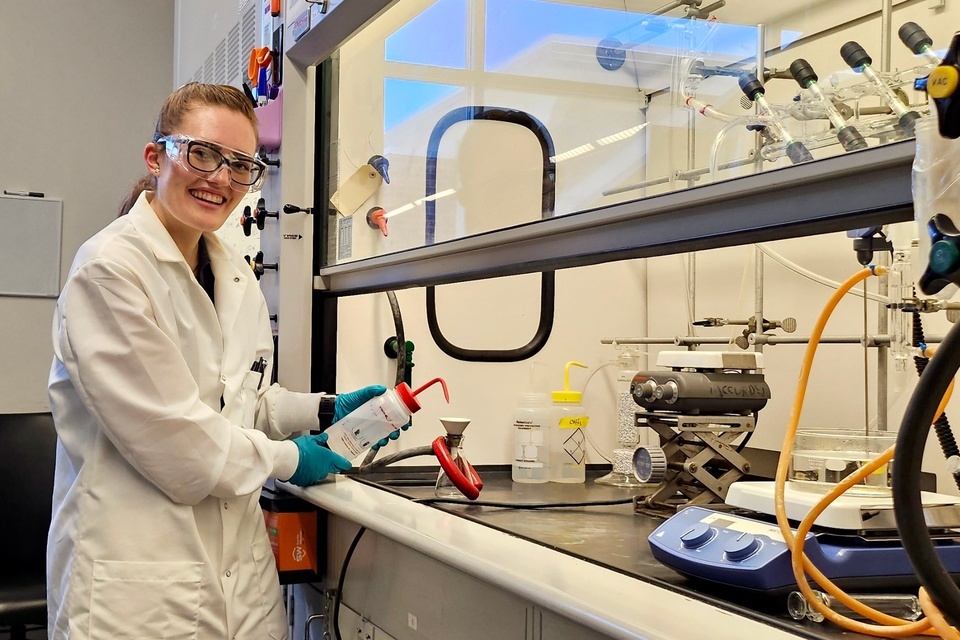
Currently, Hastie is synthesizing “cyclodextrin-based nanosponges” — cup-shaped molecules with a water-soluble exterior and a water-repelling cavity, allowing them to trap molecules in their core. That’s the science behind Febreze, which captures odor particles in cyclodextrins, Hastie explained.
But cyclodextrins have many more applications, including the removal of pollutants from soil and water and targeted drug delivery.
One of Hastie’s Cal State LA professors who helps oversee her research said in a statement that “her thirst for knowledge and understanding has fueled her outstanding scholarly performance both in the classroom and in the laboratory.”
Now a junior at Cal State LA, Hastie said she hopes to become a chemistry professor and establish her own research lab.
Blanco, Hastie’s LBCC mentor, said Hastie is making contributions not only to scientific research but to the scientific community. “She’s kind; she’s empathetic,” Blanco said, adding that the scientific community needs women in science as well as those who look out for others.
“I’m really happy to just be a part of her story,” Blanco said. “I can say that I knew her before she was famous.”