

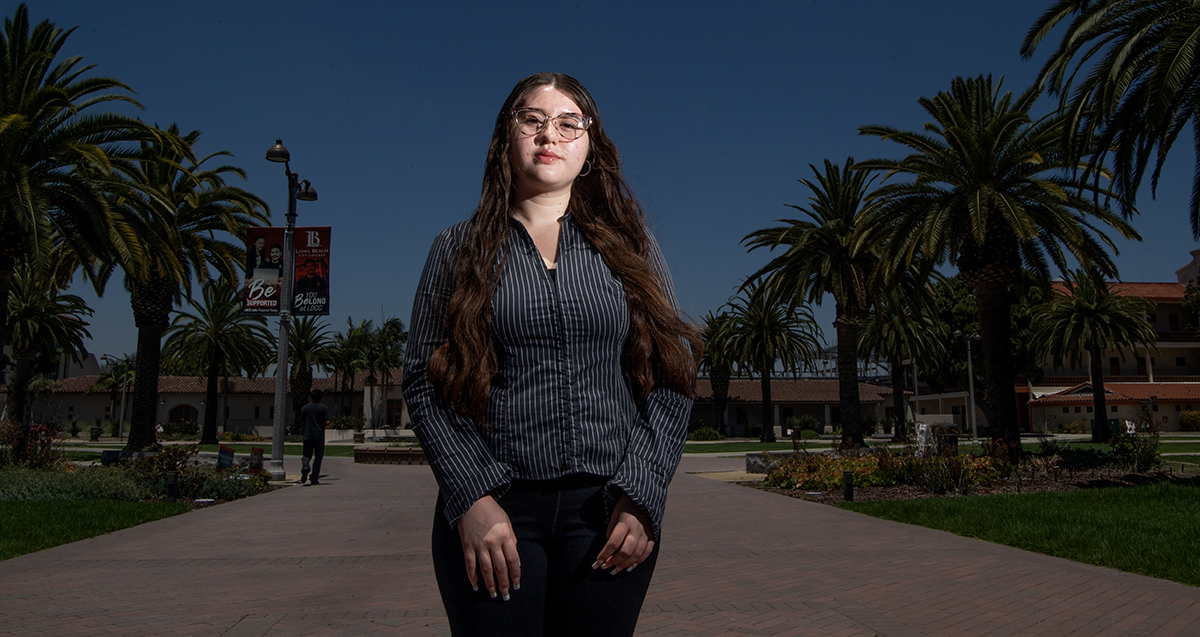
A Long Beach City College student had to defend herself at a formal disciplinary hearing this month after the college threatened to possibly suspend her or place her on academic probation for pursuing answers about a controversial student-body election.
Paloma Maciel, co-editor in chief of LBCC’s student newspaper, had spent weeks reporting and publishing stories on the elections, which had been invalidated in early May due to problems with the voting system and verification of student voters, Maciel reported. The muddled results elicited questions from students about why a re-election was necessary and how votes were verified, Maciel reported.
Maciel sought answers from the dean of students in a scheduled interview on May 8, she said. In the same building, she said, she tried to interview the student activities advisor, who declined to comment and left the area. Maciel told the Long Beach Post she waited by the door for the advisor until the dean told her the office was busy and then said it was closed, at which point Maciel left.
Three days later, the office of student conduct informed Maciel that a report had been made against her, according to a copy of the email, provided by Maciel and first reported in The Viking News student newspaper. The letter alleged that she had “engaged in persistent and increasingly harassing and aggressive behavior under the pretense of requesting interviews.” The letter further alleged that Maciel had “physically blocked” the path of an administrator, who “felt unsafe and sought shelter in another office.” If found guilty, the letter said, Maciel could be suspended or placed on probation, calling her approaching graduation into question.
The administrators involved could not be reached for comment, and the college declined to comment on the matter, citing student confidentiality.
“I wasn’t doing anything wrong,” Maciel said. “In my eyes, I was just reporting.”
Eventually, the college agreed. The week before commencement, on June 2, Maciel met with Nohel Corral, executive vice president of student services, for a hearing, during which she answered questions and explained her version of events, she said, in accordance with LBCC’s discipline policies. The next day, Corral sent an email containing his findings: she had not violated the standards of student conduct and no further disciplinary action would be taken. Maciel would be free to attend commencement and transfer to UC Santa Barbara, as planned, according to the email, reviewed by the Post.
Yet legal experts raised serious concerns about LBCC threatening to discipline Maciel in the first place.
Maciel’s behavior “never even got close” to harassment, said Mike Hiestand, senior legal counsel for the Student Press Law Center. The invalidation of a student election is a major story on campus, he said, and she was simply doing her job as a reporter: asking questions of those who have the information.
Administrators don’t have to comment, said David Loy, legal director of the First Amendment Coalition. But they “should not be weaponizing rules against harassment to chill and deter newsgathering protected by the First Amendment,” he said. Even when someone is not ultimately found guilty of the alleged conduct, launching an investigation against legitimate journalism also suppresses free speech, he said.
The “most troubling part of this whole story” is the imbalance of power between a student-journalist attempting to report on the institution she attends, Hiestand said. A public institution like LBCC has disciplinary authority while student-journalists have notebooks and questions, he said. Using that authority against reporters for doing their job, he said, “is exactly the wrong message about transparency and accountability” to be sending to the next generation of journalists.
Editor’s note: This story was corrected to more accurately describe Maciel’s account of her interaction with the dean of students. She said she was told the office was busy and closed, not that she was directly asked to leave.