

This story was originally published by CalMatters. Sign up for their newsletters.
California legislators this week are rushing to broker a compromise on child sexual assault lawsuits before the Legislature finishes for the year.
They are faced with the unenviable task of figuring out how to give justice to survivors of child sexual assault by school or county employees without bankrupting the cash-strapped school districts and local governments responsible for compensating them.
Counties and school districts have been flooded with lawsuits from survivors since the Legislature essentially waived any statute of limitations for those cases. The resulting damage payments and insurance premium hikes have cost schools and local governments billions, depleting their reserves and blowing holes in their budgets.
In the final week of the 2026 legislative session, lobbyists for schools and counties are pushing Senate and Assembly leaders to strike a last-minute deal that would allow survivors to be compensated for past harms while simultaneously stewarding taxpayer dollars and protecting local agencies from going bankrupt. An attempt last year to find common ground collapsed in the final hours of the legislative session.
Victims’ advocacy groups fiercely oppose any changes that would make it more difficult for survivors to receive compensation and have been rallying support to keep the law as it is.
“It’s impossible to choose between the future education of California students and meeting the needs for survivors,” said Dr. Debra Schade, president of the California School Boards Association, one of the groups pushing for a deal. “But if we don’t do something soon, the future of our public school system in California is at risk.”
‘A difficult needle to thread’
Counties and school districts want to be able to cap how much money each survivor could seek in damages, as well as require a greater amount of evidence from victims who wait more than 20 years to file a claim. But both of those proposals are nonstarters with survivor advocates, who are livid that the government would consider putting a “price tag” on someone’s sexual abuse. They say it’s also unreasonable to expect that children and parents would keep documentation that could prove they were assaulted.
A June draft proposal from Assembly Speaker Robert Rivas’s office, obtained by CalMatters, showed that Assembly leaders were at least considering caps on damages and a higher threshold for evidence in older cases.
Decades-old claims are much more likely to involve perpetrators and witnesses who are dead, as well as missing or damaged records. Without access to that evidence, counties and schools say they’re at an unfair disadvantage.
While counties and school districts say they agree victims should be able to seek just compensation for the harms they’ve suffered, public entities are responsible for “safeguarding the resources that we are entrusted with” to help current students and vulnerable populations, said Faith Borges, a lobbyist for local government insurance pools that are called joint powers authorities.
“It’s been a difficult needle to thread,” Borges said.
Victims’ groups argue that the government has vast resources at its disposal to defend itself — including staff attorneys, researchers and archives of public documents — whereas most survivors and their families can only afford litigation with a plaintiff’s attorney.
“It is a towering immorality to make the traumatized survivors of child rape, beatings, and sex abuse pay the bills for our negligence,” said Ed Howard, senior attorney for the Children’s Advocacy Institute, at a news conference in Sacramento. The politically powerful Consumer Attorneys of California, which has contributed at least $350,000 to California lawmakers this legislative session, is also part of the campaign
“It is our fault what happened to them. Not theirs,” Howard said. “That is grotesque that a child would have to have a higher burden of proof to get compensation for crimes committed to them by people that we selected.”
Suzie, a 25-year-old survivor who asked to be identified by her first name, hopes the financial pain will force school districts and counties to make changes to protect children under their care.
She said seeking justice through the courts required her to confront her abuser — her fourth grade teacher — and take on an army of attorneys for the Mountain View School District who sought to discredit her allegations that the teacher molested and groomed her.
“I just became super suicidal like, when I was only eight or nine,” Suzie said. “I couldn’t tell my parents that I was scared of going to school, so I was like, at such a young age, the bad guy.”
After she and five other students sued the district, a jury last April awarded them a $48 million verdict, with the district responsible for just over $36 million and the teacher responsible for the remainder.
“I wish a lot of things wouldn’t have happened to me,” Suzie said. “But also, with the financial compensation, there’s going to be, maybe, room for growth for (the district). And a definite change. Because it cannot happen again.”
Previous compromise attempt collapsed
An effort to strike a deal last year, brokered by Sen. John Laird, a Santa Cruz Democrat, fell apart at the last minute. Counties and school districts were upset that Senate Bill 577 didn’t include caps on how much money victims could seek in damages. Government agencies say a compensation limit is the only way to achieve meaningful change, but the concept infuriates survivor groups.
Survivors were also angry that that proposal sought to ban any further claims from survivors of sex abuse at one Los Angeles County juvenile detention facility, MacLaren Children’s Center, which permanently closed in 2003. The county approved a $4 billion settlement last April to resolve more than 6,800 child sex abuse cases, some of which date to 1959.
Rivas shelved the bill in the hope that the two sides could continue negotiating and hash out a more comprehensive deal in 2026, according to people familiar with the decision.
This year, legislative leaders are split along the same fault lines. The speaker’s office wants to ensure the public entities’ financial health and has been open to discussions about damage caps, while Senate President Pro Tem Monique Limón and her staff insist caps would hamper survivors’ rights, according to sources familiar with the negotiations.
Limón in a statement said the Senate “remains committed to maintaining access to justice for all survivors” while also recognizing the financial challenges of public entities.
Although the two leaders have met regularly for weeks, and sources familiar with the negotiations say the two sides are very close to a compromise, no deal has emerged.
Flood of lawsuits squeezes tight budgets
According to a 2024 Legislature-mandated report, thousands of suits have been filed since Gov. Gavin Newsom signed Assembly Bill 218 in 2019, raising the age for victims to report past abuse and file lawsuits from 26 to 40 years old.
The law also allows people who discover as adults that they were sexually abused as children five years to file a claim, up from the previous three years, and created a three-year window during which survivors could revive past claims that expired due to the previous statute of limitations.
The flood of claims has resulted in settlements and jury verdicts that are projected to cost California school districts up to $3 billion. Counties face liabilities several times those of school districts, according to the 2024 state report.
Los Angeles County alone estimated that its payouts reach $3 billion to resolve roughly 3,000 claims of sexual abuse that occurred in the county’s foster homes, youth shelters and probation camps and halls dating to the 1950s.
While some counties and school districts had private insurance to help cover their liabilities, the state’s insurance crisis in the 1970s forced the vast majority of them to embrace the alternate, self-run joint-powers authorities.
Unlike private insurance companies, which have large stores of capital in case of unexpected costs, public entities pay their premiums with taxpayer dollars. The sheer volume of cases filed since 2019 has sent premiums skyrocketing, which disproportionately hurts smaller rural school districts and counties and those with few or no claims against them.
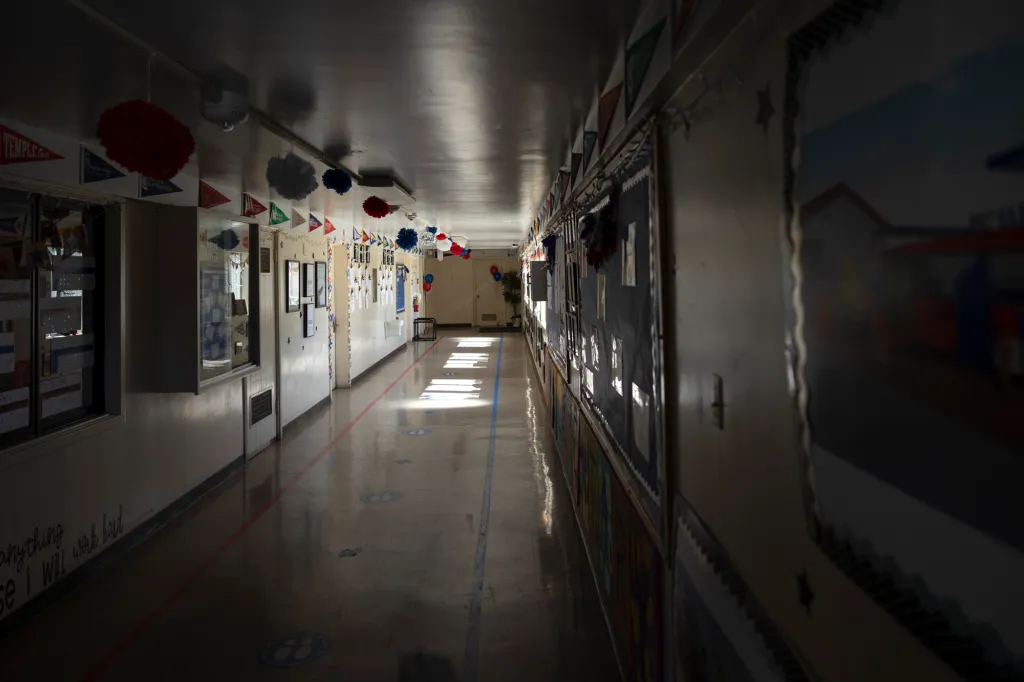
Several counties and school districts say they’ve had to cut staff and defer maintenance, such as replacing schools’ aging air conditioning, to afford their insurance payments as well as cover the cost of claims for harms that took place when the district or county didn’t have insurance.
Eric Dill, an associate superintendent for the Poway Unified School District, said his district has been forced to cut $10 million a year from its budget over the last three years, mostly from programming, staff and maintenance because of a requirement to set aside money for underinsured or uninsured claims. The district has dedicated $7.5 million — the equivalent of 75 teachers’ salaries and benefits — in premiums and contributions to its self-insurance fund over the last four years.
“It is very real that today’s students are suffering from a lack of services that could otherwise be provided if we could use those general fund dollars to put back into the classroom,” Dill said.
While child sexual assault cases are at the heart of legislative negotiations, advocates for the school districts and counties are pushing for the changes to apply to all civil liability cases brought against them.
Survivors decry backroom dealing
Survivor advocates say legislative leaders are cutting out crucial voices and public input by trying to fast-track a deal at the last minute. If a bill had gone through the traditional process, victims could have testified before committees about their abuse.
“We’re having to ask survivors to speak into a microphone and hope that the folks who are making the decisions in the building hear our voices,” said Jennifer Rodriguez, executive director of the Youth Law Center, at the news conference. “That’s not a democratic process.”
Howard, the senior attorney at Children’s Advocacy Institute, acknowledged that the topic of childhood sexual abuse is thorny and any measure that could alter the existing law “may not have survived a more thorough scrutiny of the regular bill process.”
Legislators have until midnight on Aug. 31 to wrap up lawmaking for the year.
Editor’s note: For the record: This story has been corrected to clarify that the survivors groups have not received any funding from the Consumer Attorneys of California.