

This story was originally published by CalMatters. Sign up for their newsletters.
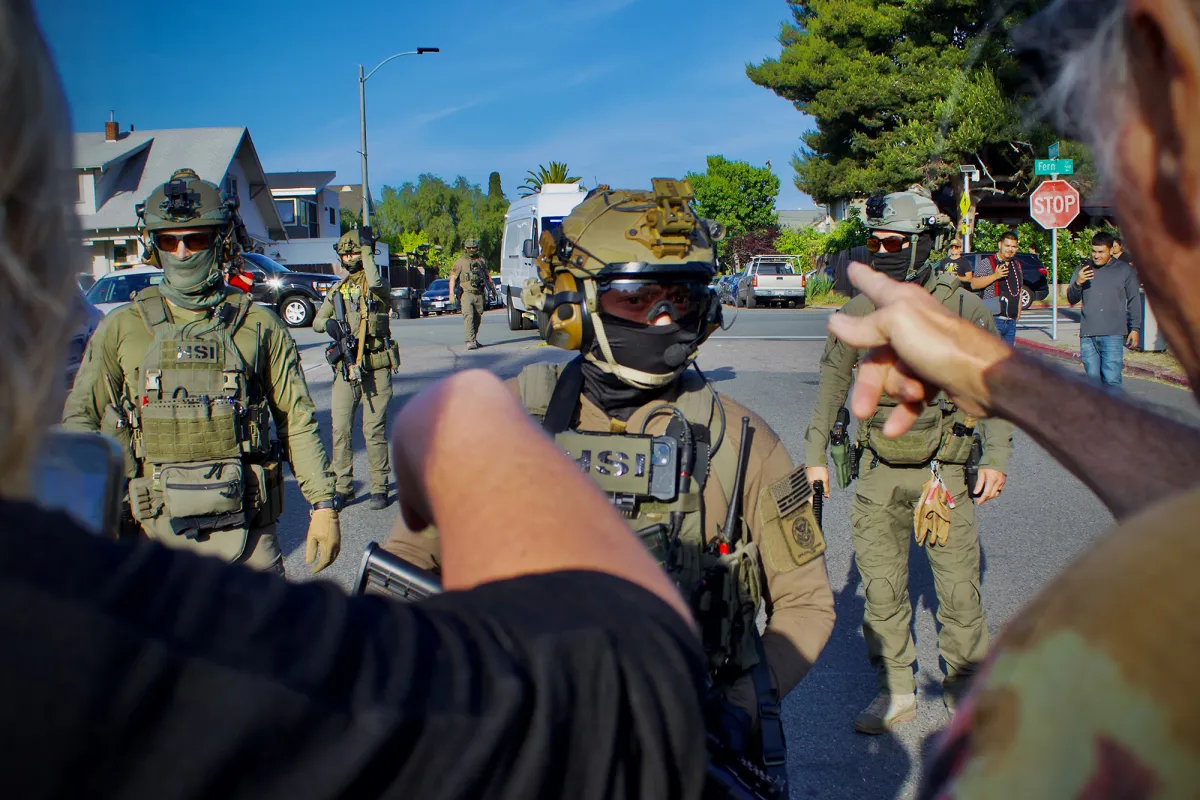
A series of immigration raids across California in 2025 had one thing in common: Most of the federal agents detaining people wore masks over their faces.
In January, the state of California and its largest county will ban law enforcement officers from covering their faces, with a few exceptions, putting local and state police at odds with masked immigration agents.
The state law gives law enforcement officers a choice: If they cover their faces, they lose the ability to assert “qualified immunity,” the doctrine that protects officers from individual liability for their actions. That means they can be sued for assault, battery, false imprisonment, false arrest or malicious prosecution, and the law adds a clause that says the minimum penalty for committing those offenses while wearing a mask is $10,000.
Assemblymember Mark Gonzalez, a Los Angeles Democrat who co-authored the law, said it was necessary to rein in anonymous federal agents.
“We initially were under the understanding that, oh, they’re only targeting folks who were not citizens,” Gonzalez said, “And then actually over time you learn they don’t give a shit who you are, they’re attacking you no matter what, with no due process.”
The Trump administration has sued to block the bill, and more than a century of federal court precedent is on its side. An 1890 Supreme Court case provides that a state cannot prosecute a federal law enforcement officer acting in the course of their duties.
The Trump administration said in its brief to the U.S. District Court for the Central District of California that forcing agents to reveal their identities would put the agents at risk.
During Immigration and Customs Enforcement “actions, individuals can be heard threatening to doxx and find out who officers and their family members are and where they live,” the administration’s lawyers said in the Nov. 17 brief. “There are even public websites that seek and publish personal information about ICE and other federal officers to harass and threaten them and their families.”
Erwin Chemerinsky, dean of the UC Berkeley School of Law, said the issue may not be as cut-and-dried as one or two Supreme Court cases. He pointed to a 2001 9th Circuit Court of Appeals decision that allowed the case of a federal sniper who killed a woman during the 1992 Ruby Ridge, Idaho, standoff to go to trial.
“It basically says that a federal officer can be criminally prosecuted for unreasonable actions,” Chemerinsky said. “Federal officers, by virtue of being federal officers, do not get immunity from all state civil and criminal laws.”
Brian Marvel, president of an organization that represents California police unions, said the law will make life harder for local cops and county sheriffs’ deputies. The organizations that represent police chiefs, sheriffs, agents in the Attorney General’s office and California Highway Patrol officers opposed the law, too.
“I think that the state has put us in a tenuous position with this battle they’re having with the Trump administration,” said Marvel of the Peace Officers Research Association of California. “We don’t want to be in the middle of this fight. But unfortunately, (with) the desire for higher name recognition and elections in 2026, they decided to create things that are much more political and not geared toward legitimate public safety issues.”
Marvel said another drawback of the law is giving “a false sense of hope to the immigrant community in California” that the law will force federal agents to leave the state.
Los Angeles County supervisors have also approved a local mask ban on law enforcement for unincorporated areas of the county, a measure that will go into effect in mid-January, unless a court decision comes sooner.
Gonzalez noted that masks have played a significant role in recent California history. First,, during the pandemic California temporarily made masks mandatory in public and at work. Then, a couple of years later, a rush of smash-and-grab robberies were harder to solve because the suspects all wore masks. Now, California finds itself in its third back-and-forth over face coverings.
The law provides exemptions for N-95 or medical-grade masks to prevent infection transmission, and permits undercover operatives to wear a mask.
“This is specifically aimed to federal agents because we gotta combat these kidnappings somehow,” Gonzalez said, “and this was our way in.”