

Good morning, Long Beach. It’s Monday, April 13. Here’s what you need to know to start your day.
City meetings and news
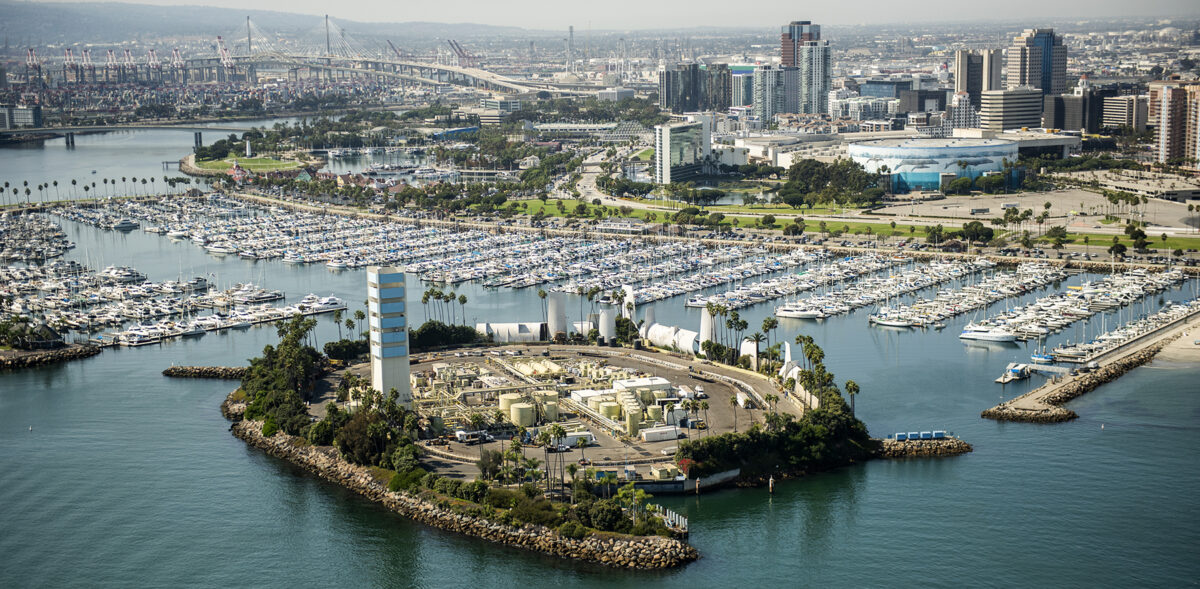
For decades, the THUMS islands — a mini skyline of midcentury towers, palms and waterfalls — has been Long Beach’s perfect little mirage: a tropical paradise at a distance, in the middle of the city harbor.
But step off a boat onto their land and you see that it’s all a facade: Inside the fringe of palm trees, workers in hard hats scoot around on forklifts and lug heavy pipes through a network of struts and cables. The towers aren’t shacks, but sound-absorbing structures that block the din of oil drilling.
But the mirage may soon materialize, officials say, into the islands onlookers wish they would be.
A study, commissioned for $25,000 and released last week, offered a number of ways to repurpose the oil islands once their usefulness for extraction has ended.
Dubbed THUMS (an acronym for Texaco, Humble, Union, Mobil and Shell, the five companies that combined in 1964 to bid on leasing the field), the four islands, which combined for 51 acres, are nicknamed the “Astronaut Islands,” each named for a spacefarer: Grissom, White, Chafee, Freeman.
After oil, the study suggests they could be used for new purposes, each different from the other. Grissom could be a boutique resort of private lodgings; White would best be used for public parks, picnicking and trails; Chaffee would be best suited for marine research and education in partnership with Cal State Long Beach or UCLA; while Freeman could serve a dual purpose of eco-tourism and trail hiking.

Each would be bounded by native vegetation and accessible by ferry.
Researchers said energy storage, hydrogen production and carbon capture were looked at but ultimately had to be ruled out due to existing laws that forbid it. They also eliminated exclusive private retreats, large residential developments and retail or commercial ventures from consideration.
But this is all hypothetical for now. Any particular plans will require further study and a lot of cash. Grants and funding options are out there but mostly for capping oil wells, not repurposing them.
This comes as the city is under mounting pressure to transition its economy away from a reliance on local oil production, which is set for a dramatic decline — $300 million over the next 10 years, according to City Auditor Laura Doud. Meanwhile, the city has $1 billion in outstanding coastal projects that have long relied on oil revenue, from a deteriorating Naples Island seawall to costly upgrades at the Convention Center.
Facing the rising cost of upkeep along the coastline, the city is expected to spend more than it earns to oversee the tidelands for the first time in 2026. Officials project future deficits through 2035 will range between $6.2 million and $10 million.
Previously, the oil business has been very good to Long Beach, especially on the islands.
At their height in the 1960s, the four islands produced 150,000 barrels a day. But now they turn out a lean 8,000 to 15,000 barrels daily using a host of mining techniques to scour each nook and underwater cranny for undiscovered oil.
In recent years, for example, operators have begun using sophisticated drilling bits that can cut sideways into once-inaccessible pockets of oil.
But new techniques and equipment can’t get around the increasingly watery mix that the wells are producing from the aging field.
Other things to watch for this week:
- The city Planning Commission on Thursday will consider an expansion of its density bonus program, which gives incentives to developers building affordable homes near public amenities. The expansion would offer more for new developments as the city tries to keep pace with benefits already provided by the state’s program.
- Hinting at the eventual opening of the city’s new amphitheater, the City Council on Tuesday is expected to greenlight a six-year, $3 million contract for security at the venue.
- The Long Beach Continuum of Care Board on Tuesday will review the performance and financial prospects of the city’s homelessness services in the 2025 fiscal year. The report found several programs to be working effectively, though challenges remain with unspent money, too few participants gaining employment and outcomes widely different across demographics. To read the report, click here.
- On Tuesday, the L.A. County Board of Supervisors wants to begin studying the impacts of data centers on public health and the environment. The supervisors are expected to also declare housing insecurity a public health crisis, address the uptick in flea-borne Typhus in the county and ask for a dashboard on case volumes in hospitals and mental health facilities.


ICYMI — California and national news
- The tale of L.A.’s iconic hot sauce and how Ozempic is making it even hotter (Los Angeles Times)
- Olympics CEO says more $28 tickets will be released in later drops. The question is, how many? (LAist)
- Long Beach warns of ‘difficult year’ of budget cuts but promises the pain will be short-term (Long Beach Post)
- Trump energy chief attacks California oil and gas policies in Long Beach (CalMatters)